Ce site philatélique donne toutes les informations connues sur le timbre 0,50F Marianne de Béquet en les illustrant.
- Accueil
- Etude technique
-
Etude des présentations du timbre

-
Etude postale
- Fin de site
 Accueil


Sommaire
- Introduction
- Principe de l’impression sur presse TD6
- Méthode d’impression des feuilles TD6
- Les barres phosphorescentes
- Les tirages du 0,50F Marianne de Béquet sur TD6
- Introduction
- Traits caractéristiques des cylindres utilisés
- Repères électroniques des cylindres utilisés
- Tirages
- 1er tirage, sur la presse TD6-1
- 2ème tirage, sur la presse TD6-7
- 3ème tirage, sur la presse TD6-2
- 4ème tirage, sur la presse TD6-1
- 5ème tirage, sur la presse TD6-3
- 6ème tirage, sur la presse TD6-4
- 9ème tirage, sur la presse TD6-1
- 10ème tirage, sur la presse TD6-4
- 11ème tirage, sur la presse TD6-1
- 12ème tirage, sur la presse TD6-3
- 13ème tirage, sur la presse TD6-4
- 14ème tirage, sur la presse TD6-5
- 15ème tirage, sur la presse TD6-3
- 16ème tirage, sur la presse TD6-7
- 17ème tirage, sur la presse TD6-4
- 18ème tirage, sur la presse TD6-4
- 19ème tirage, sur la presse TD6-4
- 20ème tirage, sur la presse TD6-1
- 21ème tirage, sur la presse TD6-4
- 22ème tirage, sur la presse TD6-7
- 23ème tirage, sur la presse TD6-6
- 24ème tirage, sur la presse TD6-4
- 25ème tirage, sur la presse TD6-1
- 26ème tirage, sur la presse TD6-4
- 27ème tirage, sur la presse TD6-6
- 28ème tirage, sur la presse TD6-7
- 29ème tirage, sur la presse TD6-2
- 30ème tirage, sur la presse TD6-5
- 31ème tirage, sur la presse TD6-4
- 32ème tirage, sur la presse TD6-4
- 33ème tirage, sur la presse TD6-6
- 34ème tirage, sur la presse TD6-2
- 35ème tirage, sur la presse TD6-1
- 36ème tirage, sur la presse TD6-2
- 37ème tirage, sur la presse TD6-7
- 38ème tirage, sur la presse TD6-1
- 39ème tirage, sur la presse TD6-6
- 40ème tirage, sur la presse TD6-7
- Quelques statistiques en guise de conclusion
Introduction
Dans cet article, nous allons d’abord expliquer le principe de l’impression sur presse TD6, puis la manière dont sont imprimées des feuilles de timbres sur une presse TD6. Nous présenterons ensuite ce à quoi correspondent les barres phosphorescentes et les quatre types de barres connus pour les Mariannes de Béquet. Nous décrirons enfin tous les tirages répertoriés pour le 0,50F Marianne de Béquet sur presse TD6.
Principe de l’impression sur presse TD6
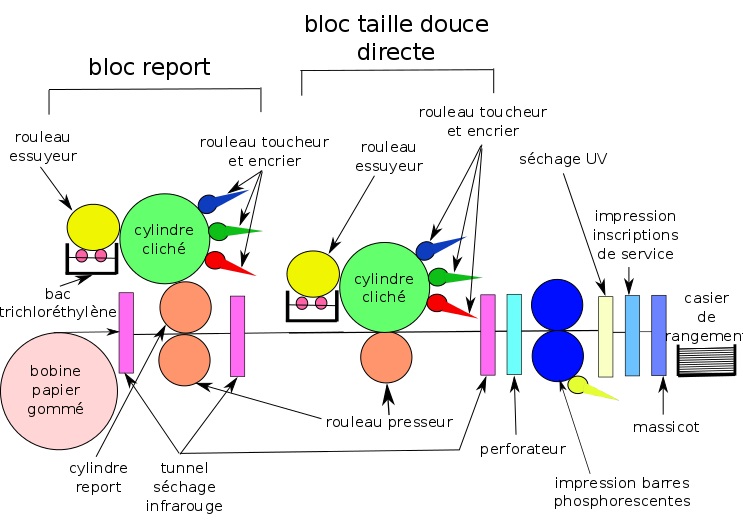
Une presse taille-douce 6 couleurs (TD6) est composée de deux blocs d’impression de chacun trois couleurs, de divers éléments d’impressions complémentaires, d’un élément assurant la perforation des feuilles de timbres et d’un dispositif de sortie, soit sous forme de feuilles, soit sous forme de bobines (cf. l’article Confection des carnets).
Le premier bloc d’impression est un élément report taille-douce. Cette première impression n’aura pas de relief (elle imprime en général les aplats de couleur comme les fonds). Le cylindre cliché est gravé en creux et l’image est à l’endroit. Après encrage avec des rouleaux toucheurs découpés et essuyage, l’encre est déposée par pression, image à l’envers, sur un cylindre en matière synthétique souple de report qui, à son tour, dépose l’encre par pression à l’endroit sur le papier, comme en offset. L’impression est séchée dans un tunnel infrarouge.
La deuxième impression est en taille-douce directe. Le cylindre est donc gravé en creux, image à l’envers, pour avoir une impression de l’image à l’endroit. L’encrage est obtenu par trois rouleaux toucheurs découpés manuellement. Un essuyeur enlève l’encre en excès pour ne la laisser que dans les tailles de la gravure. Après un deuxième mouillage du papier, le cylindre cliché dépose directement son encre par pression d’un cylindre "presseur", lui-même appuyé par un cylindre de contre-pression. Cette impression est séchée à son tour et refroidie brutalement au contact de cylindres creux dans lesquels passe de l’eau froide pour créer un choc thermique.
Les timbres sont ensuite perforés par un peigne qui découpe à l’emporte-pièce les petits trous. Sur les presses TD6, le peigne est constitué de deux rangées horizontales d’aiguilles de la largeur de la feuille de timbres et de 11 rangées latérales.
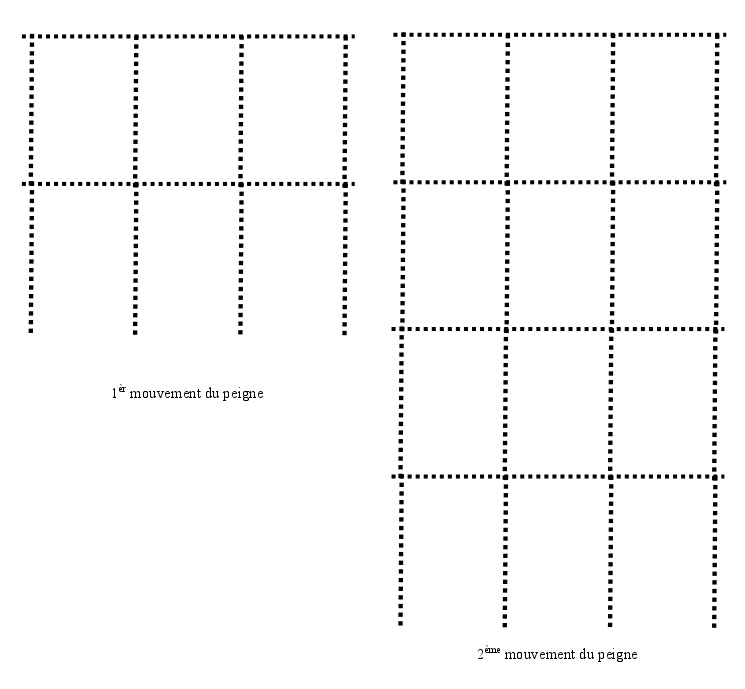
- principe de fonctionnement d’un peigne sur presse TD6
Les barres phosphorescentes (pour les tirages avec barres) sont imprimées ensuite avec de l’encre UV, séchée instantanément par un sécheur UV. Il y a eu plusieurs systèmes d’impression de ces barres, nous y reviendrons plus loin.
Les mentions de service sont imprimées en typographie avec un cylindre comportant le numéroteur, l’indicatif de la machine et le dateur.
- sheet of 100 stamps produced on TD3-1 press
Une coupe rotative découpe chaque feuille pour les laisser se superposer sur un tapis roulant de réception où il ne reste plus qu’à les empiler par paquets de mille.
Il est toujours possible de n’utiliser qu’un seul encrier pour avoir une impression monochrome (ce qui est le cas pour le 0,50F Marianne de Béquet). Dans ce cas, le rouleau toucheur ne sera pas découpé.
Le séchage, pour éviter les mélanges de couleurs et les salissures, est une préoccupation majeure tout au long de l’impression sur presse TD6. Une presse TD6 possède un tunnel de séchage par rayonnement infrarouge et le papier passe à quatre reprises dans ce tunnel :
- Avant l’impression : le papier subit un préchauffage pour lui faire perdre le maximum d’humidité. Cette opération, qui provoque un retrait important du papier, permet de limiter ses variations dimensionnelles au cours du séchage de l’impression report taille-douce ;
- Après l’impression report Taille-Douce : le papier repasse dans le tunnel de séchage pour sécher les encres et éviter tout maculage et mélange des couleurs au cours de l’impression de la taille-douce directe ;
- Après l’impression Taille-Douce directe : ce nouveau passage permet de sécher les encres de la taille-douce et, ainsi, de procéder aux dernières opérations de numérotage des feuilles, de perforage et de coupe) ;
- Après l’impression des barres phosphorescentes.
Signalons enfin, pour terminer cette section, que les timbres une fois imprimés sont envoyés, sous forme de paquets de 1000 feuilles, à probablement une recette par département. Pour cela, l’imprimerie de Boulazac imprimait des étiquettes qui figuraient sur les paquets envoyés :
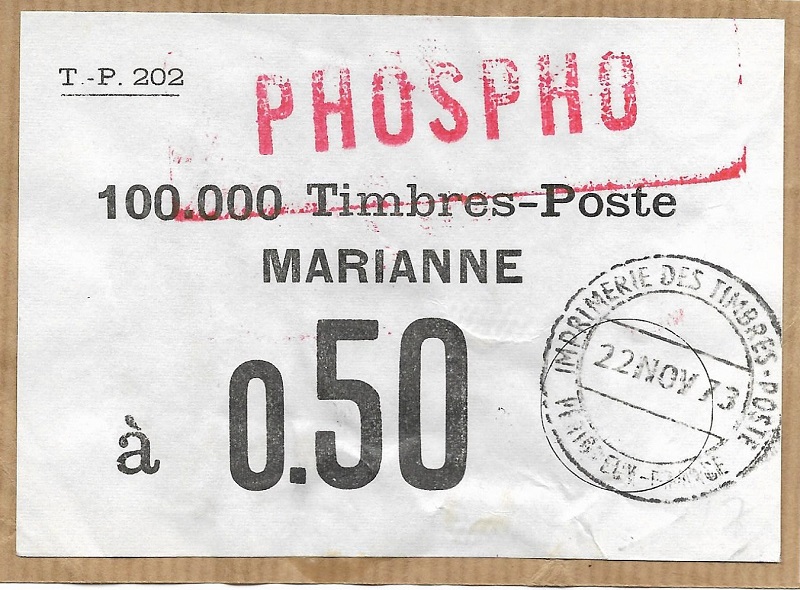
- label affixed to the package containing 1000 sheets of the stamp 0,50F Marianne de Béquet (with phosphor bands)
Méthode d’impression des feuilles TD6
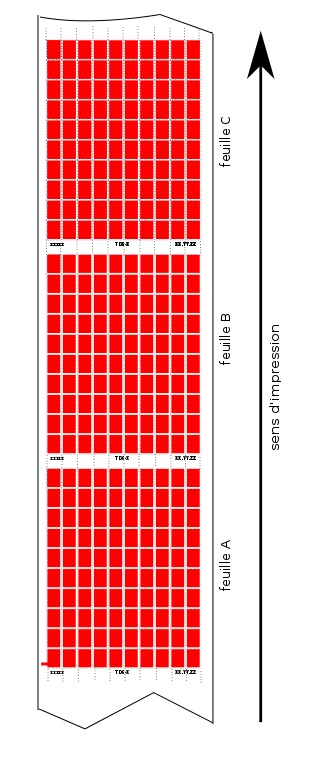
- schéma d’impression de feuilles sur une presse TD6
Chaque tour de virole imprime 3 feuilles de 100 timbres du bas vers le haut, numérotées de 00000 (= 100 000) à 00001, séparées par un intervalle de la hauteur d’un timbre, intervalle dans lequel le massicotage des feuilles sera réalisé.
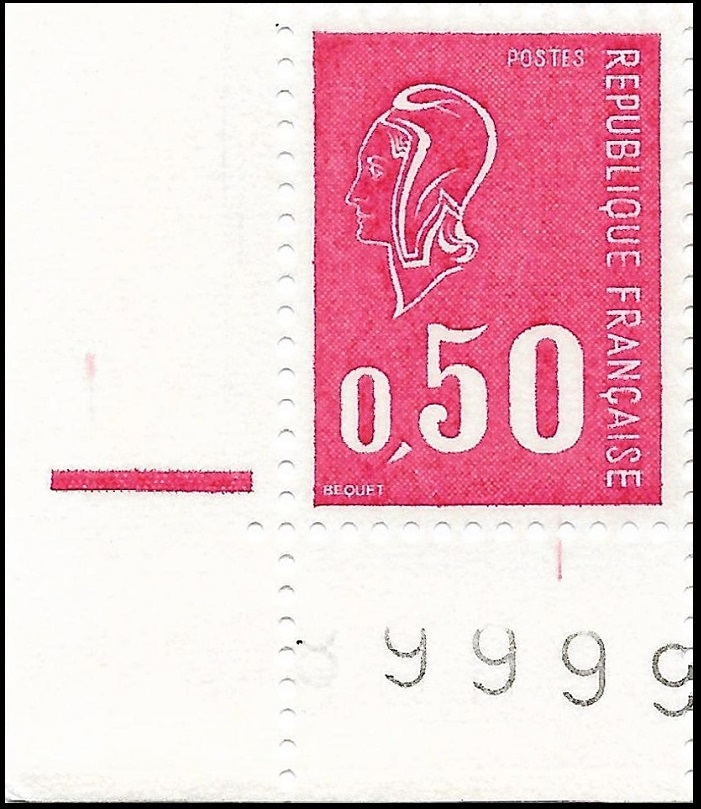
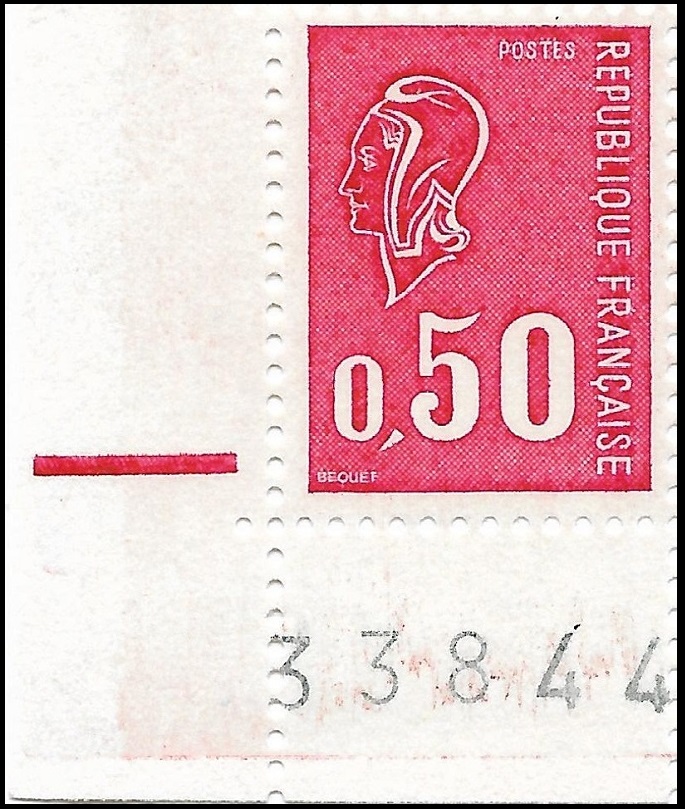
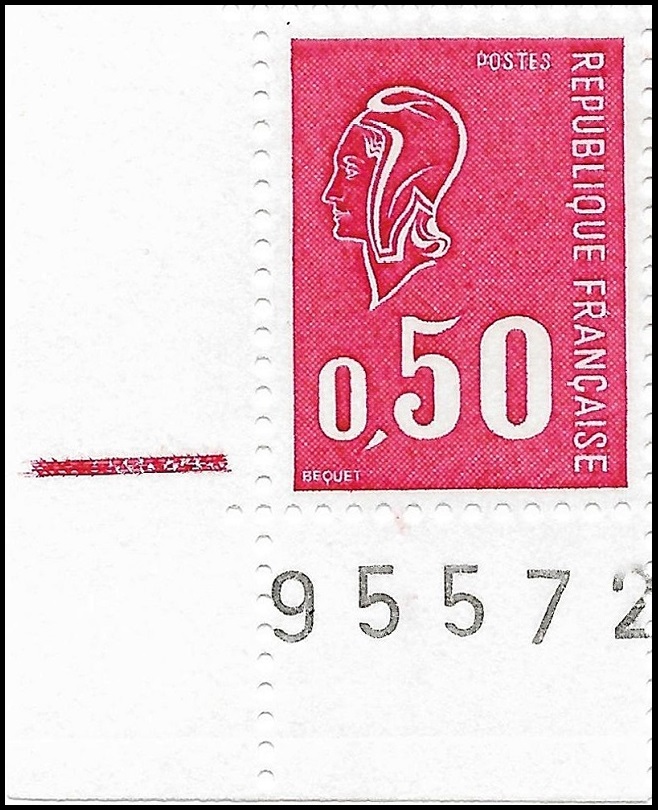
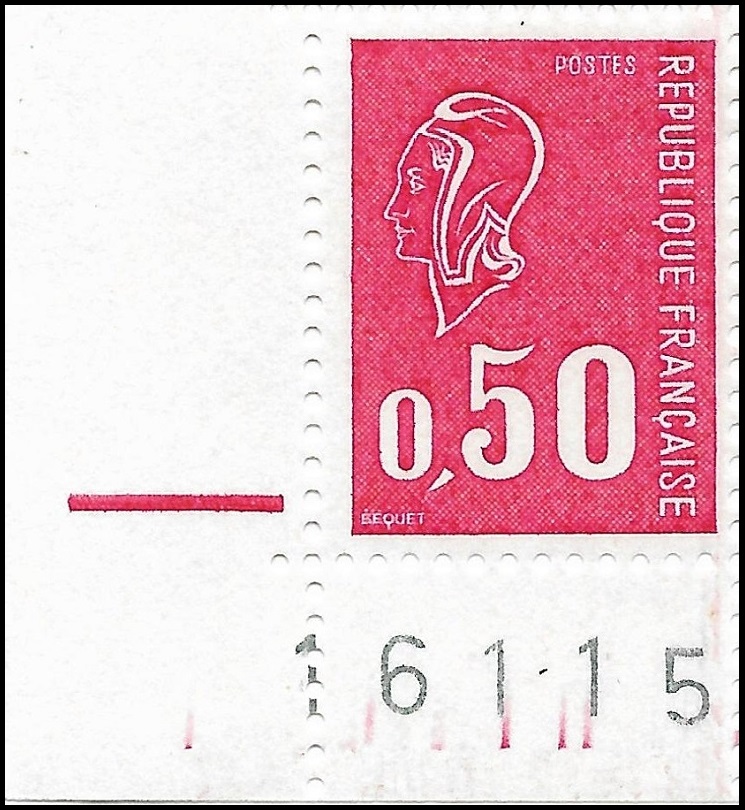
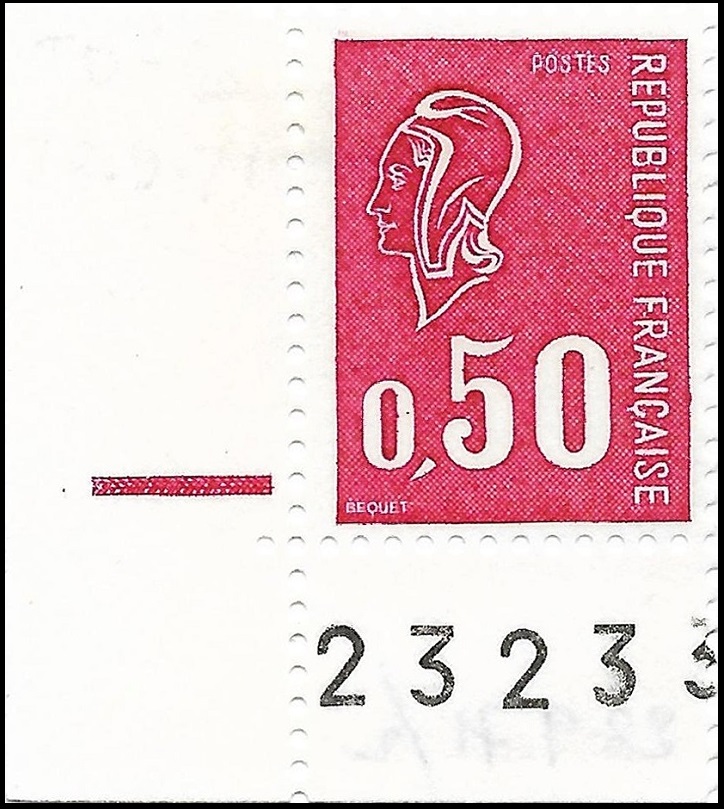
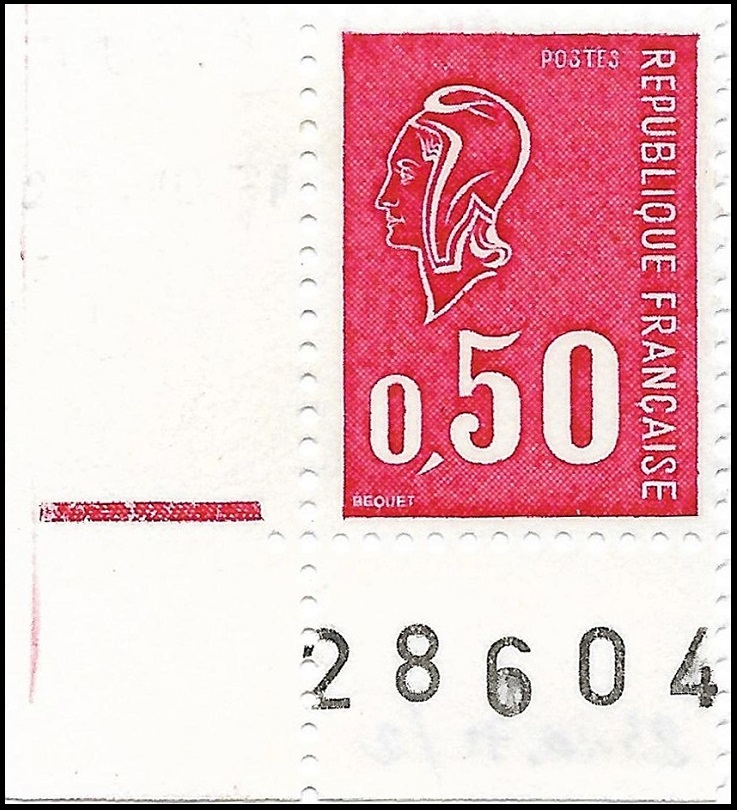
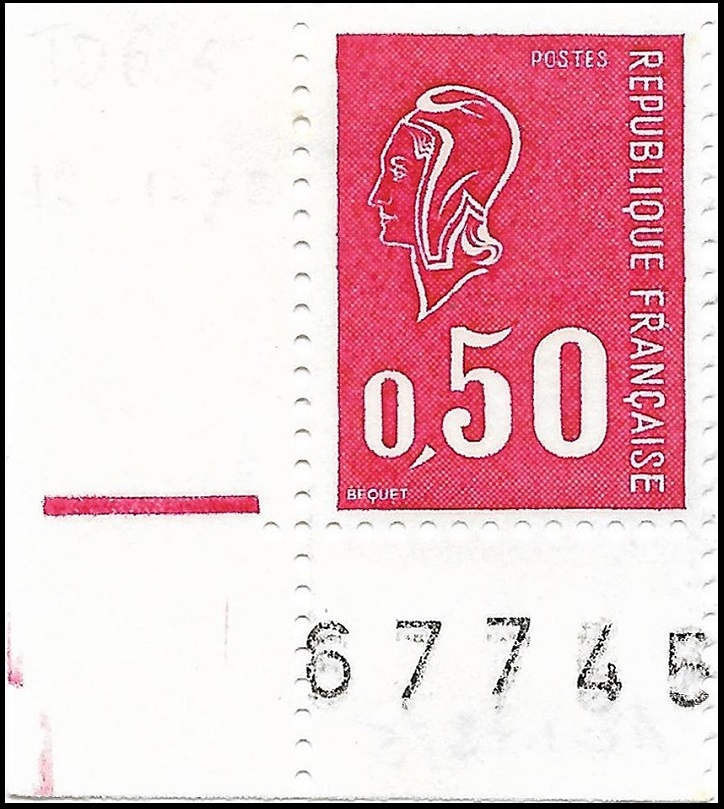
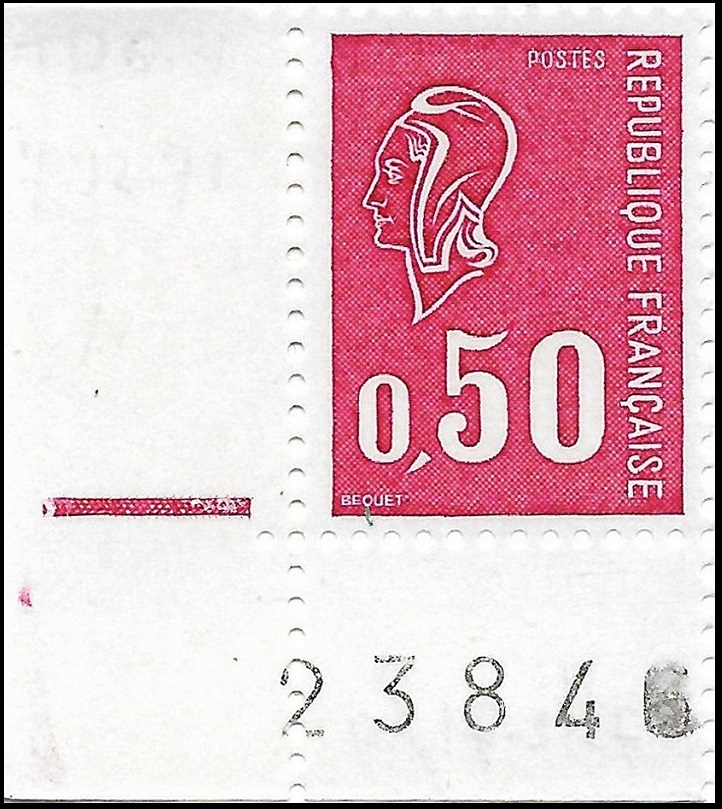
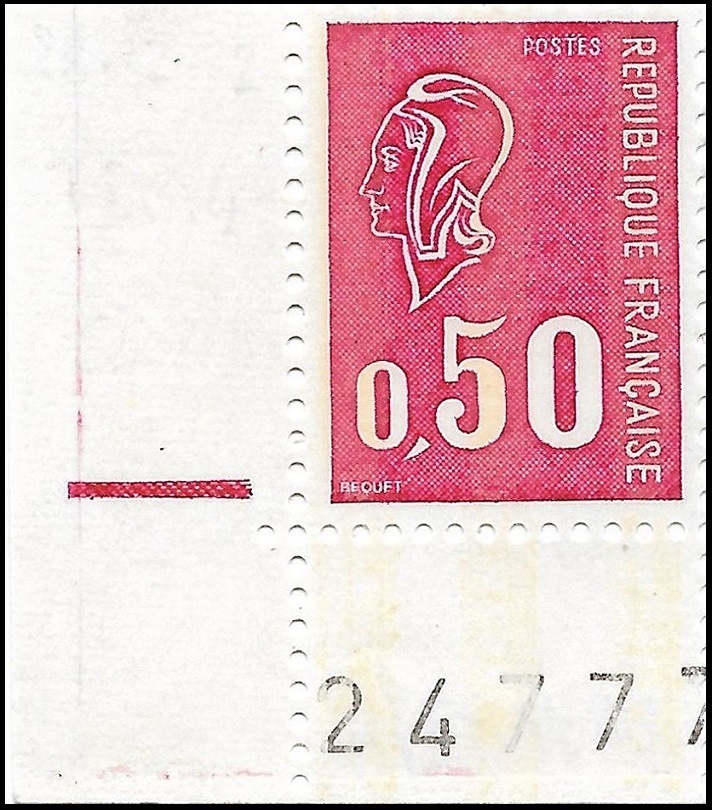
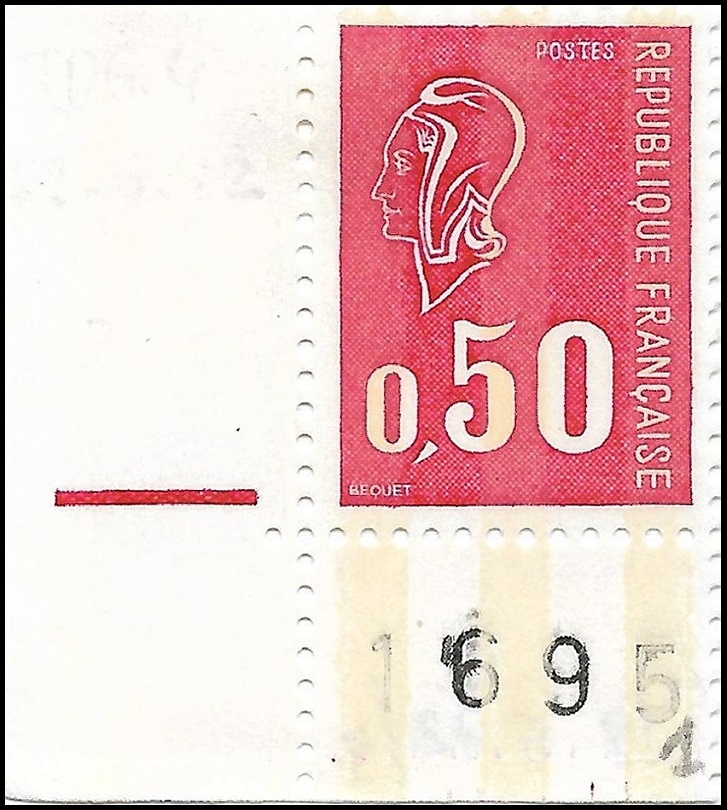
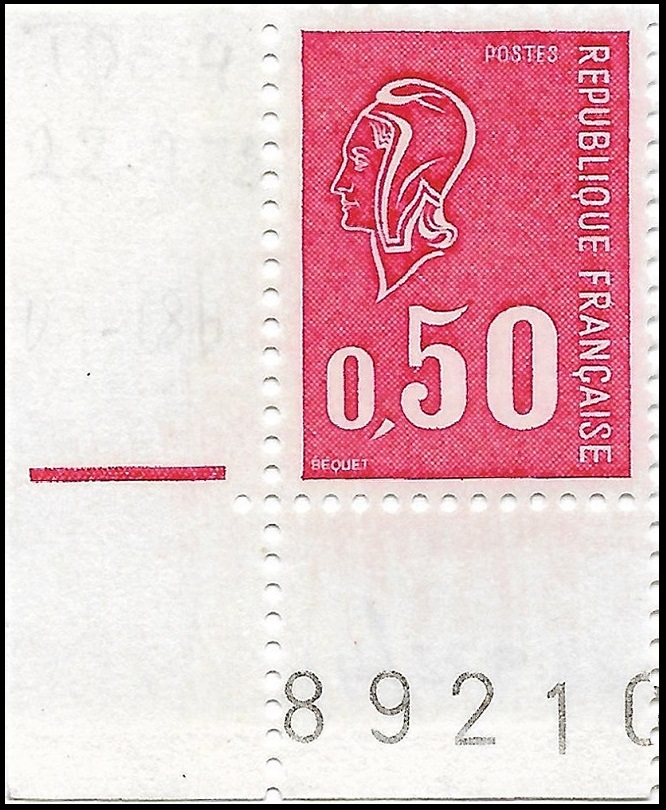
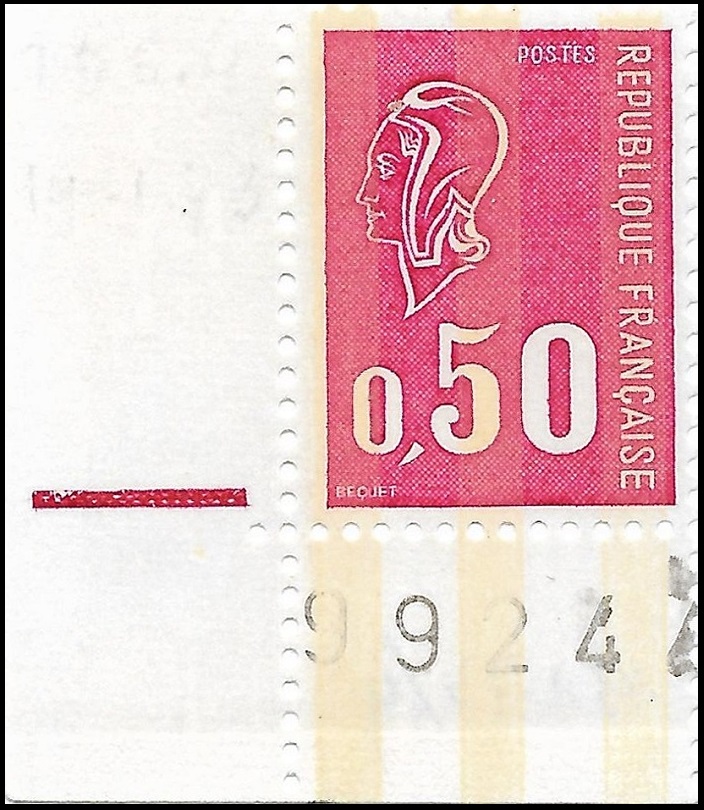
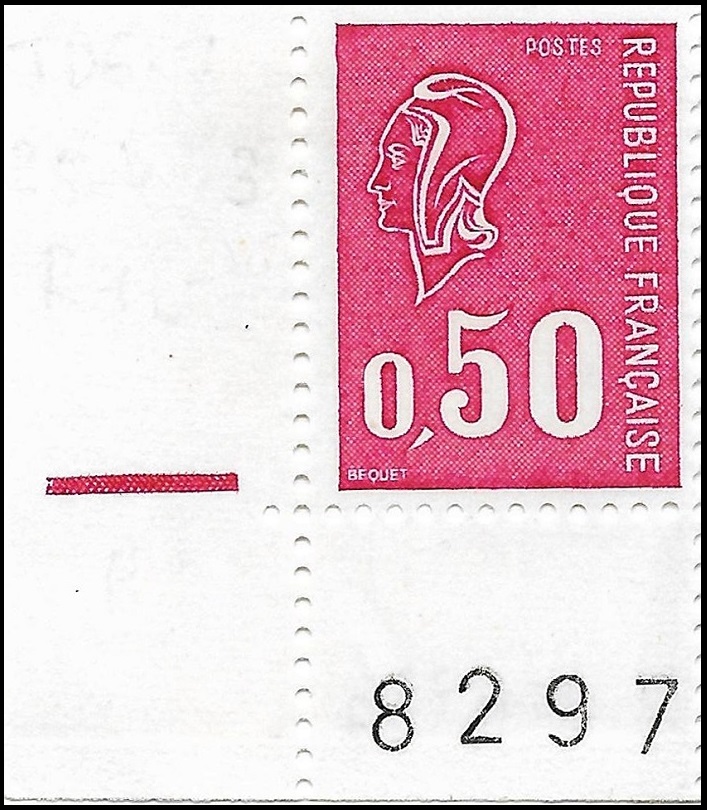
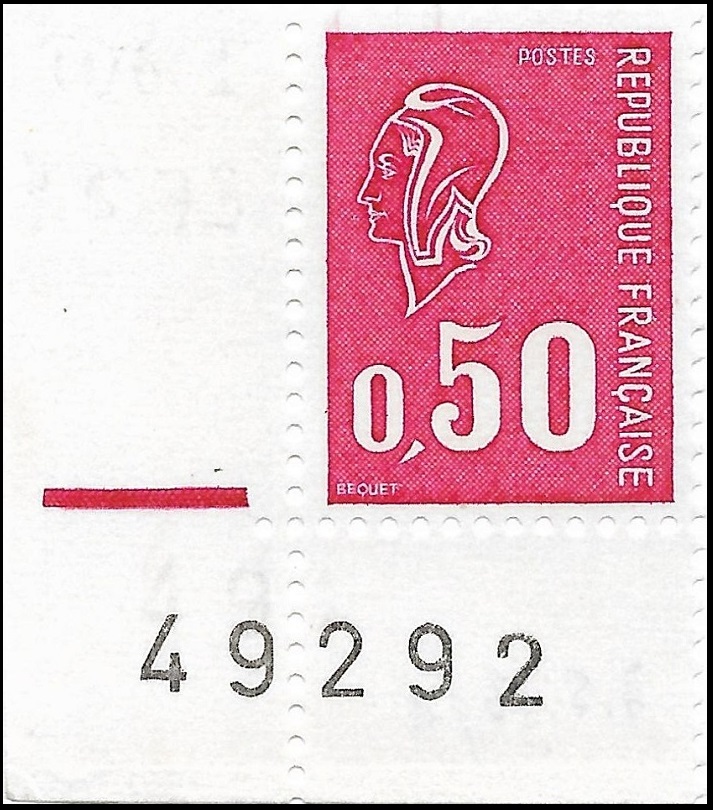
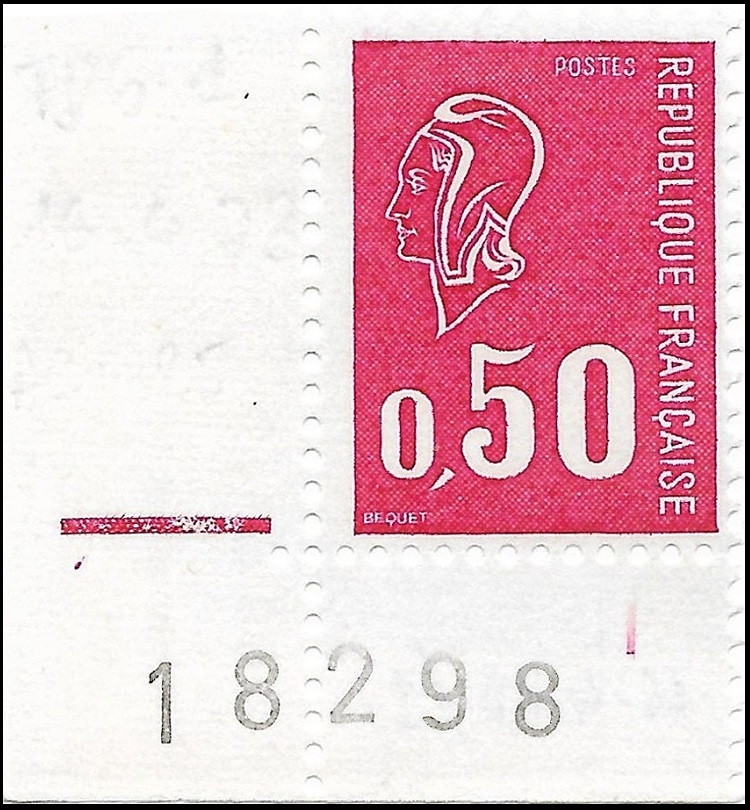
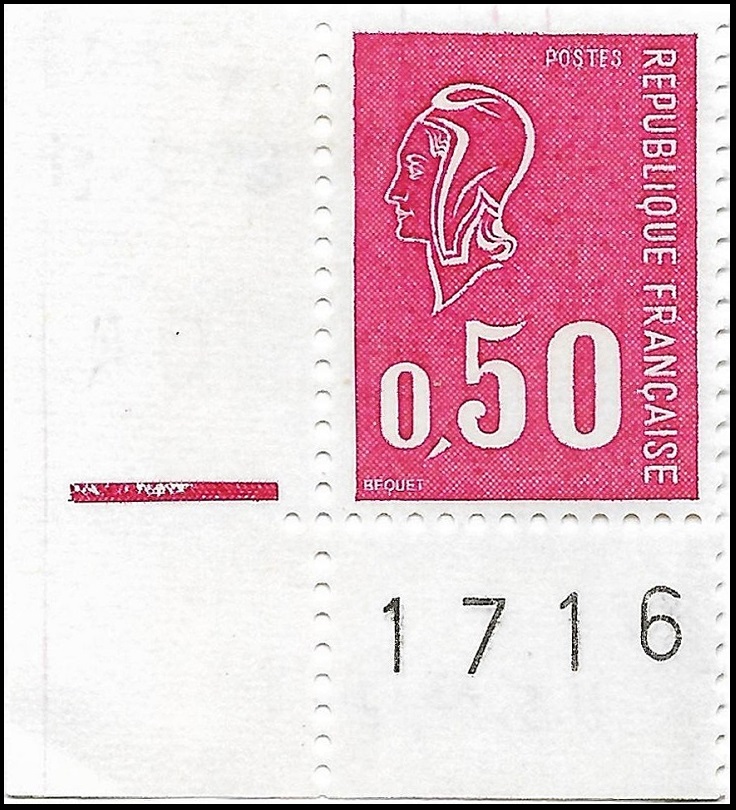
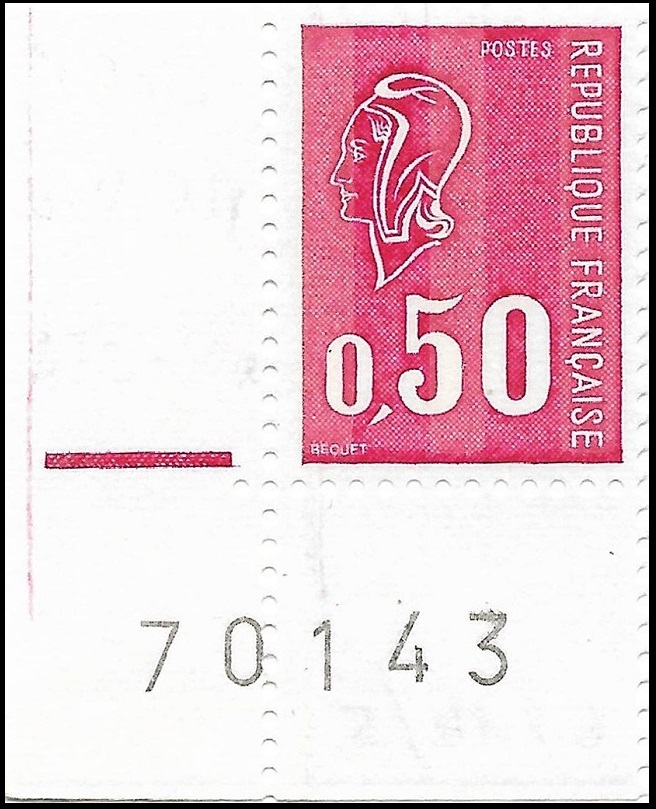
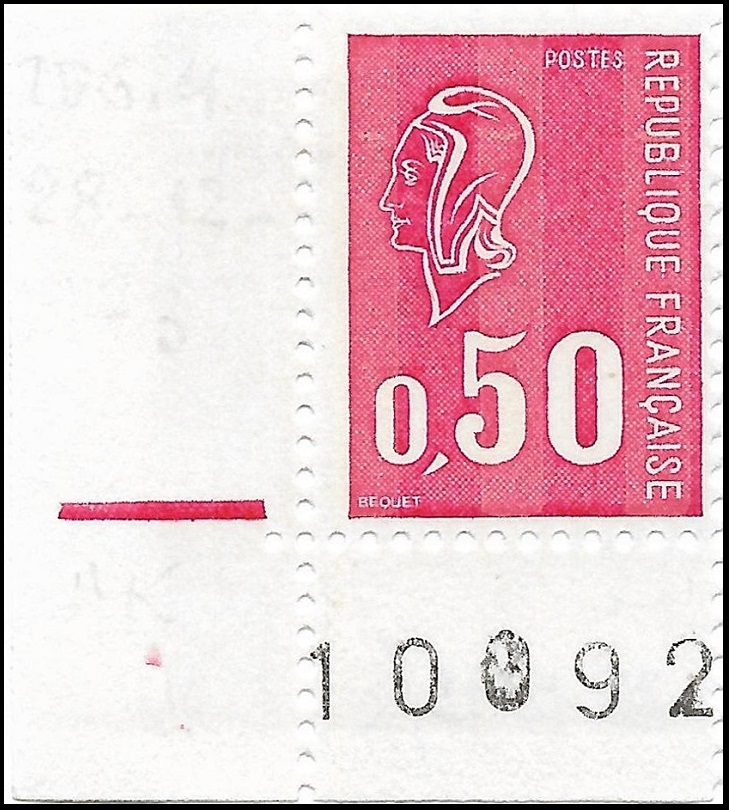
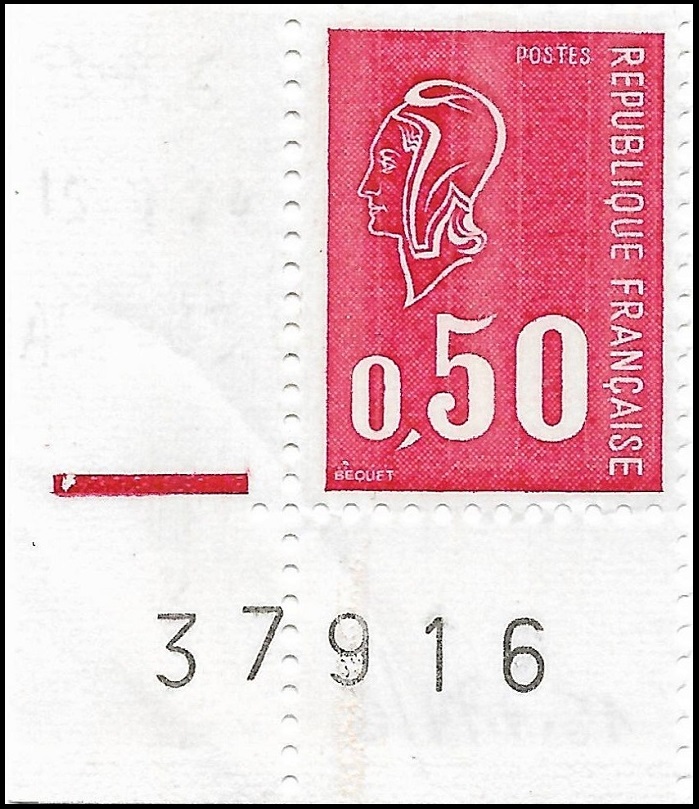
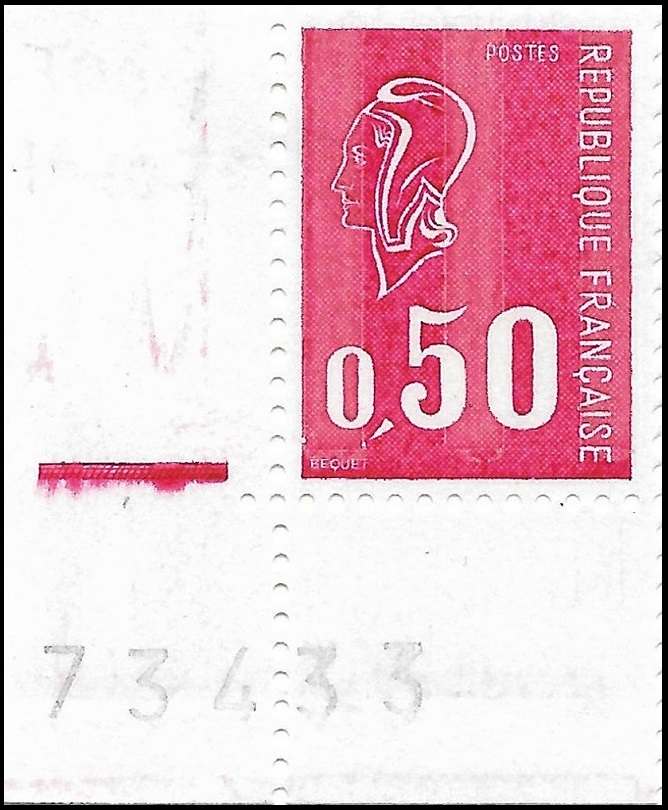
La première feuille (la feuille A) possède un repère électronique (R.E.) à gauche de la case 91 (rappelons que le R.E. est gravé manuellement directement sur la virole en taille-douce 6 couleurs pour permettre le repérage électronique de la seconde impression et du perforage après lecture optique. Étant gravés à la main, ils ont des formes différentes et sont à des emplacements différents les uns des autres par rapport aux timbres. C’est ce qui permet aux philatélistes de les décrire et de les étudier). La feuille B n’a rien et la feuille C a deux traits fins rouges sous la case 100 (pour certains tirages, les deux traits sont situés à gauche ; pour d’autres tirages, les deux traits sont non encrés. Ces informations seront fournies dans la section sur la description des tirages).
Sur la figure qui suit, on montre trois bas de feuille imprimés par un tour de virole (numéros se suivant). On peut voir les deux traits du cylindre AG sur le bas de feuille 10913 et le repère électronique du même cylindre sur le bas de feuille 10911.
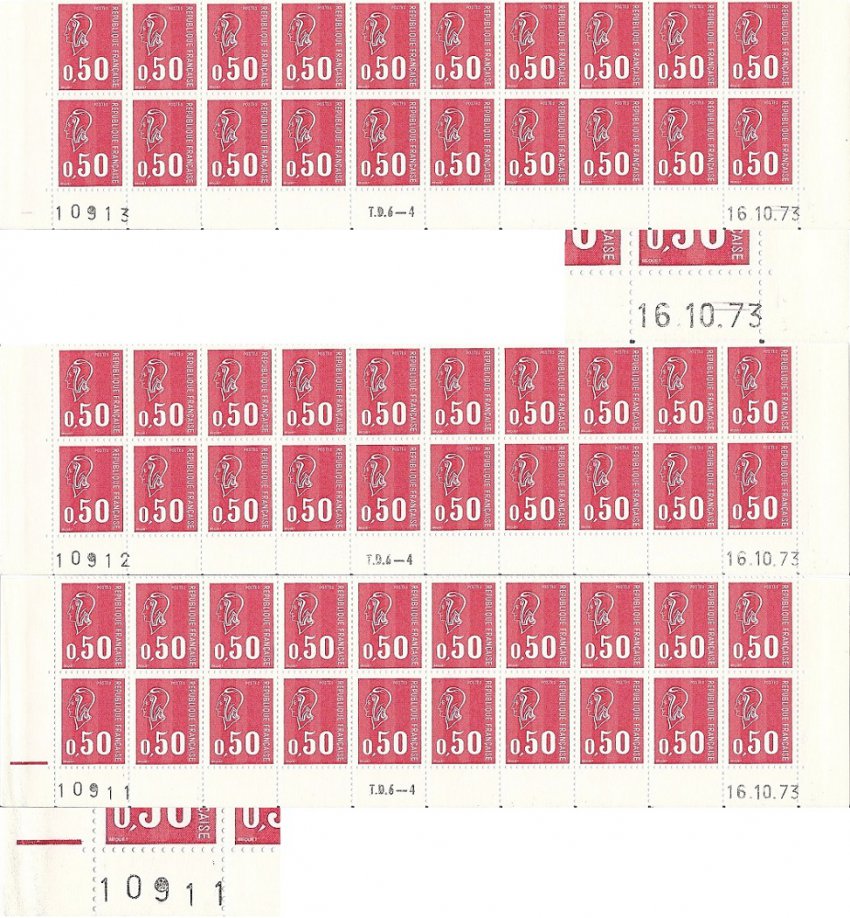
- three consecutive dated plate blocks of 20 stamps printed by the form cylinder AG
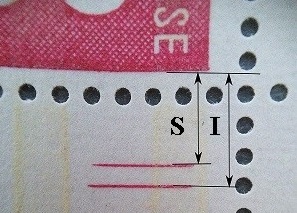
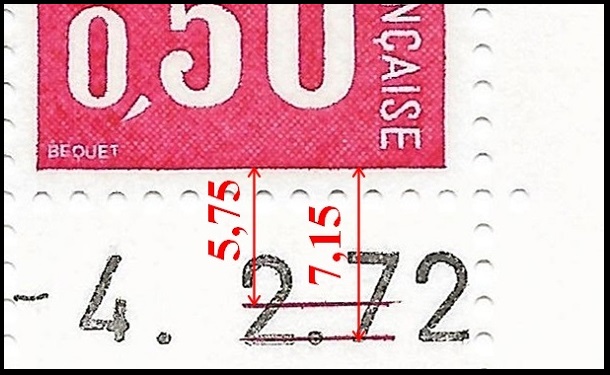
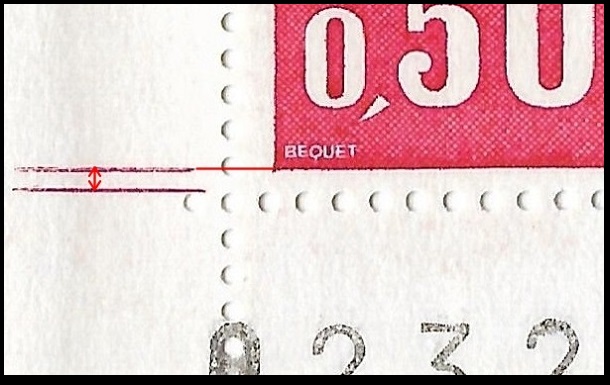
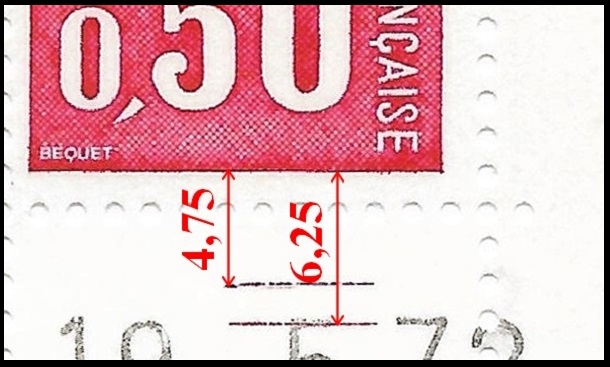
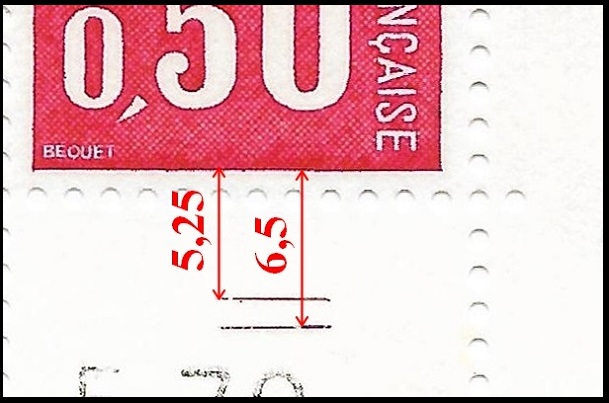
- characterization of a form cylinder by its two red lines
Les philatélistes ont l’habitude (cf. les brochures de la SOCOCODAMI notamment) de décrire les tirages grâce aux cylindres imprimant les timbres et de caractériser ces cylindres à l’aide des deux traits apparaissant dans l’angle inférieur droit d’une feuille sur trois. Nous voudrions rappeler ici comment sont caractérisés ces cylindres.
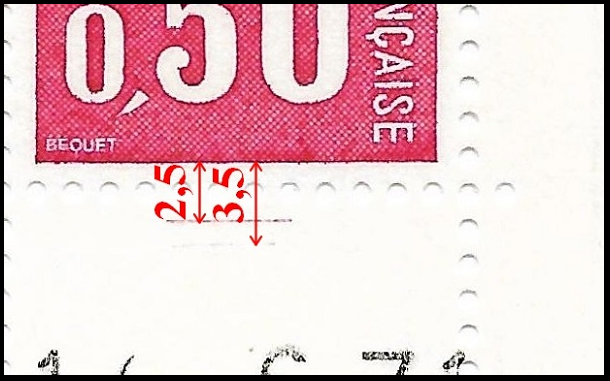
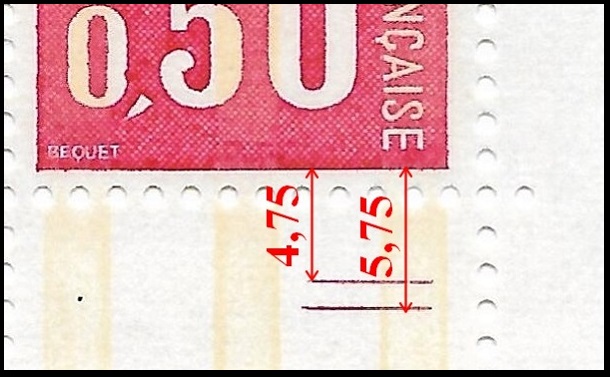
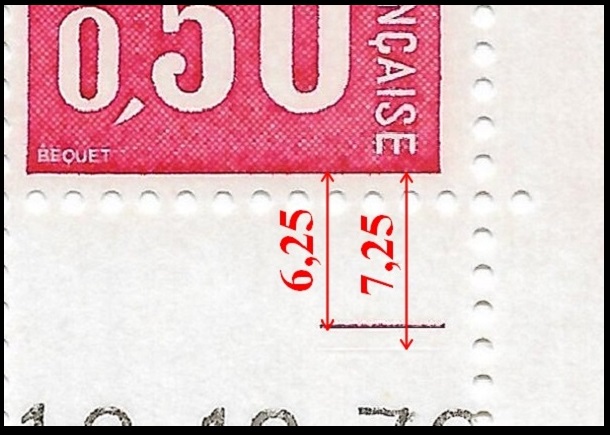
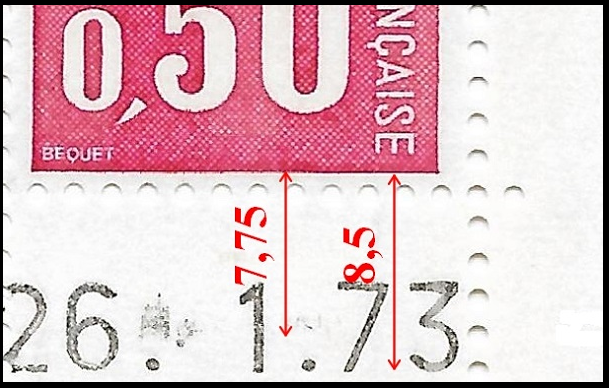
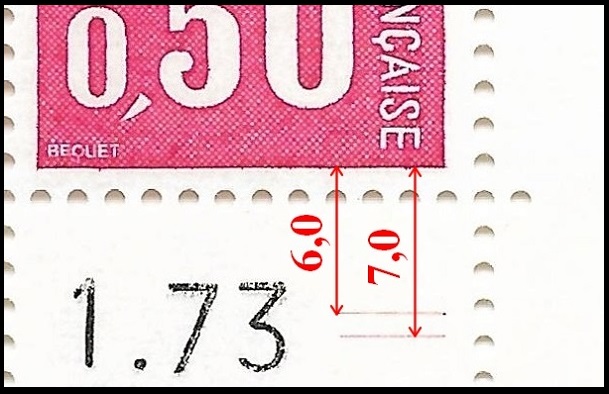
Les deux traits sont appelés respectivement S (pour Supérieur) et I (pour Inférieur) et sont définis par les distances en millimètres entre chacun de ces traits et le bas du timbre situé juste au dessus (cf. l’image ci-contre). Par exemple, le cylindre T est décrit ainsi sur la brochure de la SOCOCODAMI sur les Béquet :
S = 4 3/4, I = 5 3/4, traits courts à droite.
Le numéro comptable est situé sous la case 91, le numéro de presse TD6-x sous la case 95, 96 ou 97 et la date d’impression sous la case 100.
Une feuille de 100 timbres mesure environ 285 mm de haut et 230 mm de large. Les marges latérales sont blanches et non dentelées, les marges haut et bas blanches et dentelées verticalement.
Les barres phosphorescentes
La luminescence est la propriété qu’ont certaines substances de restituer sous forme de photons une partie de l’énergie absorbée au cours d’une excitation d’un certain type (électrique, chimique, mécanique, lumineuse, ...). Fluorescence et phosphorescence sont deux formes différentes de la luminescence : pour la fluorescence, l’émission de photons est visible tant que la source d’énergie absorbée est active. Pour la phosphorescence, le rayonnement persiste durant quelques secondes après l’extinction de la source d’énergie, phénomène que l’on appelle la rémanence.
Les barres phosphorescentes utilisées pour les timbres en France correspondent à la définition donnée ci-dessus, la lumière ultra-violette étant utilisée comme source d’énergie d’excitation, comme le montre une note de la Direction Générale des Postes de 1973 :
Ces barres sont imprimées par surimpression en typographie ou en flexographie.
A la suite des recherches de J.J. Rabineau, quatre types de barres phosphorescentes, dénotées A, B, C et D, ont été définis pour les premières émissions de timbres avec barres (d’autres types de barres phosphorescentes apparaîtront après la disparition des Mariannes de Béquet et ne seront pas évoqués ici). Voici la caractérisation de chacun de ces types de barres (les images proviennent du site LES BARRES PHOSPHORESCENTES ET LEURS VARIETES) :
le type A
- encre visqueuse et épaisse, mate à l’œil nu, très peu visible à la lumière du jour ;
- les barres, qui apparaissent homogènes sous UV, sont imprimées en typographie (à l’aide d’un cliché métallique recouvert de bronze tourné pour les bandes en relief et fraisé pour couper les bandes) et séchées naturellement.
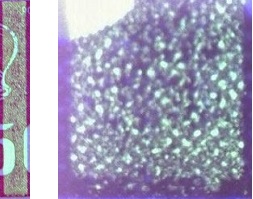
- type A phosphor band seen under UV light on the left, magnified 60 times on the right
le type B
- encre fluide (diluée à l’alcool) mate, très peu visible à la lumière du jour ;
- les barres, qui ont des cernes périphériques et sont plus ou moins creuses et très hétérogènes sous UV, sont imprimées en flexographie à l’aide d’un cliché métallique recouvert de matière plastique et séchées par infrarouge.
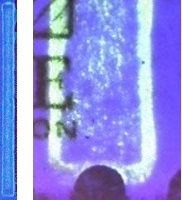
- type B phosphor band seen under UV light on the left, magnified 60 times on the right
le type C
- encre visqueuse et épaisse, pâteuse à l’œil nu, brillante en lumière rasante ;
- les barres, qui sont assez hétérogènes sous UV, avec des cernes périphériques plus ou moins larges, sont imprimées en typographie à l’aide d’un cliché en caoutchouc ou en plastique et séchées par ultra-violet.
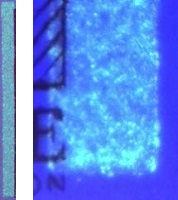
- type C phosphor band seen under UV light on the left, magnified 60 times on the right
le type D
- encre visqueuse et épaisse, légèrement brillante à l’œil nu et en lumière rasante, très visible à la lumière du jour ;
- les barres, qui ont un léger cerne périphérique sous UV avec aspect pointillé plus ou moins prononcé, sont imprimées en typographie à l’aide d’un cliché métallique et séchées par infrarouge.
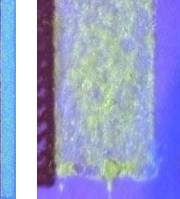
- type D phosphor band seen under UV light on the left, magnified 60 times on the right
Le timbre 0,50F Marianne de Béquet a une largeur de 20 mmm et une hauteur de 26 mm : la figurine a une largeur de 17 mm et une hauteur de 22,5 mm, ce qui laisse une marge de 1,5 mm sur les côtés. La largeur des barres phosphorescentes est de 3 mm et leur hauteur de 22 mm.
Les tirages du 0,50F Marianne de Béquet sur TD6
Introduction
Les presses TD6 ont imprimé
- des timbres sans barre phosphorescente
- avec gomme normale (20 tirages sur les presses TD6-1, 6-2, 6-3, 6-4, 6-5 et 6-7) ;
- avec gomme tropicale (1 tirage sur la presse TD6-2 et 1 tirage sur la presse TD6-4) ;
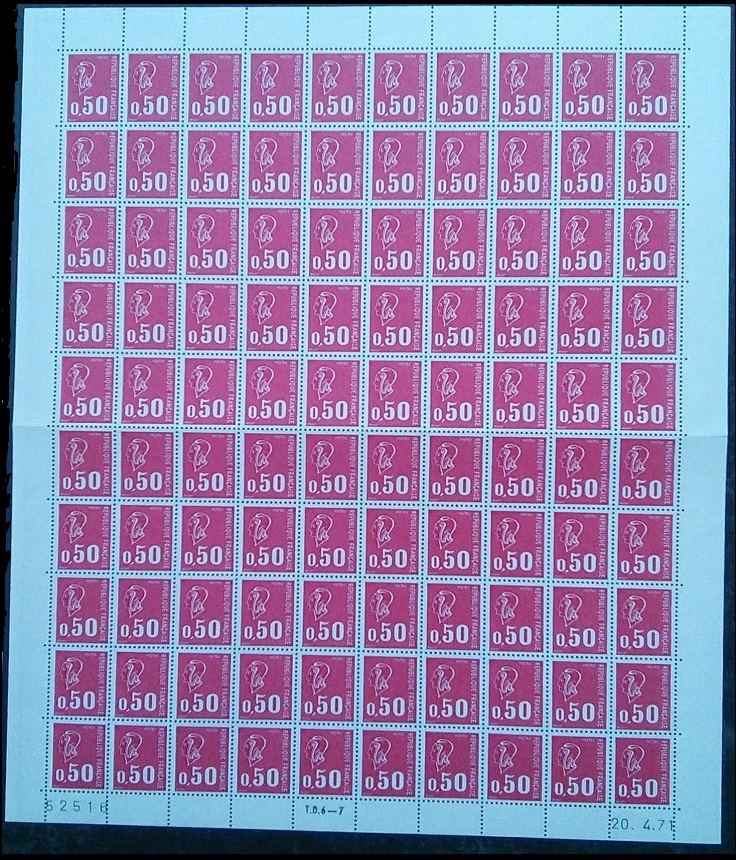
- sheet of 100 stamps without phosphor band
- avec gomme normale (20 tirages sur les presses TD6-1, 6-2, 6-3, 6-4, 6-5 et 6-7) ;
- des timbres sans barre phosphorescente surchargés CFA en typographie à plat
- avec gomme normale (2 tirages sur la presse TD6-1) ;
- avec gomme tropicale (1 tirage sur la presse TD6-1 et 1 tirage sur la presse TD6-4) ;
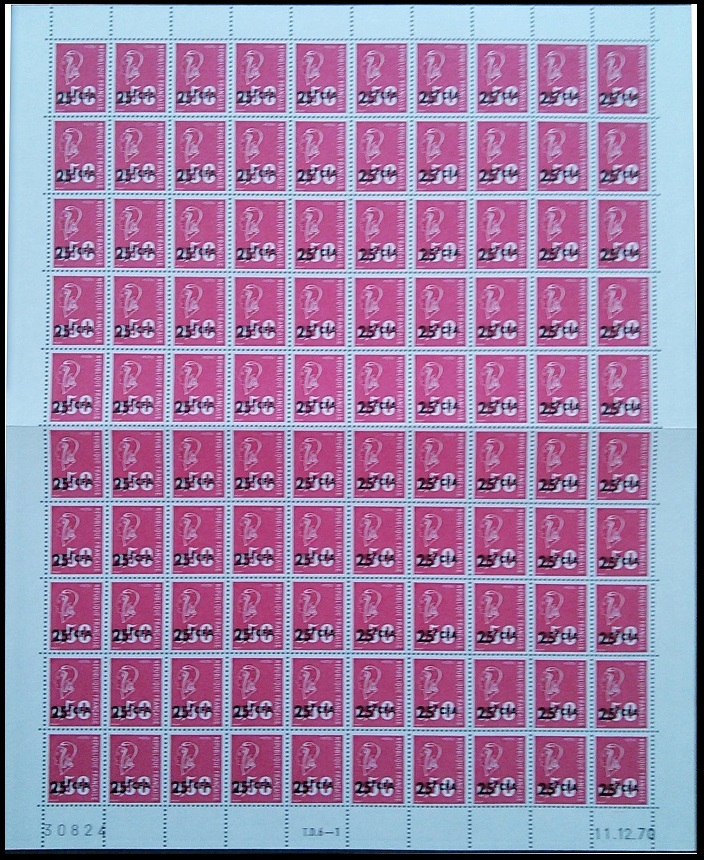
- sheet of 100 stamps 0,50F Marianne de Béquet overprinted 25F CFA
- avec gomme normale (2 tirages sur la presse TD6-1) ;
- des timbres avec 3 barres phosphorescentes
- avec gomme normale (18 tirages sur les presses TD6-1 (barres phosphorescentes au type A ou D), TD6-2 (barres phosphorescentes au type D), TD6-4 (barres phosphorescentes au type A ou D), TD6-5 (barres phosphorescentes au type D), TD6-6 (barres phosphorescentes au type B) et TD6-7 (barres phosphorescentes au type B)) ;
- avec gomme tropicale (1 tirage sur la presse TD6-7 (barres phosphorescentes au type B)).
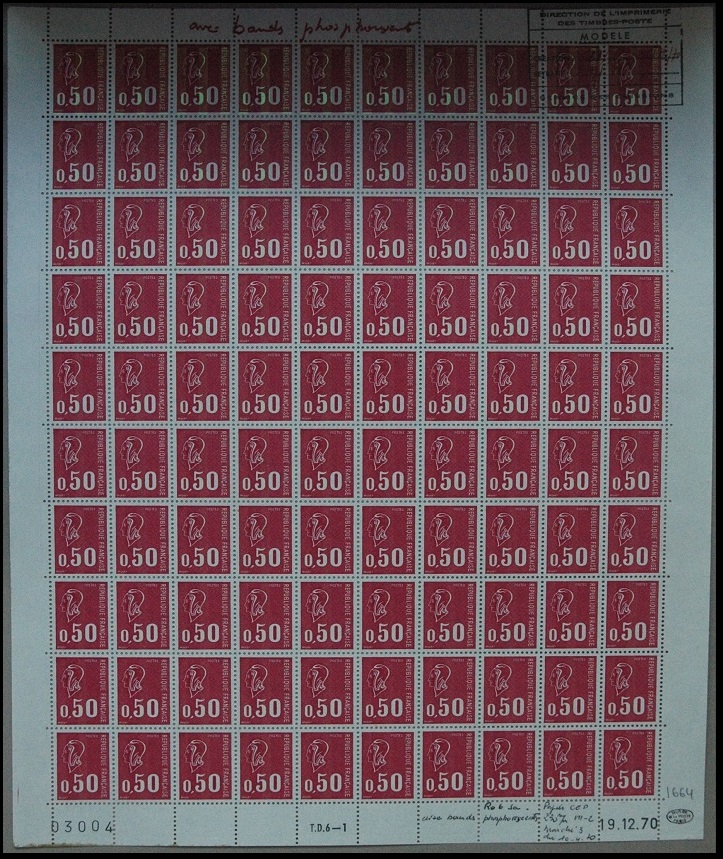
- imprimatur sheet of the stamp 0,50F Marianne de Béquet with 3 phosphor bands (Source : Copyright Coll. L’Adresse Musée de La Poste, Paris / La Poste)
- avec gomme normale (18 tirages sur les presses TD6-1 (barres phosphorescentes au type A ou D), TD6-2 (barres phosphorescentes au type D), TD6-4 (barres phosphorescentes au type A ou D), TD6-5 (barres phosphorescentes au type D), TD6-6 (barres phosphorescentes au type B) et TD6-7 (barres phosphorescentes au type B)) ;
Au total, il existe donc 38 tirages du 0,50F Marianne de Béquet sur presse TD6, obtenus à l’aide de 36 cylindres dénommés A à AO, que l’on peut résumer sous la forme du tableau suivant :
Nous allons maintenant montrer les deux traits caractéristiques de chaque cylindre, puis les repères électroniques associés à chaque cylindre, avant d’illustrer tous les tirages réalisés. Signalons que toutes les informations fournies dans cette section sont dues à la SOCOCODAMI et à ses membres.
Traits caractéristiques des cylindres utilisés
Voici, sous forme de tableau, les 2 traits qui caractérisent les cylindres utilisés sur les presses TD6 pour produire les timbres 0,50F Marianne de Béquet (sauf pour trois cylindres où ces deux traits n’ont pas été gravés).
le trait I est très fin, souvent à sec | |
| |
| pour ce cylindre
| |
les 2 traits sont situés dans le coin gauche | |
les 2 traits sont situés dans le coin gauche | |
| |
| pour ce cylindre
| |
| |
| pour ce cylindre
| |
| |
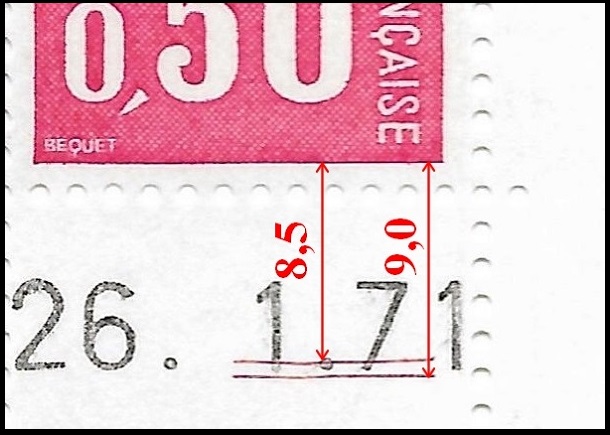
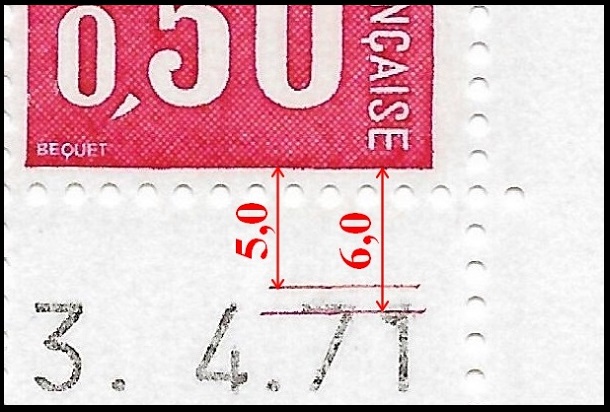
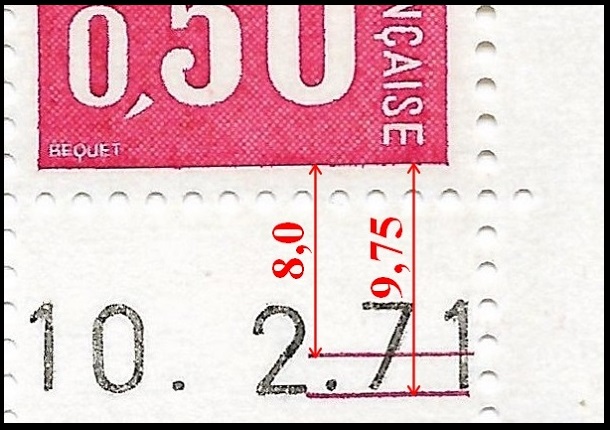
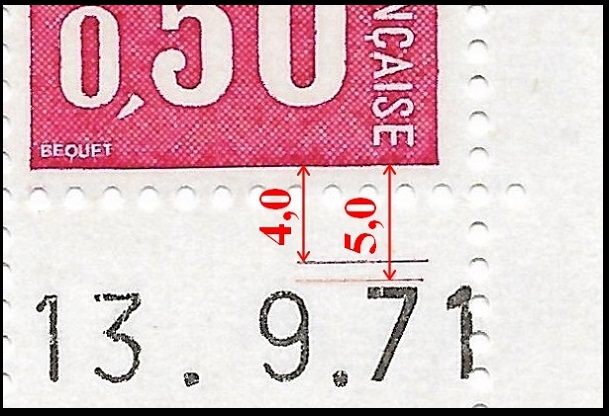
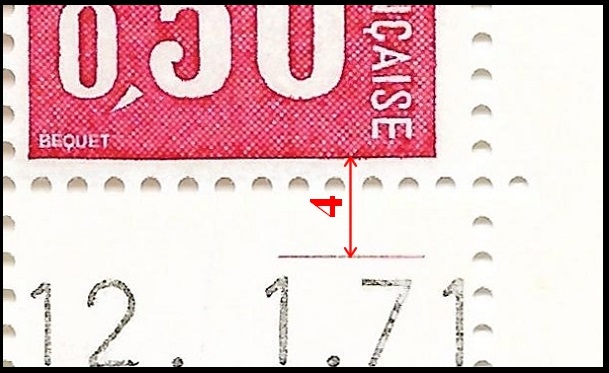
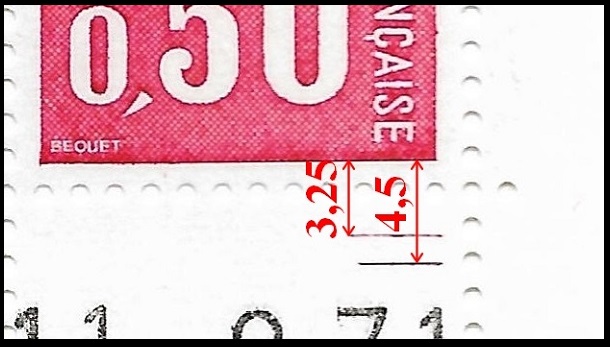
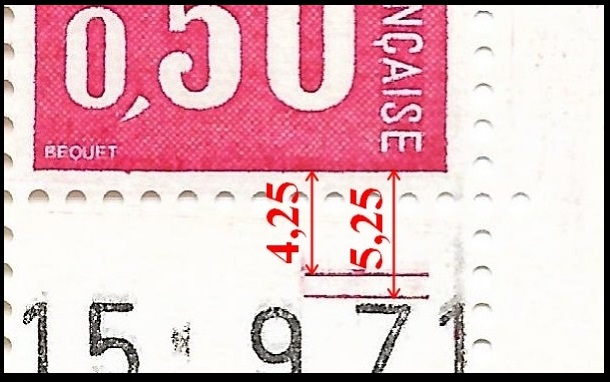
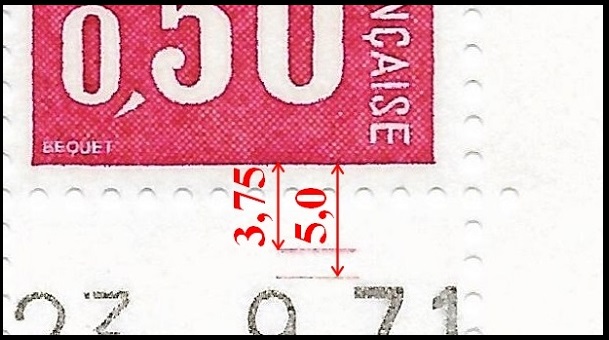
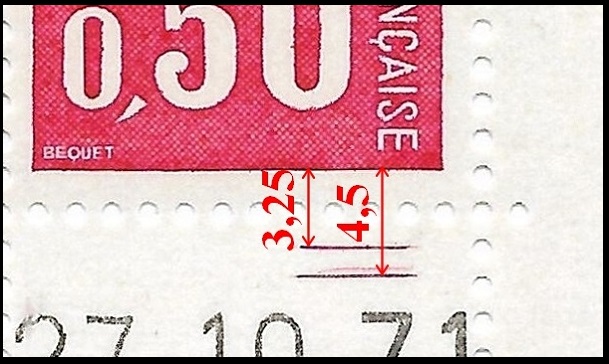
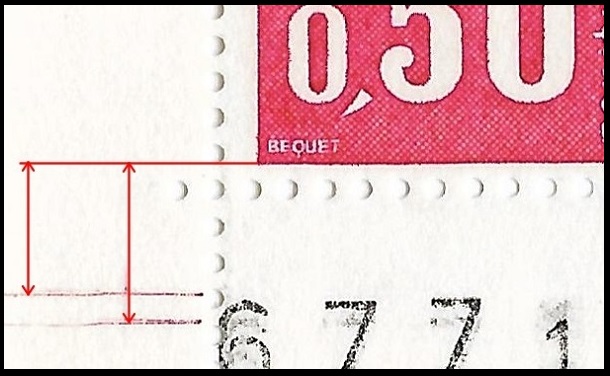
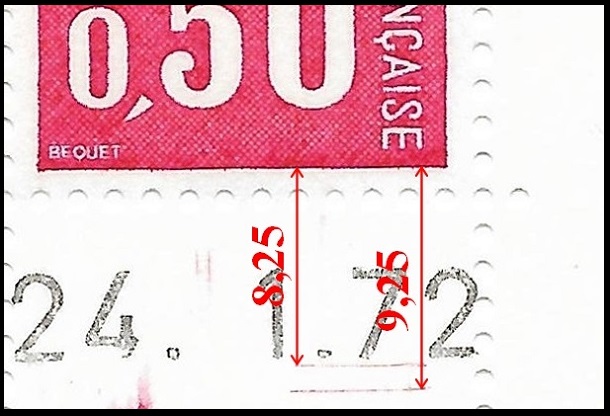
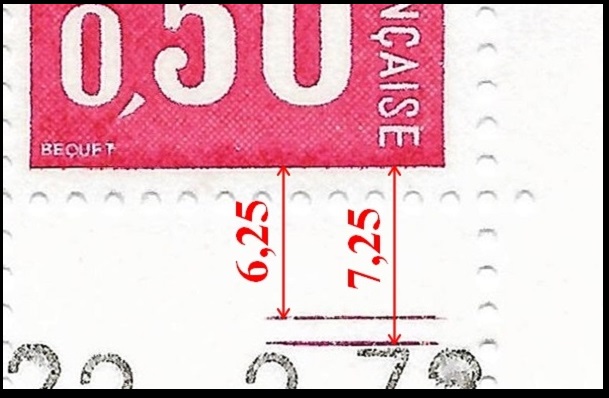
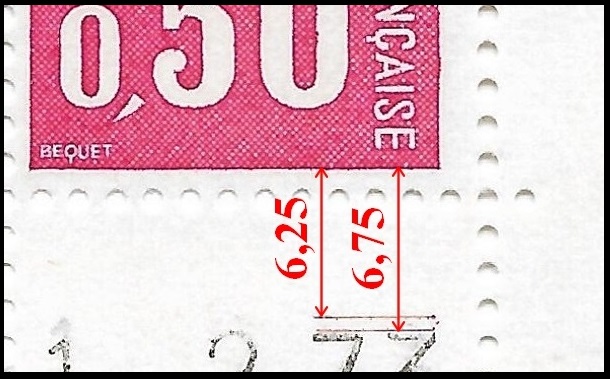
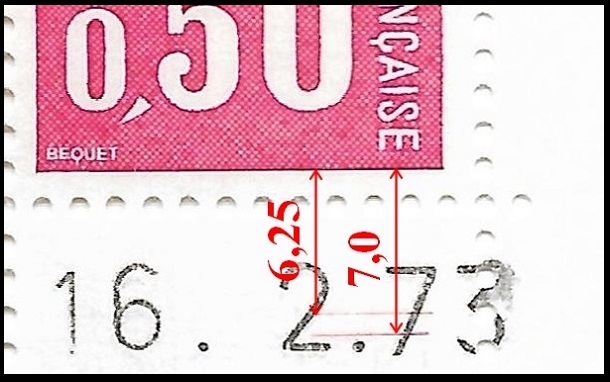
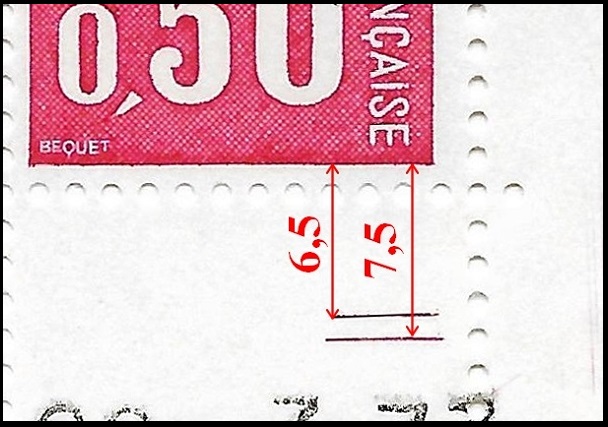
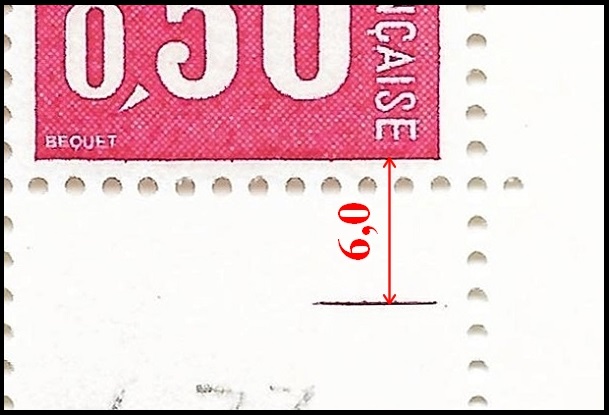
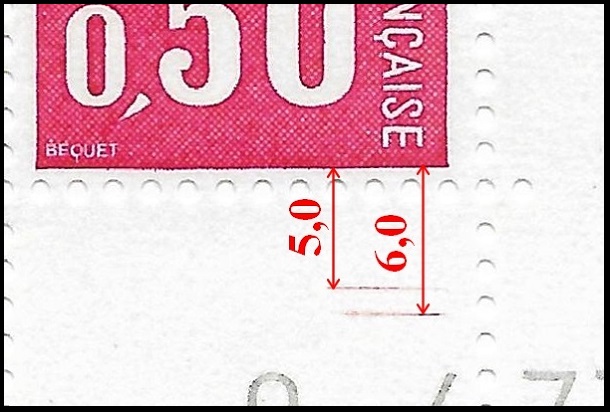
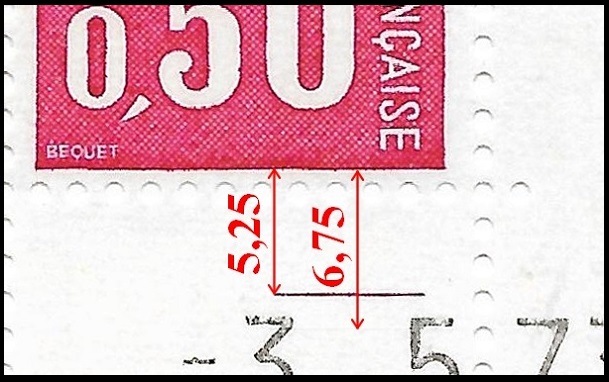
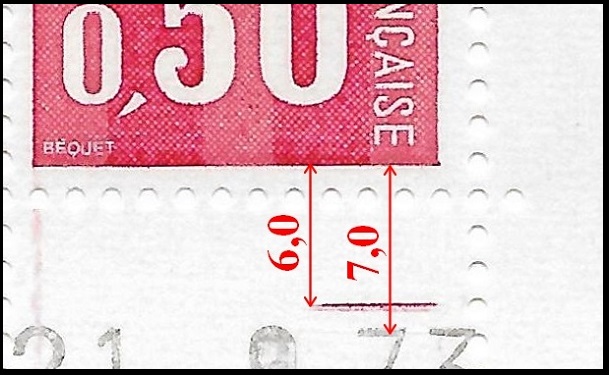
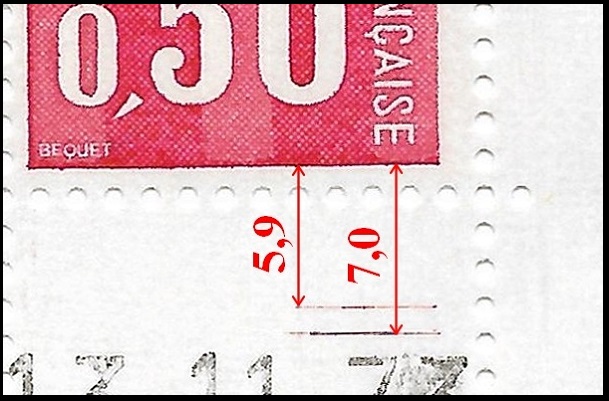
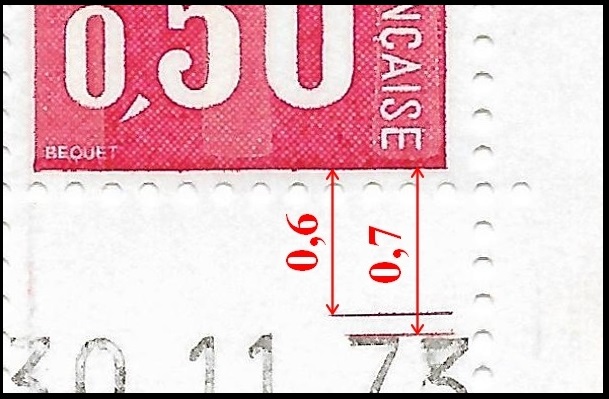
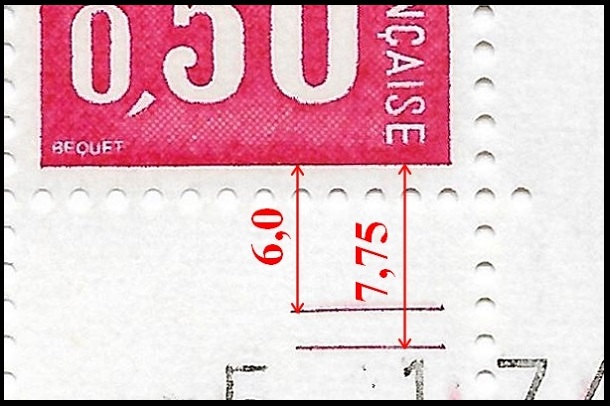
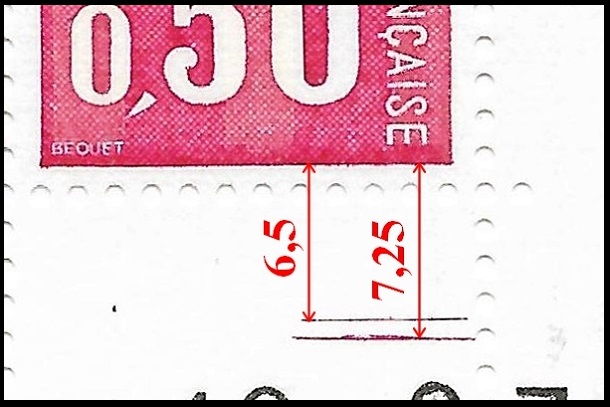
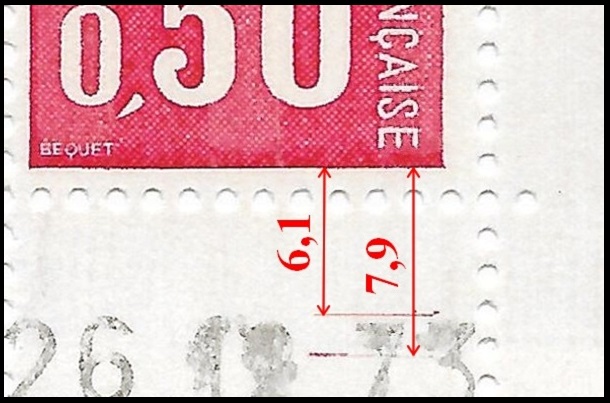
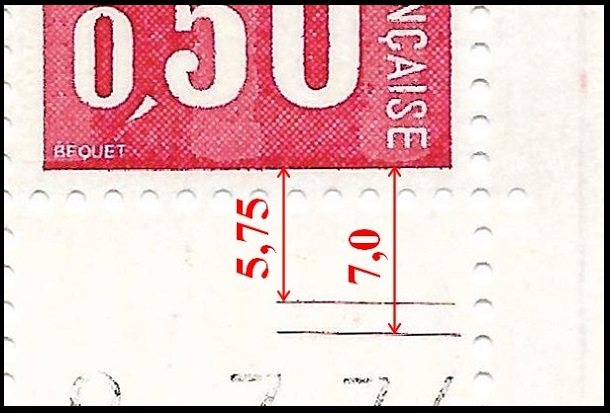
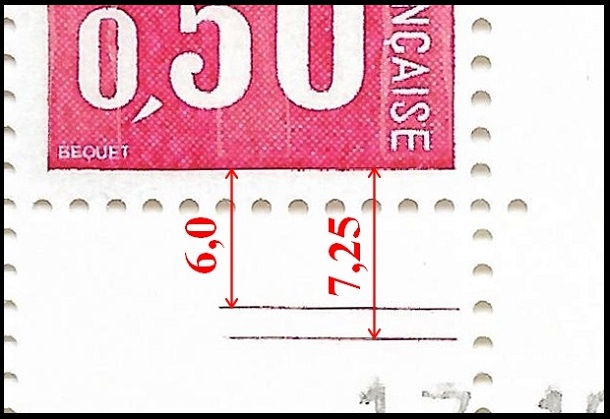
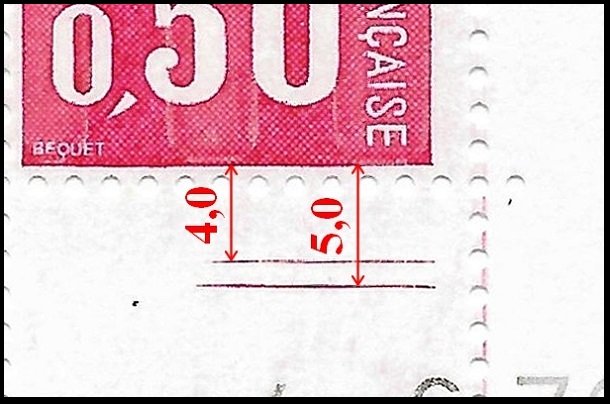
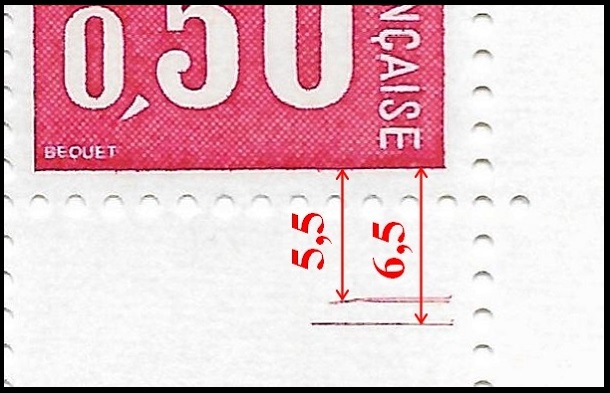
Repères électroniques des cylindres utilisés
Voici, toujours sous forme de tableau, les repères électroniques des cylindres utilisés sur les presses TD6 pour produire les timbres 0,50F Marianne de Béquet (sauf le repère du cylindre AO que je ne possède pas).
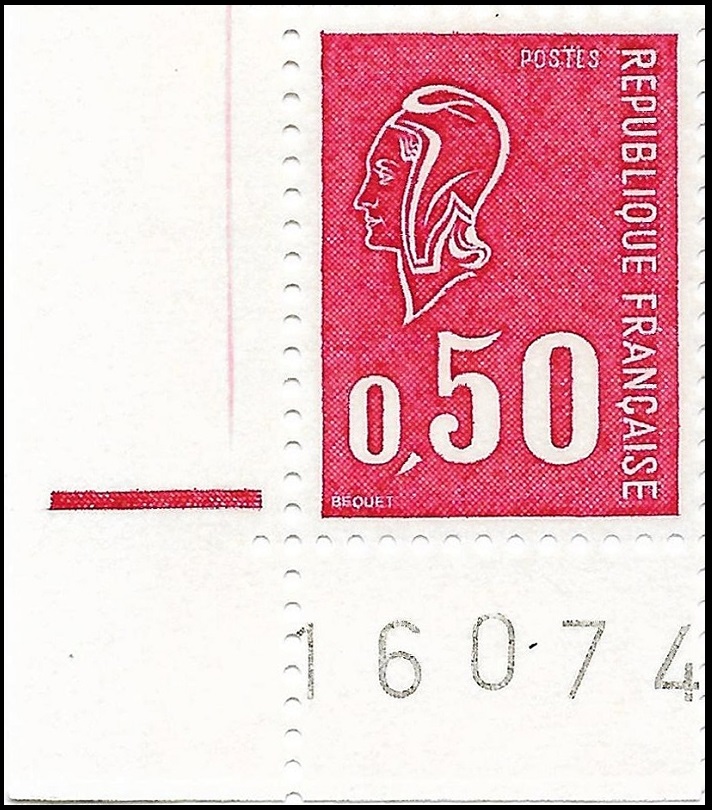
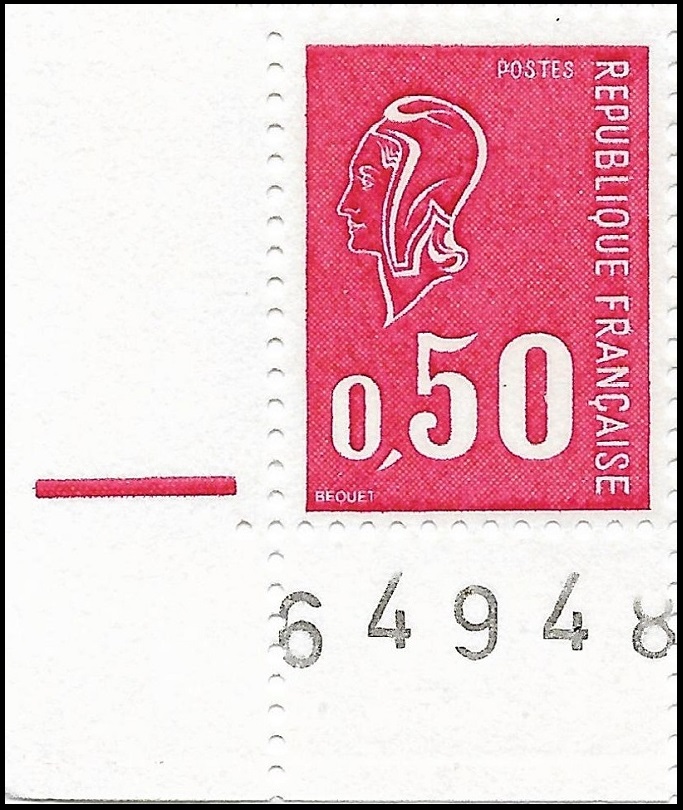
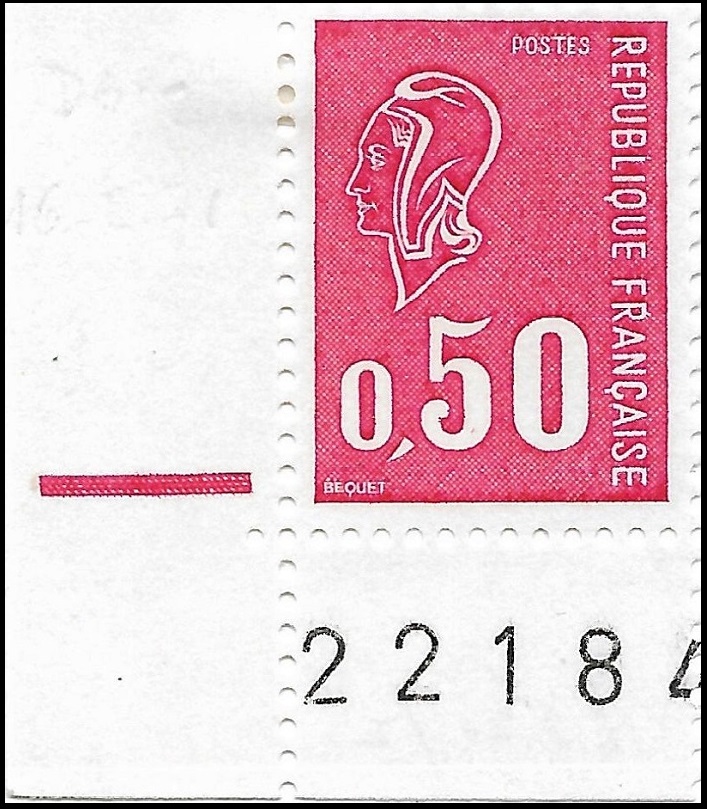
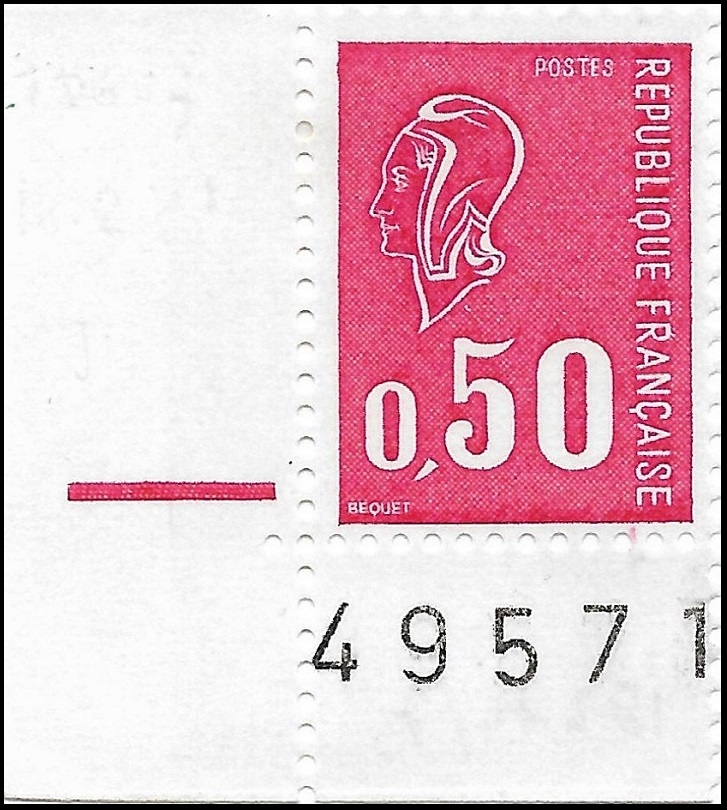
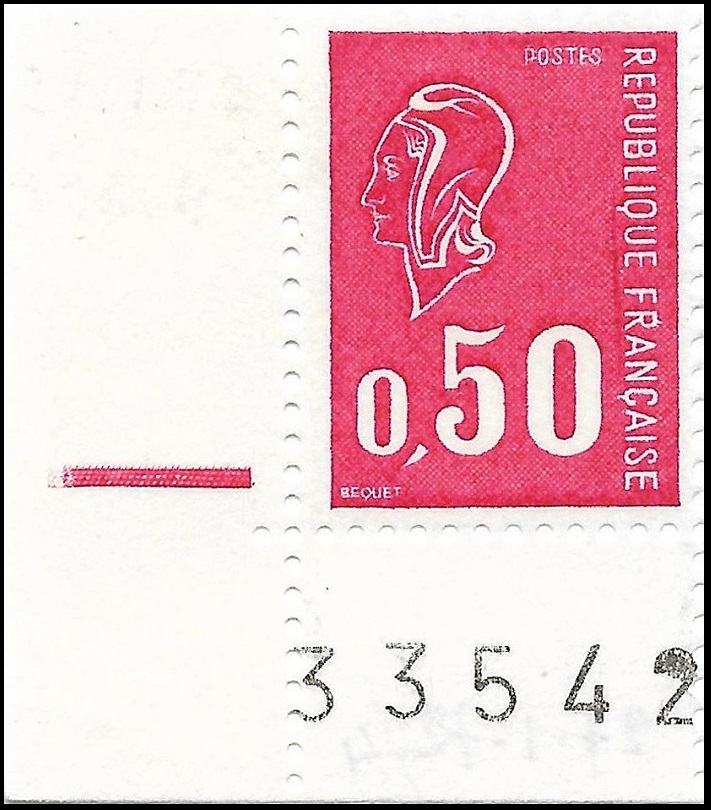
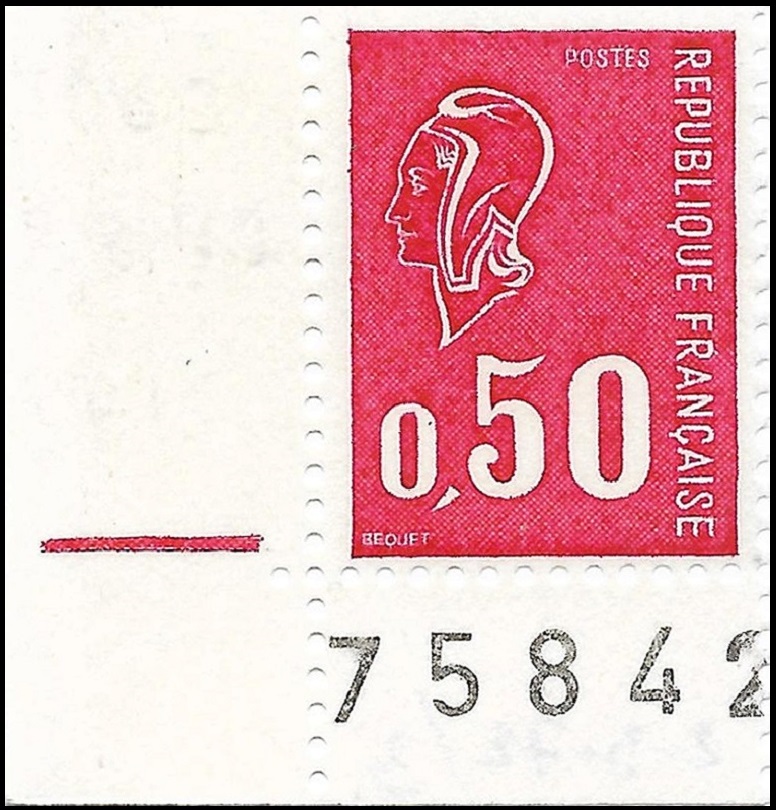
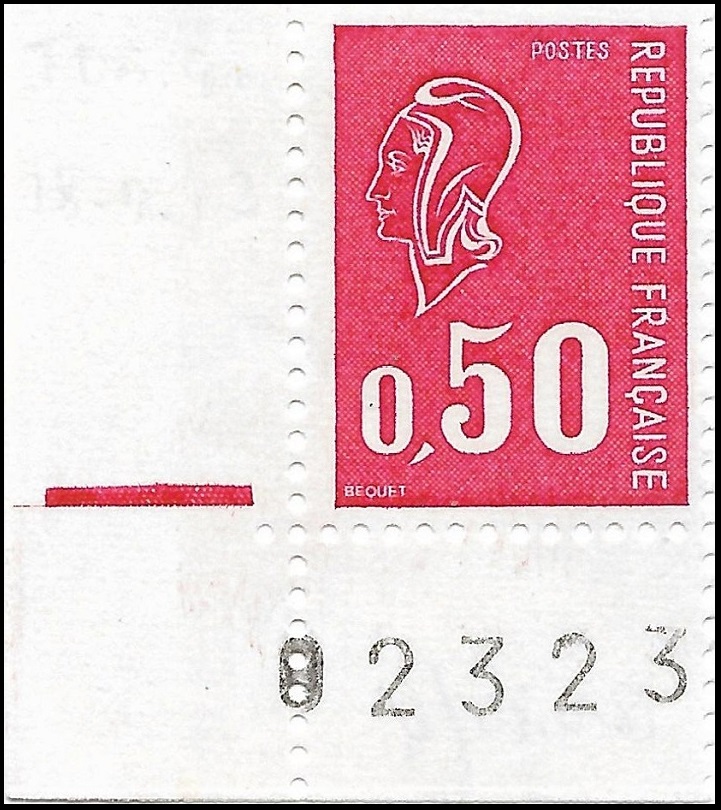
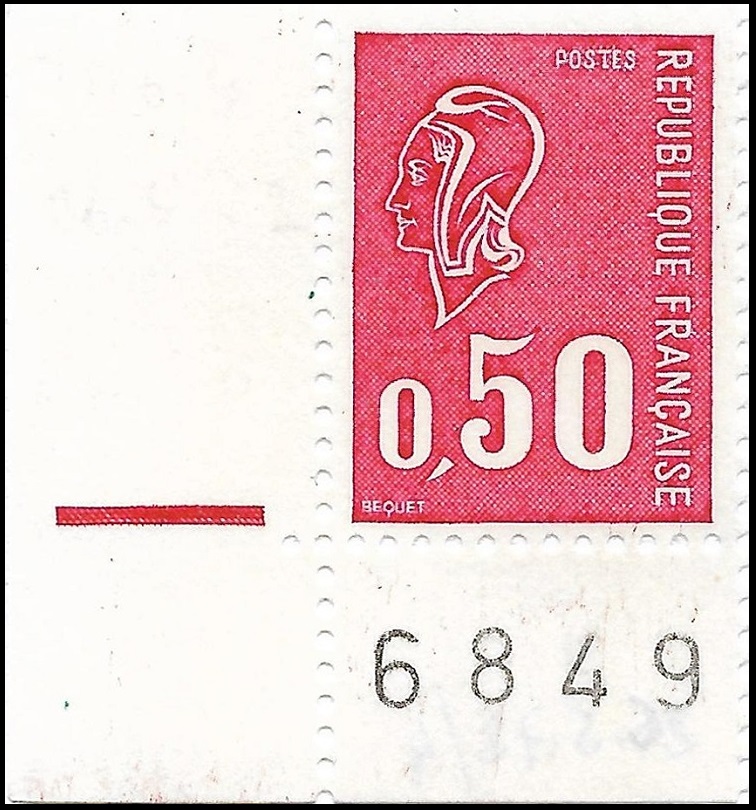
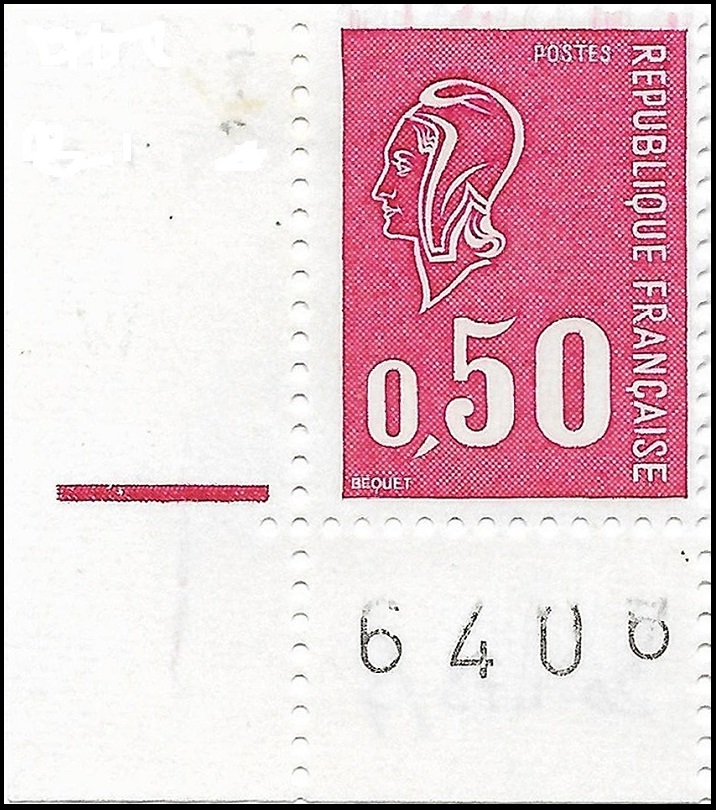
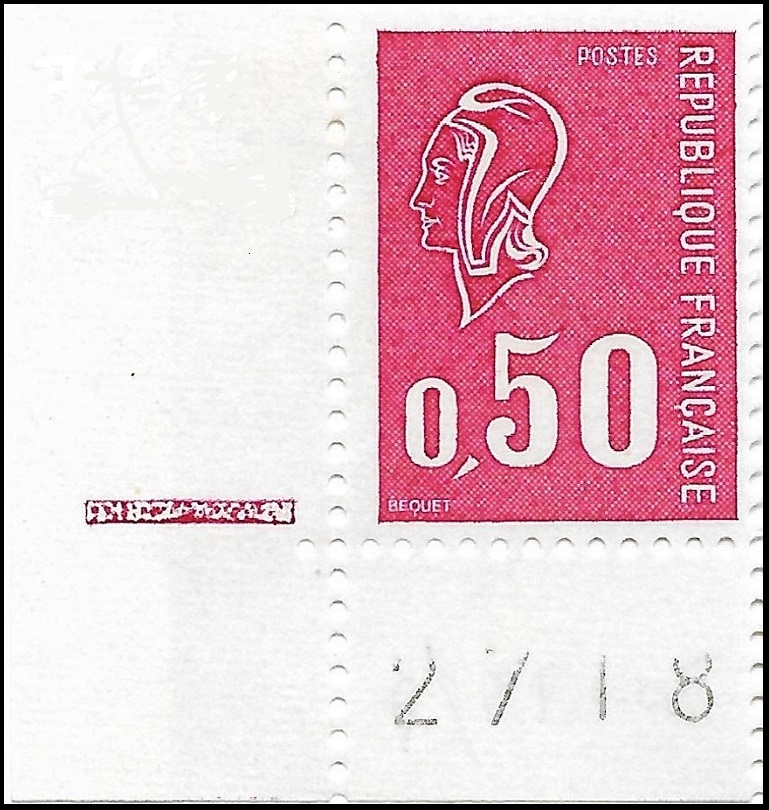
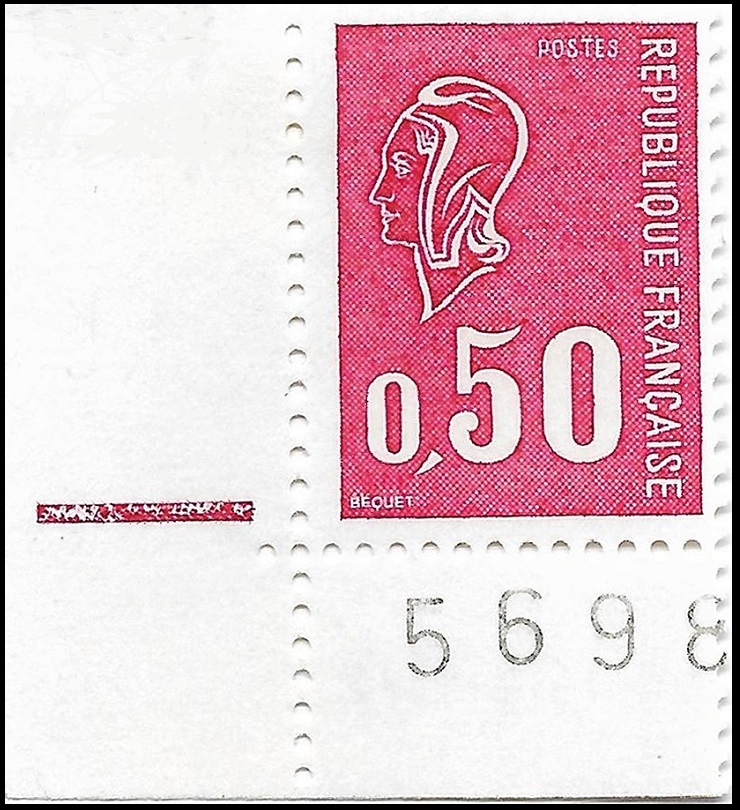
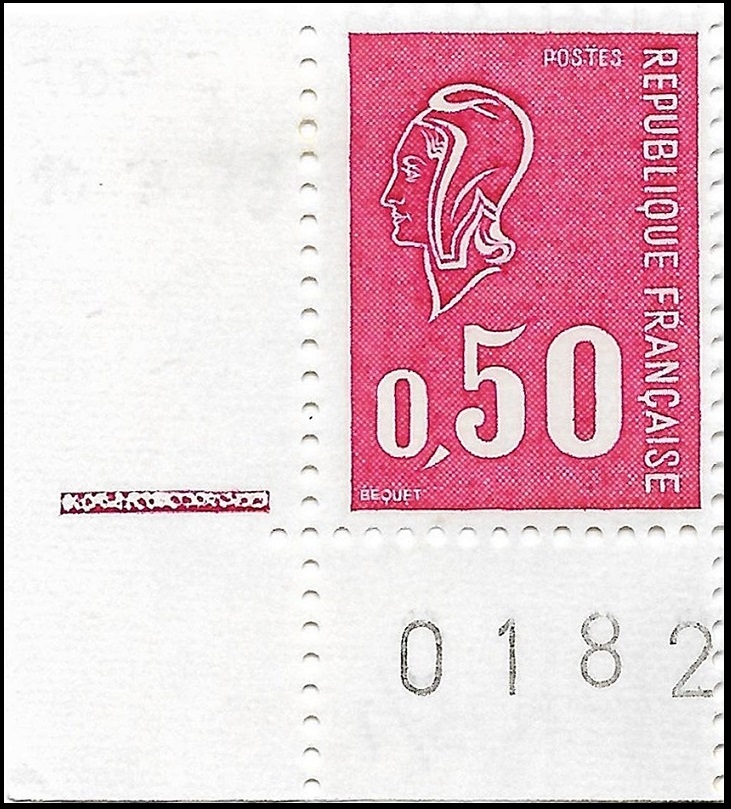
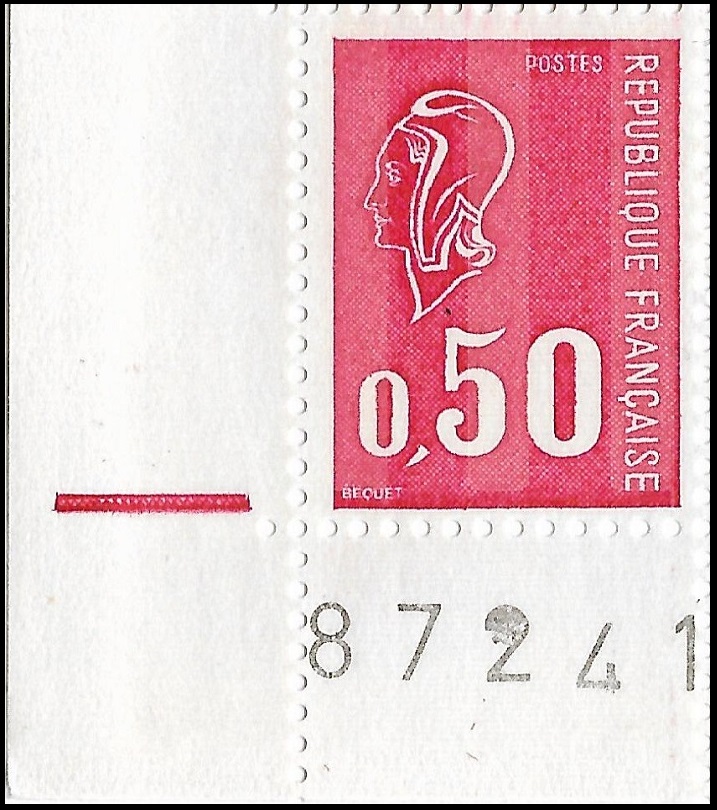
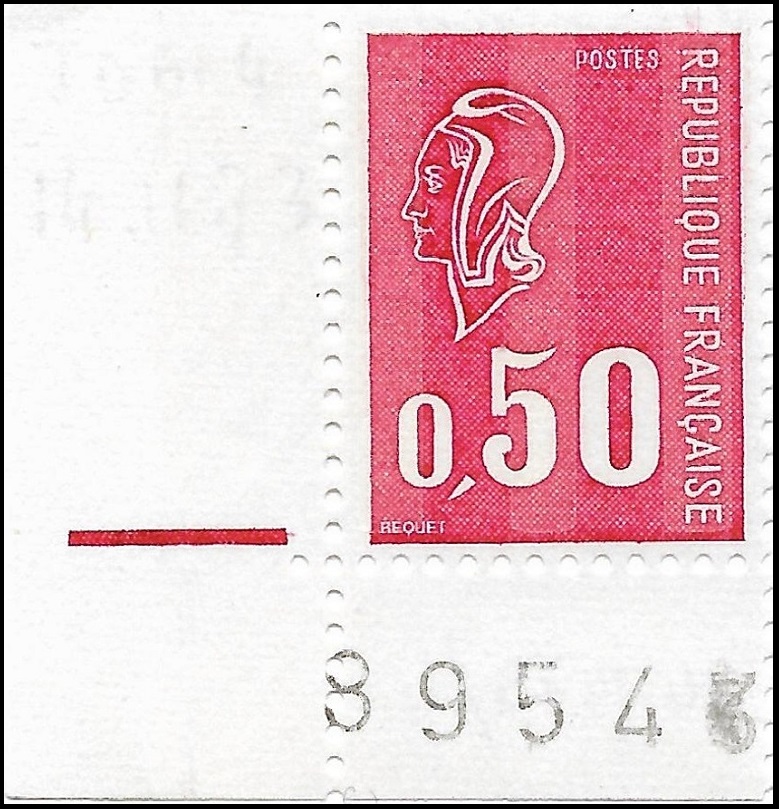
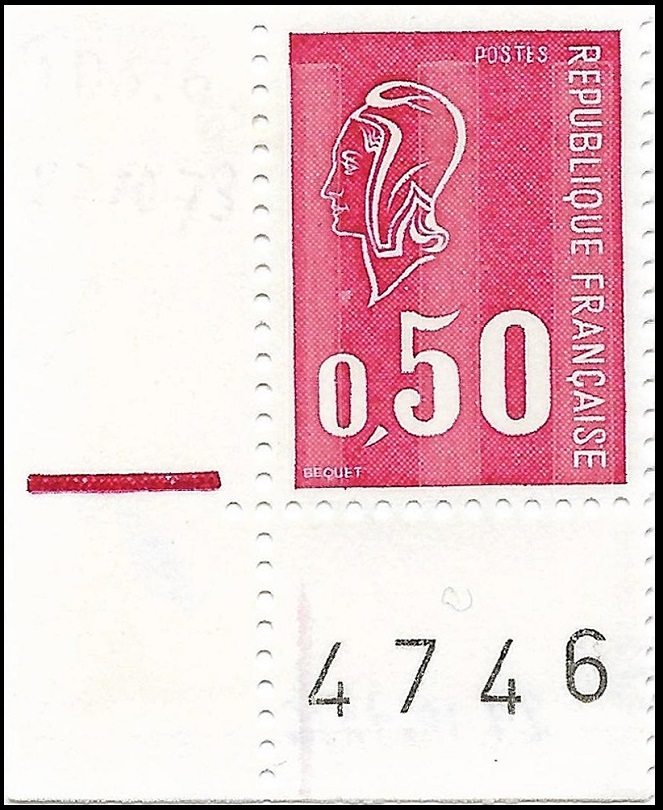
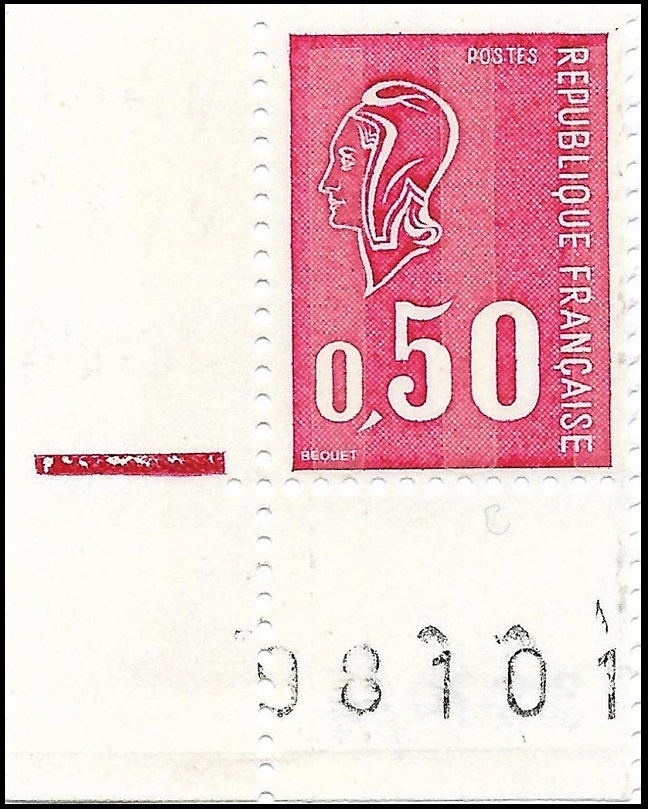
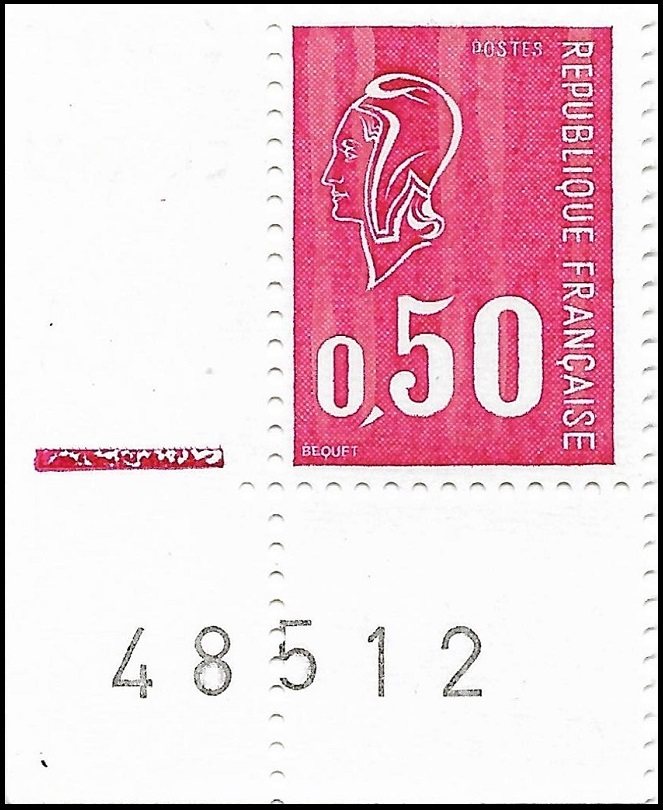
Tirages
Je vais maintenant fournir les dates connues de tous les tirages et parties de tirages du 0,50F Marianne de Béquet (la définition précise de ces termes a été fournie dans l’introduction aux timbres de feuilles). Rappelons une nouvelle fois que ces informations sont connues grâce aux membres actuels et passés de la SOCOCODAMI. Celles-ci sont donc susceptibles d’évoluer en fonction des futures trouvailles des collectionneurs.
1er tirage, sur la presse TD6-1
- cylindre A, du 27.11.70 au 10.12.70, timbres sans barre phosphorescente
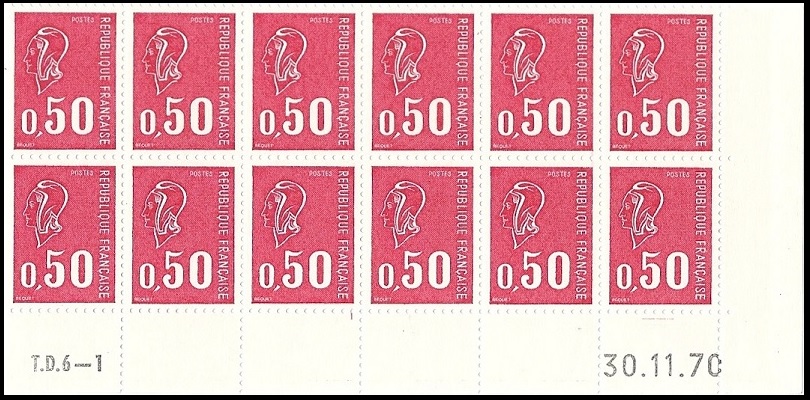
- dated plate block of 12 stamps from the 1st printing with the cylinder A
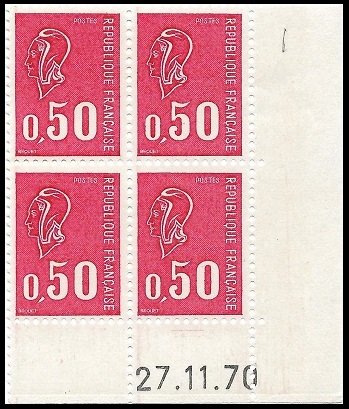
- corner dated block of 4 stamps from the 1st printing day of the stamp 0,50F Marianne de Béquet
- surchargé 25F C.F.A. le 11.12.70, gomme métropolitaine, timbres sans barre phosphorescente
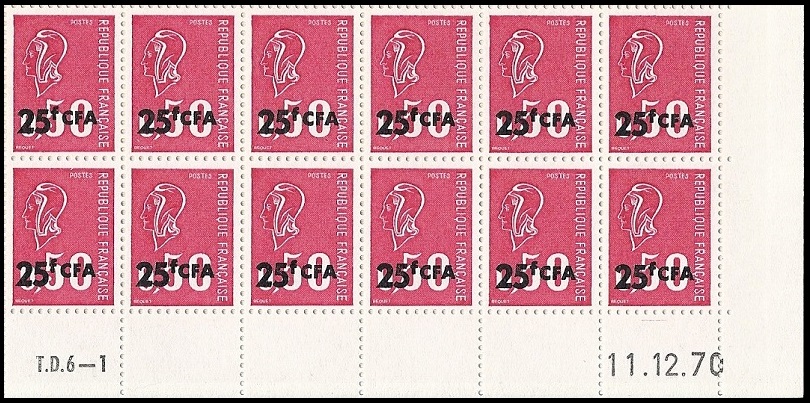
- dated plate block of 12 stamps from the 1st printing overprinted CFA
2ème tirage, sur la presse TD6-7
- cylindre B, du 1.12.70 au 28.1.71, timbres sans barre phosphorescente
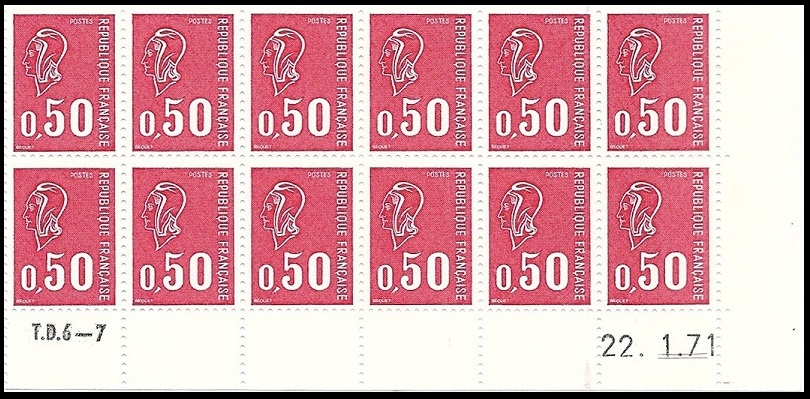
- dated plate block of 12 stamps from the 2nd printing with the cylinder B
Les deux traits ne sont encrés qu’à partir du 22.1.71.
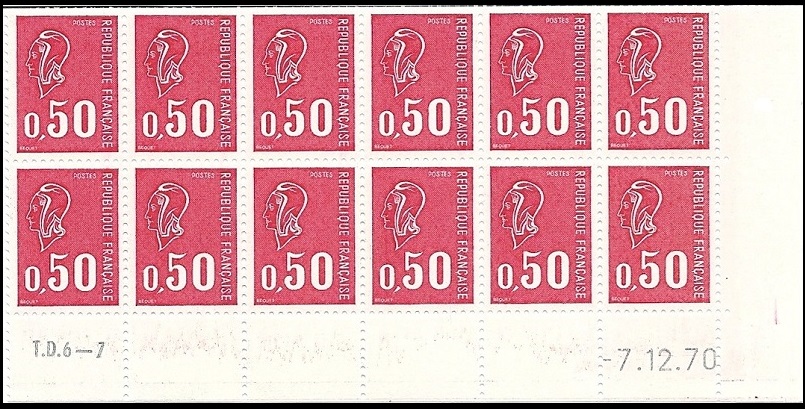
- dated plate block of 12 stamps from the 2nd printing with the cylinder B with the two lines dry printed
- cylindre D, du 1.2.71 au 10.2.71, timbres sans barre phosphorescente
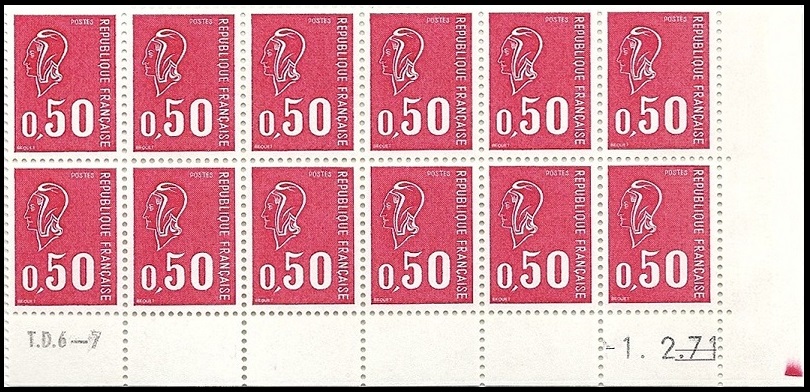
- dated plate block of 12 stamps from the 2nd printing with the cylinder D
- cylindre I, du 11.2.71 au 16.2.71, timbres sans barre phosphorescente
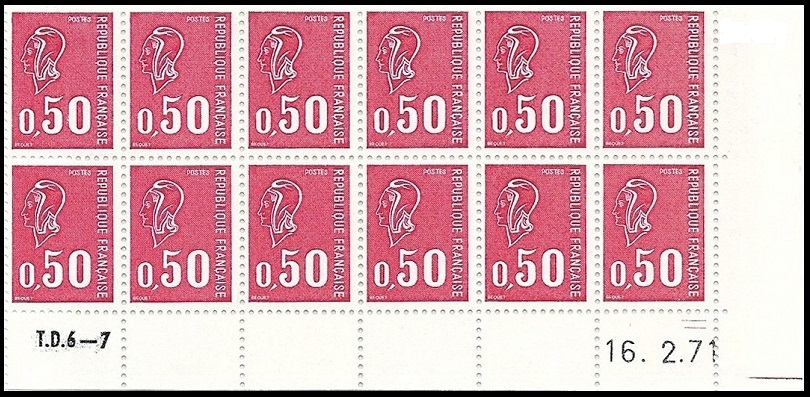
- dated plate block of 12 stamps from the 2nd printing with the cylinder I
- cylindre J, du 17.2.71 au 27.2.71, timbres sans barre phosphorescente
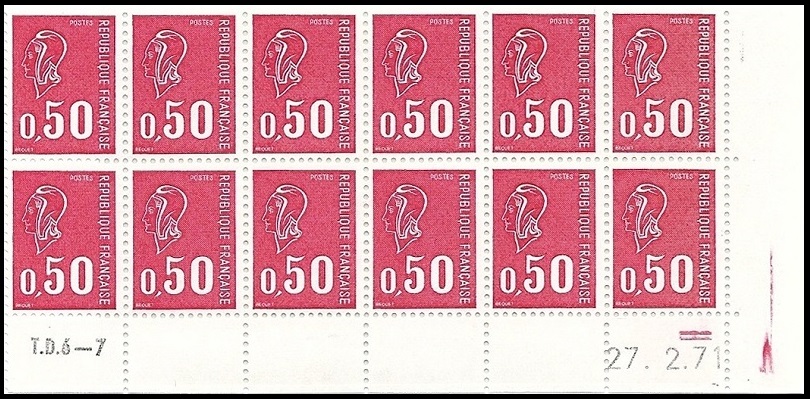
- dated plate block of 12 stamps from the 2nd printing with the cylinder J
- cylindre C, du 5.3.71 au 18.6.71, timbres sans barre phosphorescente
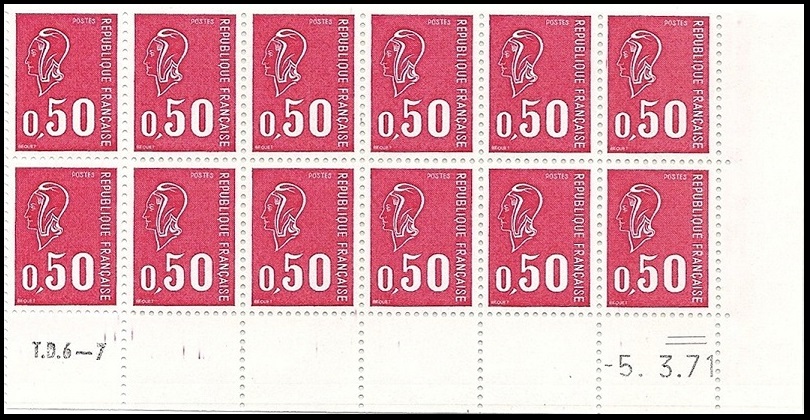
- dated plate block of 12 stamps from the 2nd printing with the cylinder C
- cylindre A, du 21.6.71 au 25.6.71, timbres sans barre phosphorescente
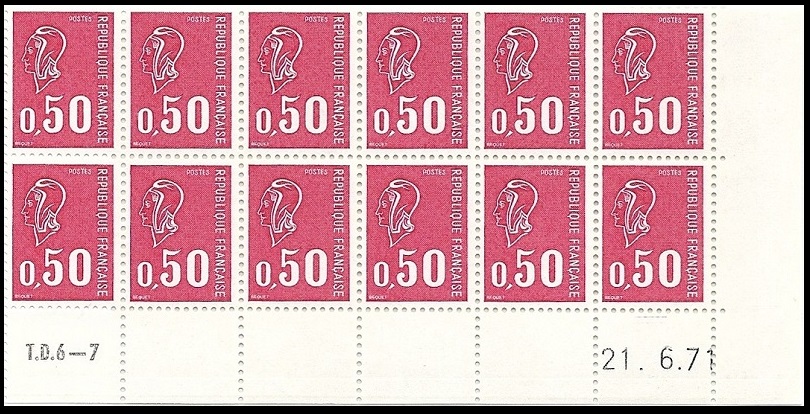
- dated plate block of 12 stamps from the 2nd printing with the cylinder A
3ème tirage, sur la presse TD6-2
- cylindre C, du 5.12.70 au 2.2.71, timbres sans barre phosphorescente
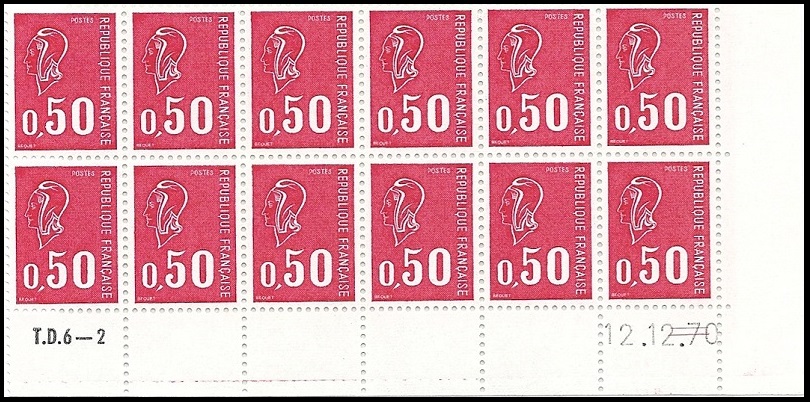
- dated plate block of 12 stamps from the 3rd printing with the cylinder C
Les traits sont à sec à partir du 23.12.70
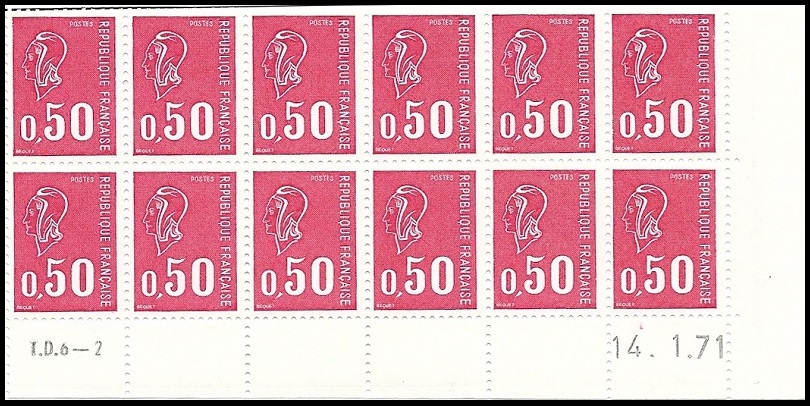
- dated plate block of 12 stamps from the 3rd printing with the cylinder C with the two lines dry printed
- cylindre H, du 10.2.71 au 17.4.71, timbres sans barre phosphorescente
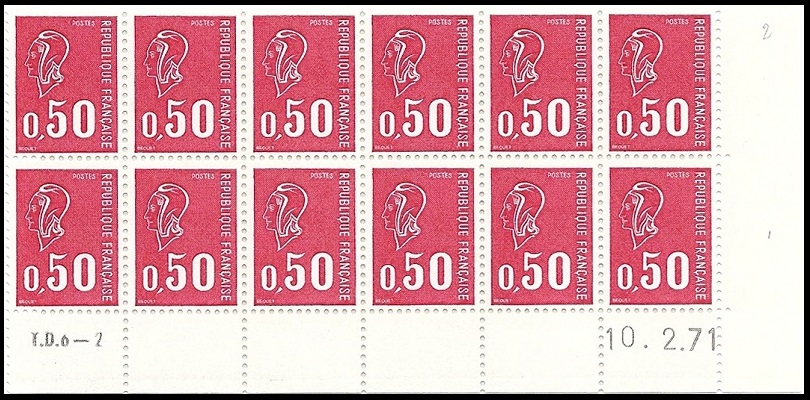
- dated plate block of 12 stamps from the 3rd printing with the cylinder H
- cylindre I, du 22.4.71 au 31.8.71, timbres sans barre phosphorescente
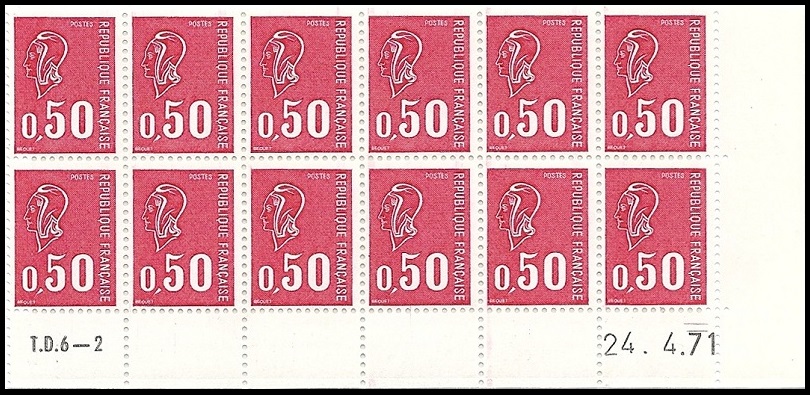
- dated plate block of 12 stamps from the 3rd printing with the cylinder I
- cylindre G, du 3.9.71 au 14.9.71, timbres sans barre phosphorescente
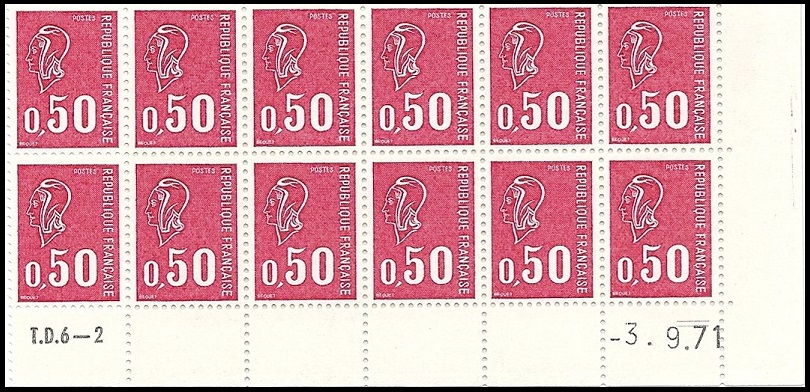
- dated plate block of 12 stamps from the 3rd printing with the cylinder G
- cylindre K, du 20.9.71 au 12.10.71, timbres sans barre phosphorescente
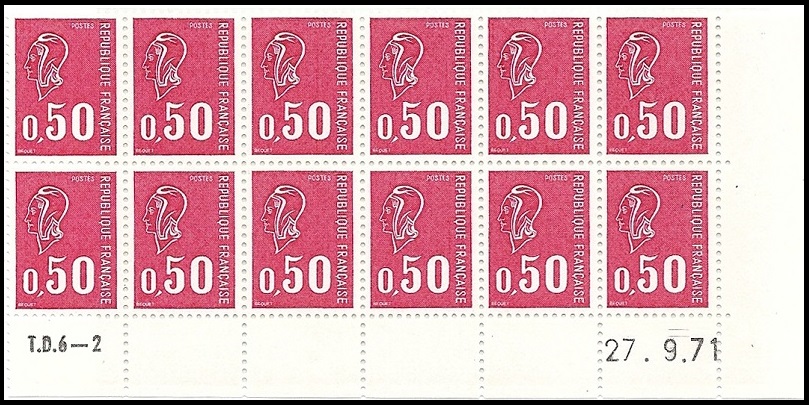
- dated plate block of 12 stamps from the 3rd printing with the cylinder K
- cylindre L, du 13.10.71 au 5.11.71, timbres sans barre phosphorescente
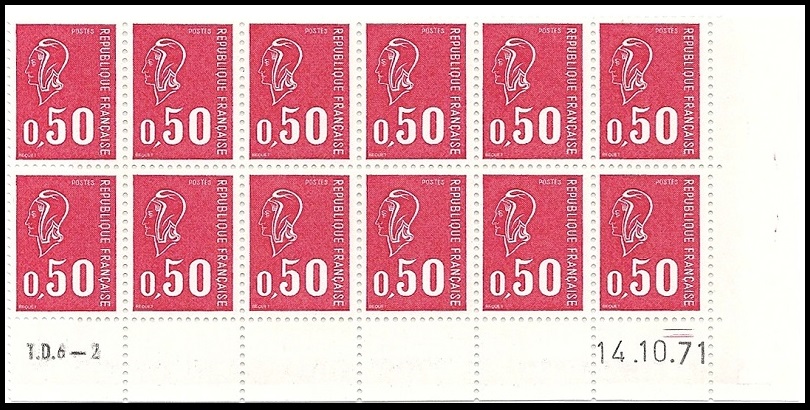
- dated plate block of 12 stamps from the 3rd printing with the cylinder L
4ème tirage, sur la presse TD6-1
- cylindre A, du 15.12.70 au 23.12.70, timbres avec 3 barres phosphorescentes au type A
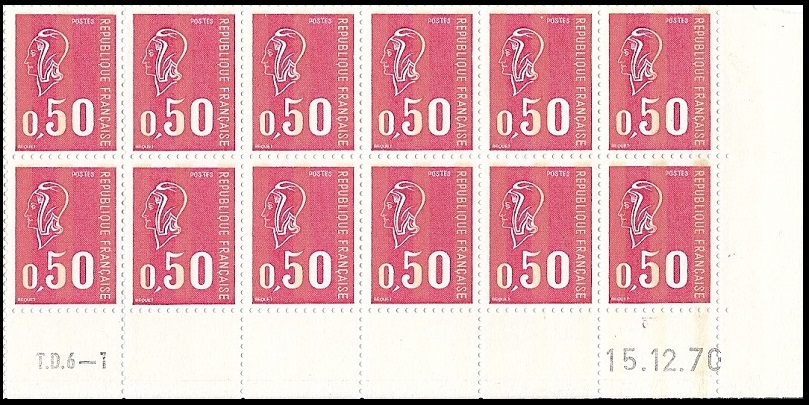
- dated plate block of 12 stamps from the 4th printing with the cylinder A, first printing day with type A phosphor bands
5ème tirage, sur la presse TD6-3
- cylindre D, du 22.12.70 au 16.1.71, timbres sans barre phosphorescente
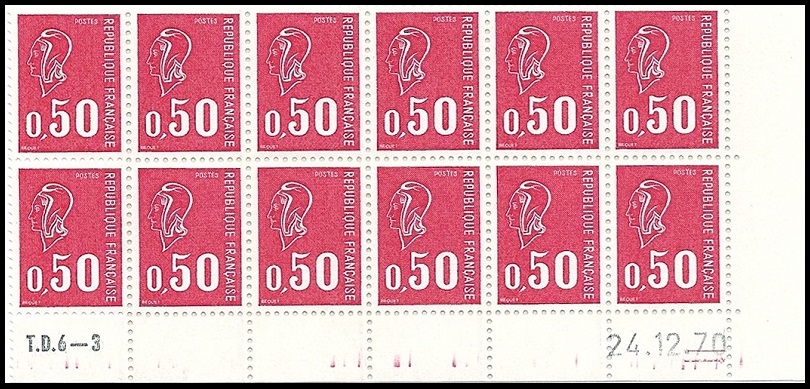
- dated plate block of 12 stamps from the 5th printing with the cylinder D
6ème tirage, sur la presse TD6-4
- cylindre G, du 7.1.71 au 18.1.71, timbres sans barre phosphorescente
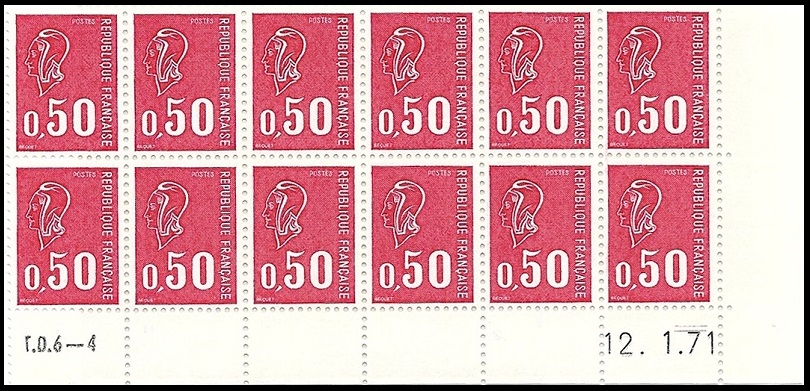
- dated plate block of 12 stamps from the 6th printing with the cylinder G
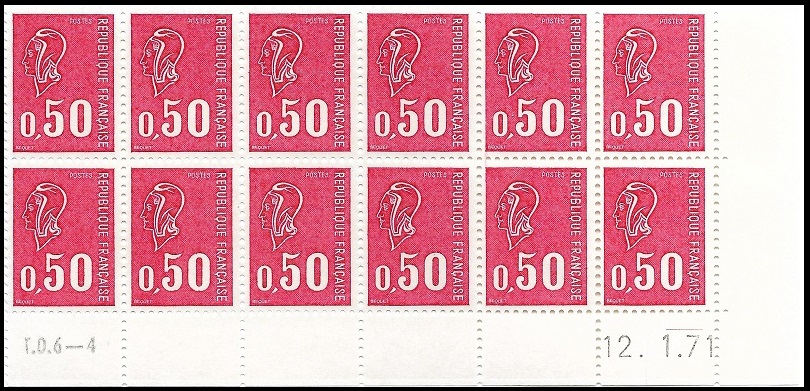
- dated plate block of 12 stamps from the 6th printing with the cylinder G with only one line
9ème tirage, sur la presse TD6-1
- 1ère partie
- cylindre A, du 28.12.70 au 4.1.71, timbres sans barre phosphorescente
les timbres sont surchargés 25F C.F.A., avec gomme métropolitaine, les 28, 29 et 30.12.70
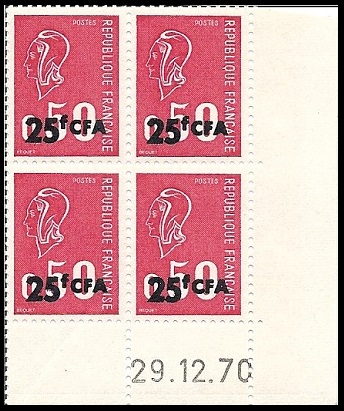
- dated plate block of 4 stamps from the 9th printing with the cylinder A overprinted 25F CFA
- cylindre A, du 28.12.70 au 4.1.71, timbres sans barre phosphorescente
- 2ème partie
- cylindre G, du 25.1.71 au 26.1.71, timbres sans barre phosphorescente
une partie des timbres du 25 et du 26.1.71 sont surchargés 25F C.F.A., avec gomme métropolitaine
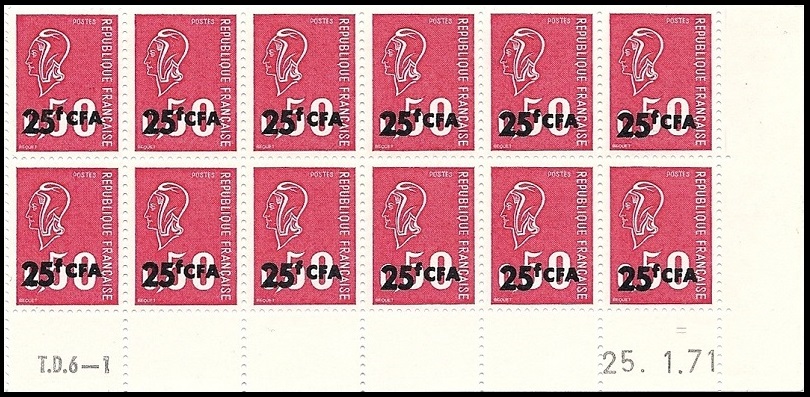
- dated plate block of 12 stamps from the 9th printing with the cylinder G overprinted 25F CFA
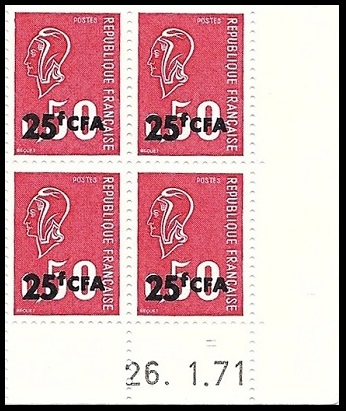
- corner dated block of 4 stamps from the 9th printing with the cylinder G overprinted 25F CFA
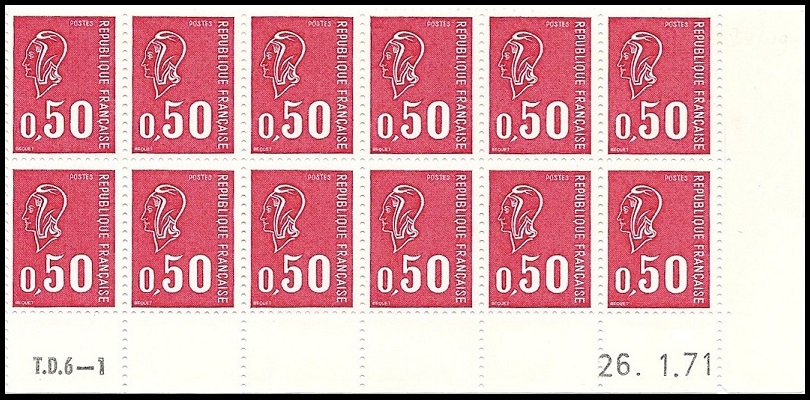
- corner dated block of 12 stamps from the 9th printing of the 26.1.71 with the cylinder G non overprinted
- cylindre G, du 25.1.71 au 26.1.71, timbres sans barre phosphorescente
10ème tirage, sur la presse TD6-4
- cylindre A, du 3.5.71 au 18.6.71, timbres sans barre phosphorescente
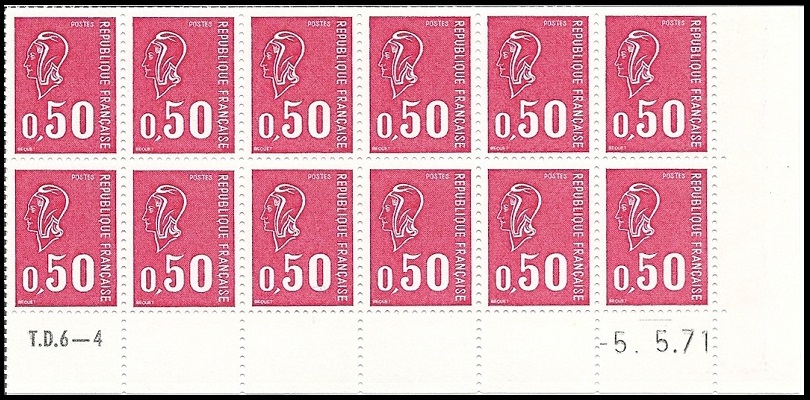
- dated plate block of 12 stamps from the 10th printing with the cylinder A
- cylindre C, du 21.6.71 au 2.9.71, timbres sans barre phosphorescente
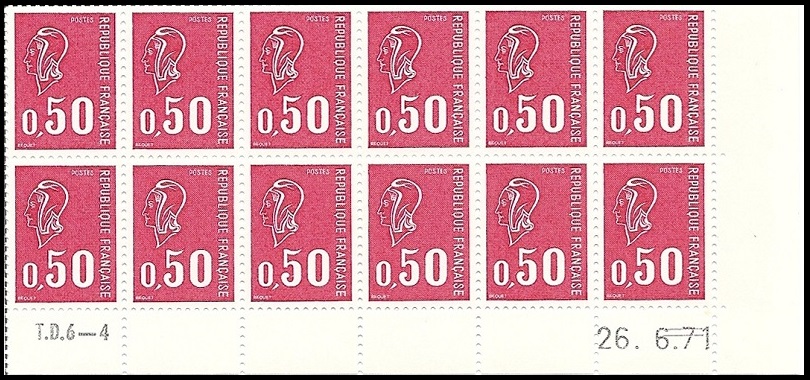
- dated plate block of 12 stamps from the 10th printing with the cylinder C
11ème tirage, sur la presse TD6-1
- cylindre H, du 26.8.71 au 9.9.71, timbres avec 3 barres phosphorescentes au type A
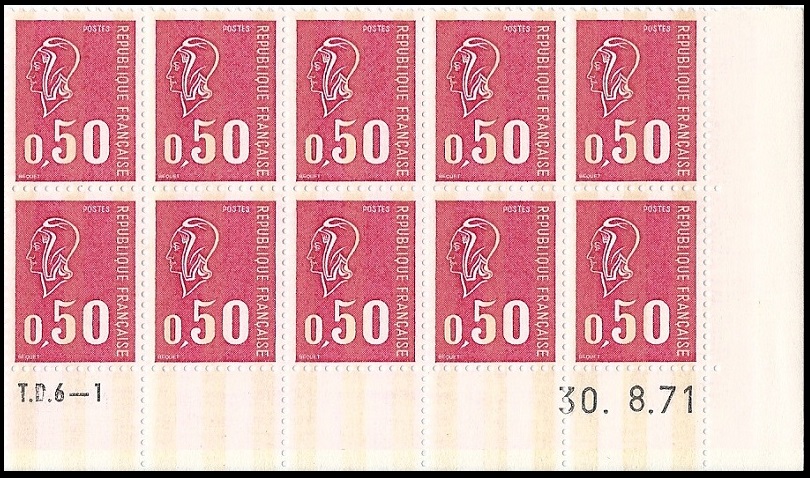
- dated plate block of 12 stamps from the11th printing with the cylinder H
- cylindre A, du 17.9.71 au 11.10.71, timbres avec 3 barres phosphorescentes au type A
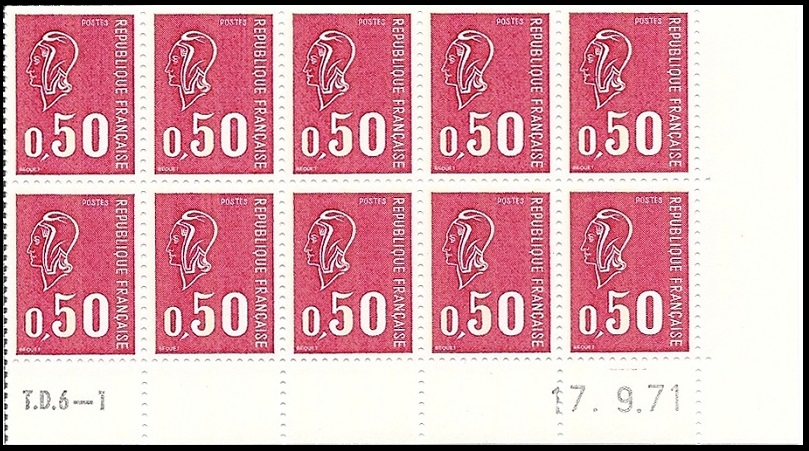
- dated plate block of 12 stamps from the 11th printing with the cylinder A
Les traits sont souvent à sec à partir du 28.9.71. - cylindre H, du 13.10.71 au 25.10.71, timbres avec 3 barres phosphorescentes au type A
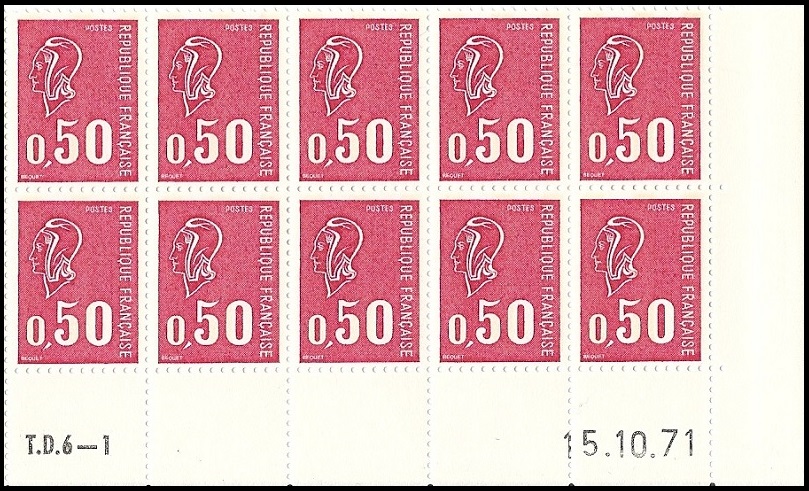
- dated plate block of 12 stamps from the 11th printing with the cylinder H
- cylindre G, du 27.10.71 au 20.11.71, timbres avec 3 barres phosphorescentes au type A
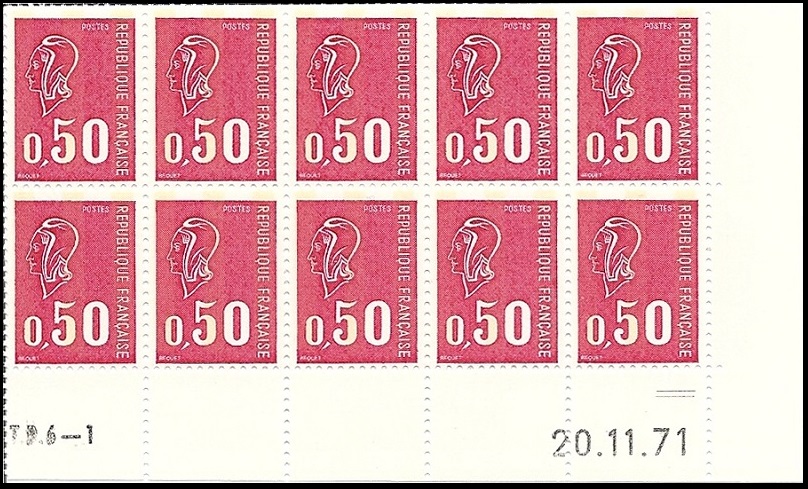
- dated plate block of 12 stamps from the 11th printing with the cylinder G
12ème tirage, sur la presse TD6-3
- cylindre C, le 9.9.71, timbres sans barre phosphorescente
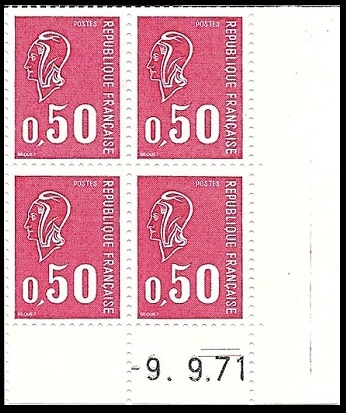
- dated plate block of 4 stamps from the 13th printing with the cylinder C
- cylindre J, du 14.9.71 au 17.9.71, timbres sans barre phosphorescente
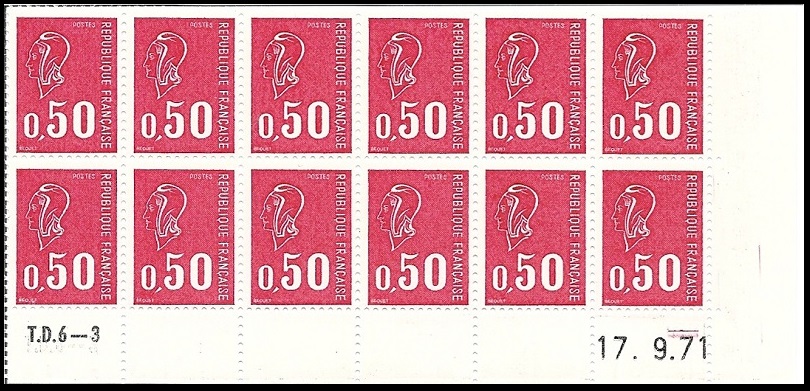
- dated plate block of 12 stamps from the 12th printing with the cylinder J
13ème tirage, sur la presse TD6-4
- 1ère partie
- cylindre K, du 16.10.71 au 2.12.71, timbres sans barre phosphorescente
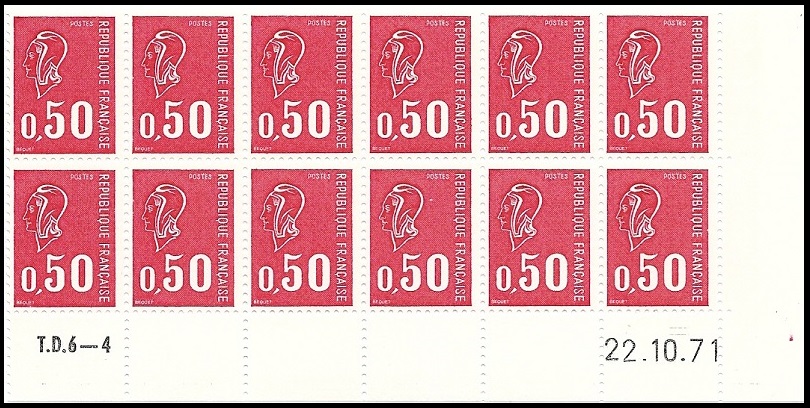
- dated plate block of 12 stamps from the 13th printing with the cylinder K
- cylindre N, du 4.12.71 au 22.12.71, timbres sans barre phosphorescente
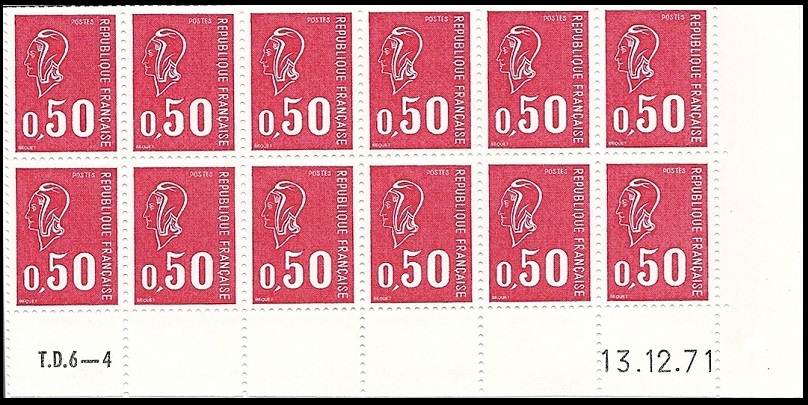
- dated plate block of 12 stamps from the 13th printing with the cylinder N
Les traits sont à sec.
- cylindre K, du 16.10.71 au 2.12.71, timbres sans barre phosphorescente
- 2ème partie
- cylindre O, du 21.1.72 au 22.2.72, timbres sans barre phosphorescente
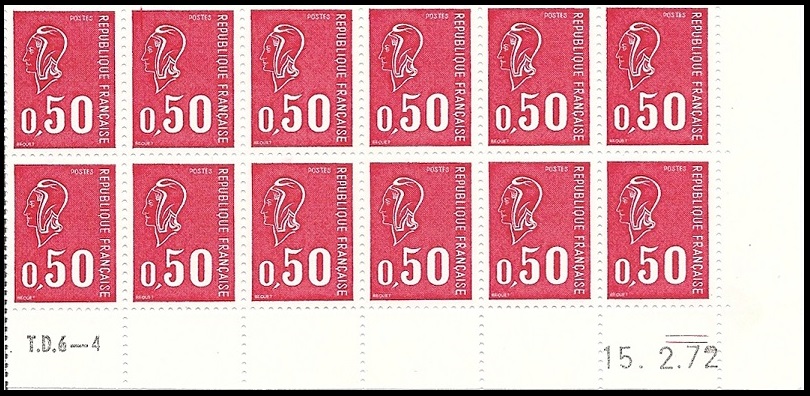
- dated plate block of 12 stamps from the 13th printing with the cylinder O
Les traits sont à sec jusqu’au 14.2.72.
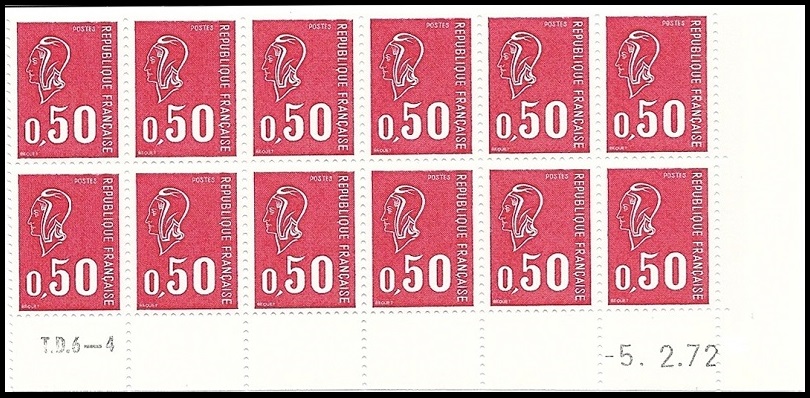
- dated plate block of 12 stamps from the 13th printing with the cylinder O with the two lines dry printed
- cylindre C, du 24.2.72 au 13.4.72, timbres sans barre phosphorescente
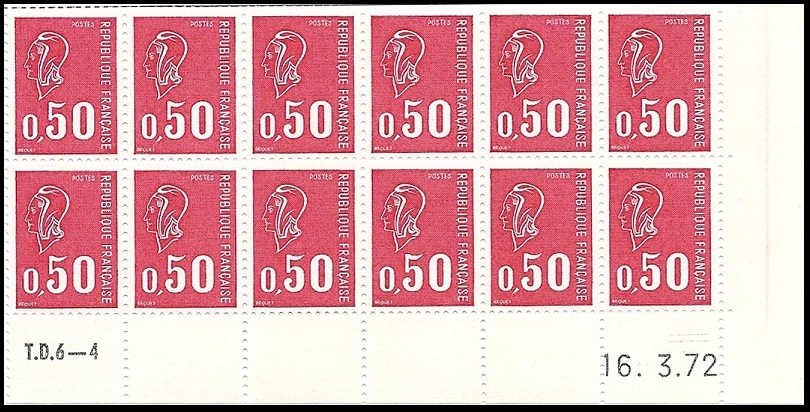
- dated plate block of 12 stamps from the 13th printing with the cylinder C
Les traits sont à sec du 7 au 13.3.72. - cylindre Q, du 17.4.72 au 21.4.72, timbres sans barre phosphorescente
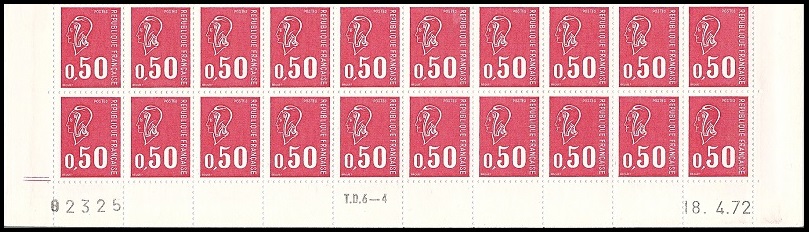
- dated plate block of 12 stamps from the 13th printing with the cylinder Q (the two lines are located on the left block corner)
- cylindre R, du 2.5.72 au 10.6.72, timbres sans barre phosphorescente
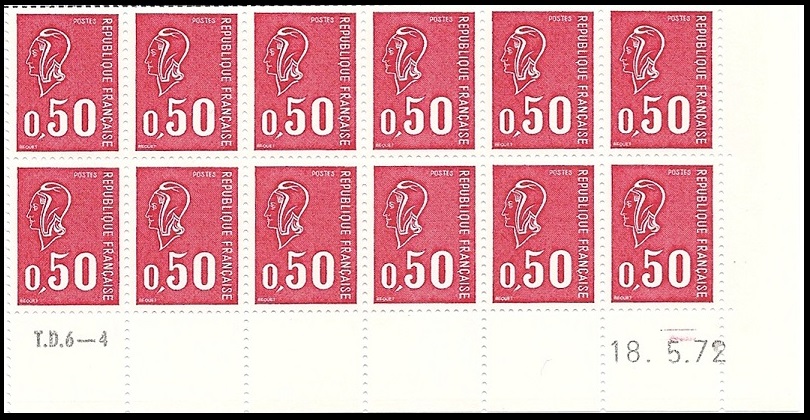
- dated plate block of 12 stamps from the 13th printing with the cylinder R
- cylindre O, du 21.1.72 au 22.2.72, timbres sans barre phosphorescente
14ème tirage, sur la presse TD6-5
- cylindre M, du 23.11.72 au 18.1.73, timbres sans barre phosphorescente
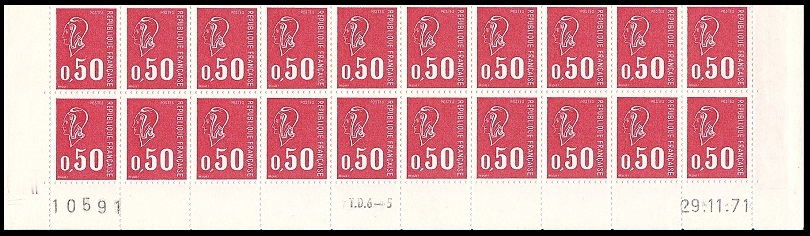
- dated plate block of 20 stamps from the 14th printing with the cylinder M (the two lines are located on the left block corner)
Les traits sont à sec, dans le coin gauche.
15ème tirage, sur la presse TD6-3
- cylindre N, du 20.1.72 au 24.1.72, timbres sans barre phosphorescente
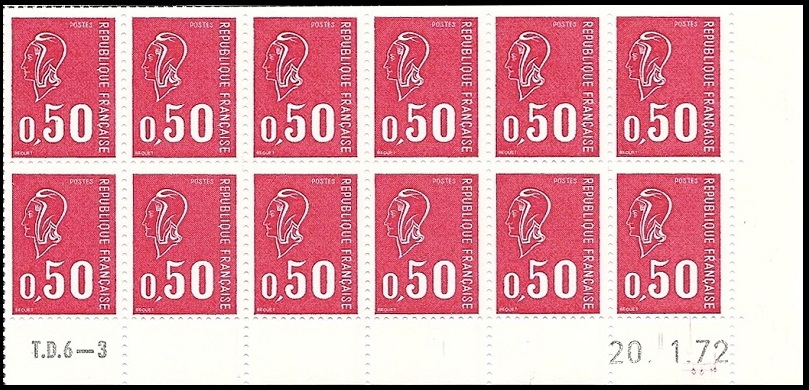
- dated plate block of 12 stamps from the 15th printing with the cylinder N
Il existe deux griffes verticales sous le 100ème timbre, à la hauteur du chiffre 5. - cylindre R, du 26.1.72 au 27.1.72, timbres sans barre phosphorescente
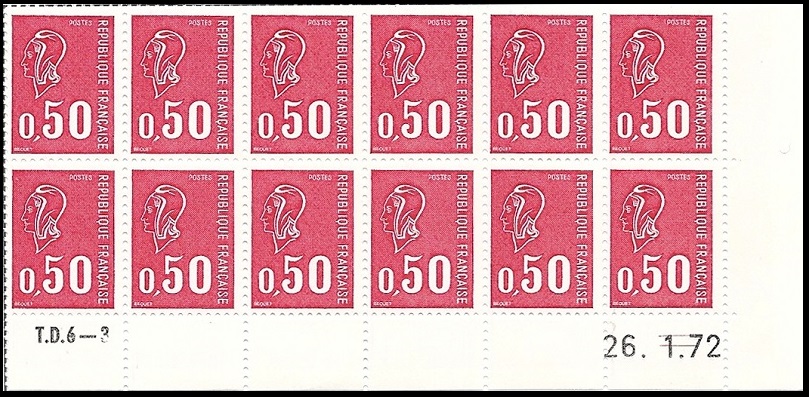
- dated plate block of 12 stamps from the 15th printing with the cylinder R
- cylindre P, du 31.1.72 au 10.3.72, timbres sans barre phosphorescente
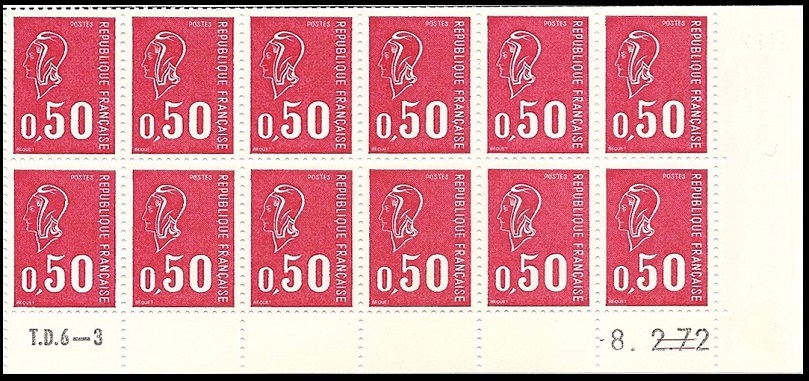
- dated plate block of 12 stamps from the 15th printing with the cylinder P
16ème tirage, sur la presse TD6-7
- cylindre S, du 17.5.72 au 29.9.72, timbres sans barre phosphorescente
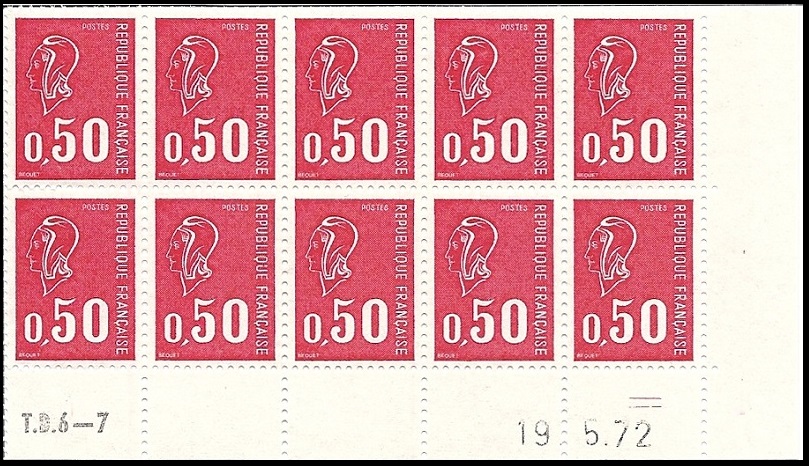
- dated plate block of 10 stamps from the 15th printing with the cylinder S
17ème tirage, sur la presse TD6-4
- cylindre R, du 12.6.72 au 16.6.72, timbres avec 3 barres phosphorescentes au type A
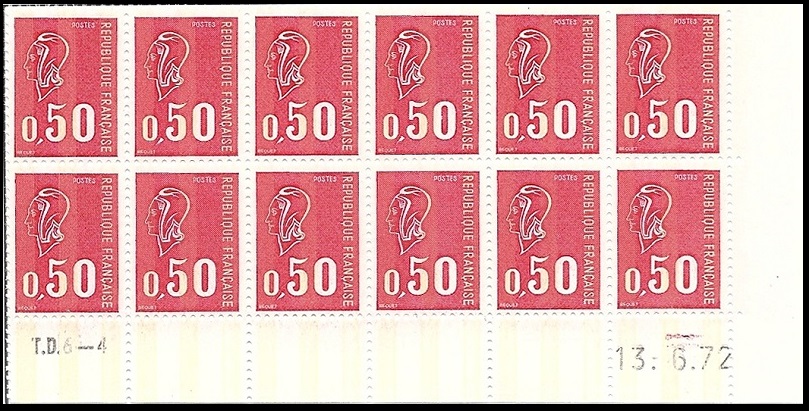
- dated plate block of 12 stamps from the 17th printing with the cylinder R
- cylindre T, du 19.6.72 au 21.7.72, timbres avec 3 barres phosphorescentes au type A
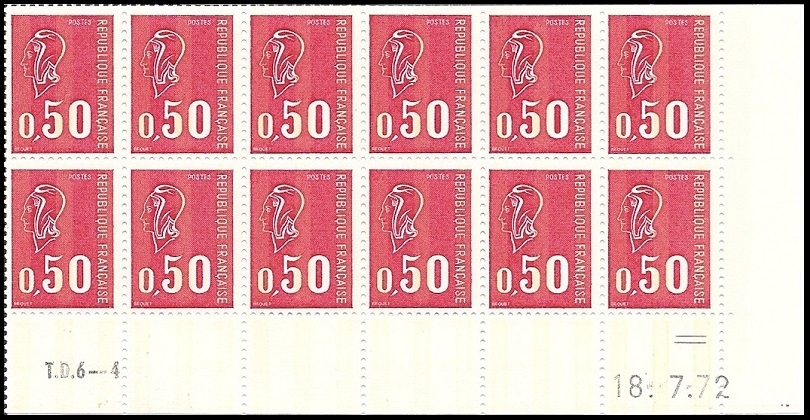
- dated plate block of 12 stamps from the 17th printing with the cylinder T
Les traits ne sont bien encrés qu’à partir du 29.6.72.
18ème tirage, sur la presse TD6-4
- 1ère partie
- cylindre T, du 28.7.72 au 11.8.72, timbres sans barre phosphorescente
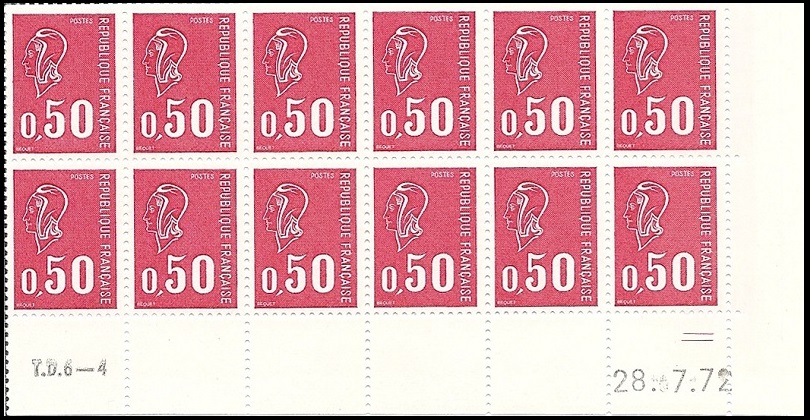
- dated plate block of 12 stamps from the 18th printing with the cylinder T
- cylindre T, du 28.7.72 au 11.8.72, timbres sans barre phosphorescente
- 2ème partie
- cylindre Q, du 7.9.72 au 15.9.72, timbres sans barre phosphorescente
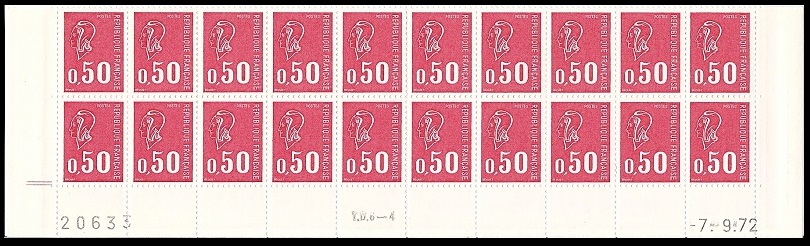
- dated plate block of 20 stamps from the 18th printing with the cylinder Q
- cylindre U, du 18.9.72 au 10.11.72, timbres sans barre phosphorescente
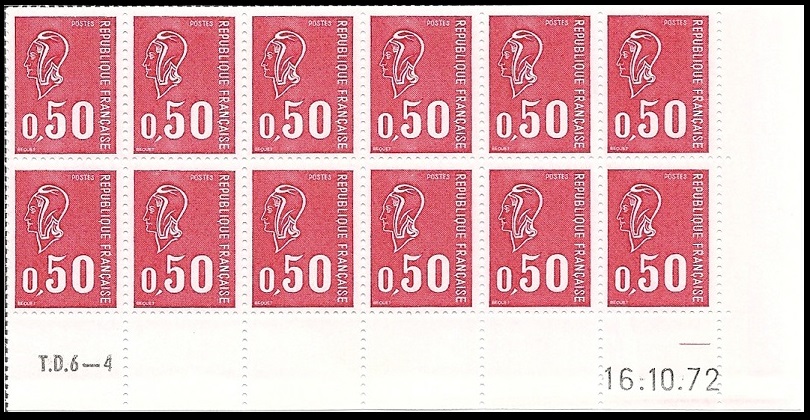
- dated plate block of 12 stamps from the 18th printing with the cylinder U
Le trait supérieur est encré à partir du 3.10.72
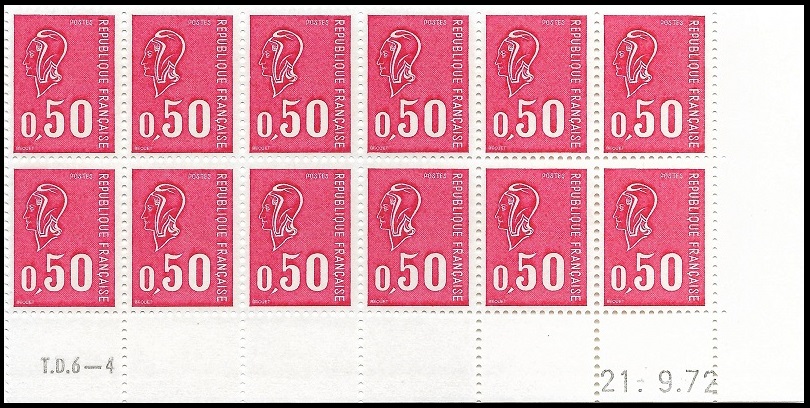
- dated plate block of 12 stamps from the 18th printing with the cylinder U
- cylindre S, du 13.11.72 au 4.12.72, timbres sans barre phosphorescente
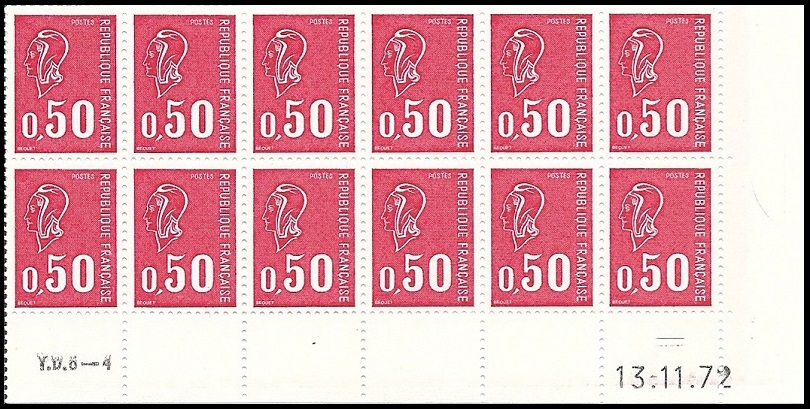
- dated plate block of 12 stamps from the 2nd part of the 18th printing with the cylinder S
- cylindre Q, du 7.9.72 au 15.9.72, timbres sans barre phosphorescente
- 3ème partie
- cylindre S, du 14.12.72 au 23.12.72, timbres sans barre phosphorescente
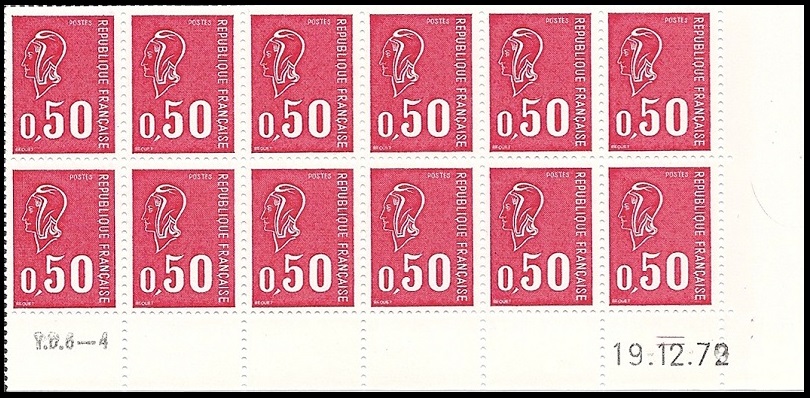
- dated plate block of 12 stamps from the 3rd part of the 18th printing with the cylinder S
- cylindre S, du 14.12.72 au 23.12.72, timbres sans barre phosphorescente
19ème tirage, sur la presse TD6-4
- cylindre T, les 28.8.72 et 29.8.72, timbres avec 3 barres phosphorescentes au type A
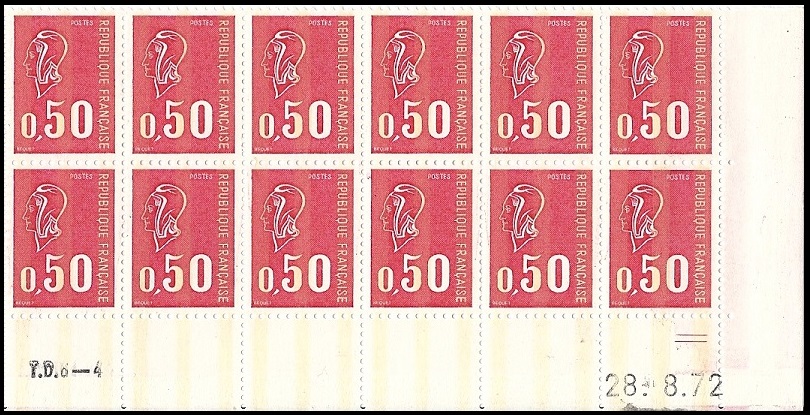
- dated plate block of 20 stamps from the 19th printing with the cylinder T
- cylindre Q, du 31.8.72 au 5.9.72, timbres avec 3 barres phosphorescentes au type A
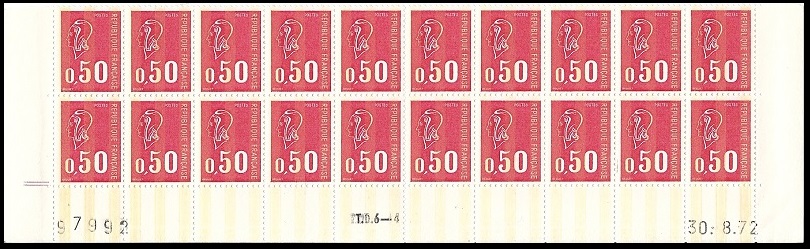
- dated plate block of 20 stamps from the 19th printing with the cylinder Q
20ème tirage, sur la presse TD6-1
- 1ère partie
- cylindre Q, du 11.10.72 au 27.11.72, timbres sans barre phosphorescente
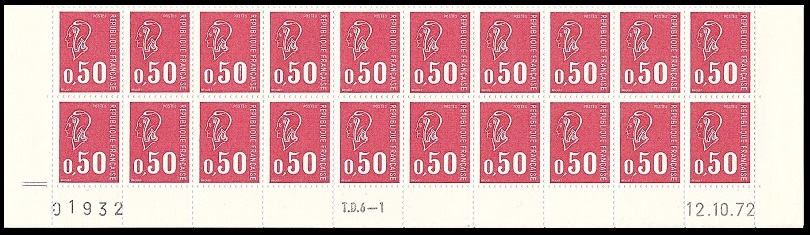
- dated plate block of 20 stamps from the 1st part of the 20th printing with the cylinder Q
- cylindre Q, du 11.10.72 au 27.11.72, timbres sans barre phosphorescente
- 2ème partie
- cylindre Q , du 20.12.72 au 3.1.73, timbres sans barre phosphorescente
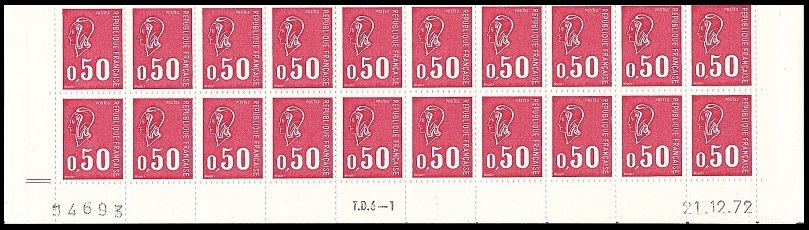
- dated plate block of 20 stamps from the 2nd part of the 20th printing with the cylinder Q
- cylindre Q , du 20.12.72 au 3.1.73, timbres sans barre phosphorescente
21ème tirage, sur la presse TD6-4
- 1ère partie
- cylindre S, le 5.12.72, timbres avec 3 barres phosphorescentes au type A
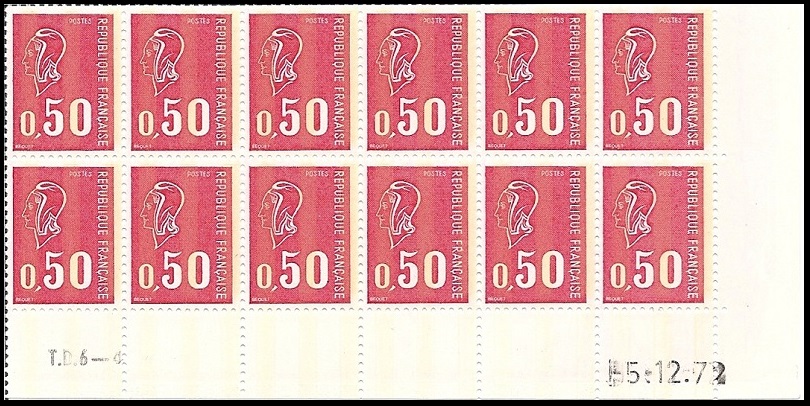
- dated plate block of 12 stamps from the 1st part of the 21st printing with the cylinder S
- cylindre S, le 5.12.72, timbres avec 3 barres phosphorescentes au type A
- 2ème partie
- cylindre S, du 27.12.72 au 13.1.73, timbres avec 3 barres phosphorescentes au type A
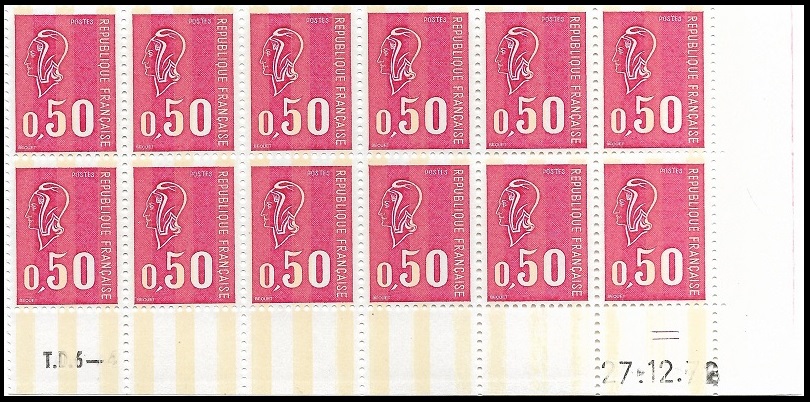
- dated plate block of 12 stamps from the 2nd part of the 21st printing with the cylinder S
- cylindre V, du 16.1.73 au 6.2.73, timbres avec 3 barres phosphorescentes au type D
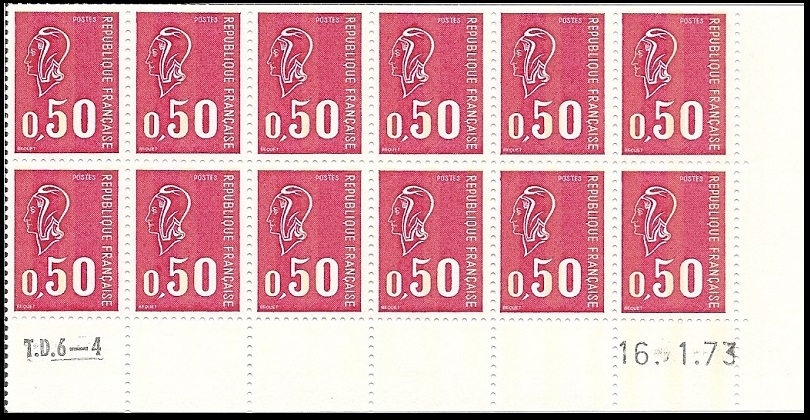
- dated plate block of 12 stamps from the 21st printing with the cylinder V
Traits à peine grattés et à sec.
- cylindre S, du 27.12.72 au 13.1.73, timbres avec 3 barres phosphorescentes au type A
22ème tirage, sur la presse TD6-7
- cylindre Q, du 6.1.73 au 9.1.73, timbres sans barre phosphorescente
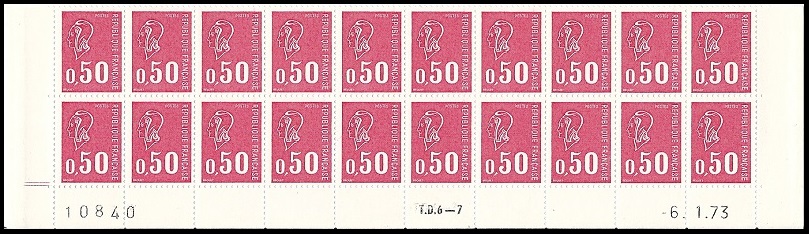
- dated plate block of 20 stamps from the 22nd printing with the cylinder Q
- cylindre W, du 16.1.73 au 23.1.73, timbres sans barre phosphorescente
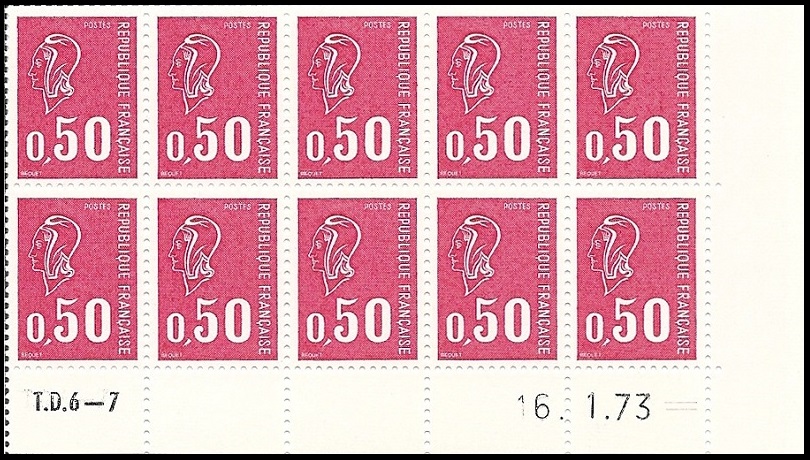
- dated plate block of 12 stamps from the 22nd printing with the cylinder W
- cylindre X, du 24.1.73 au 2.2.73, timbres sans barre phosphorescente
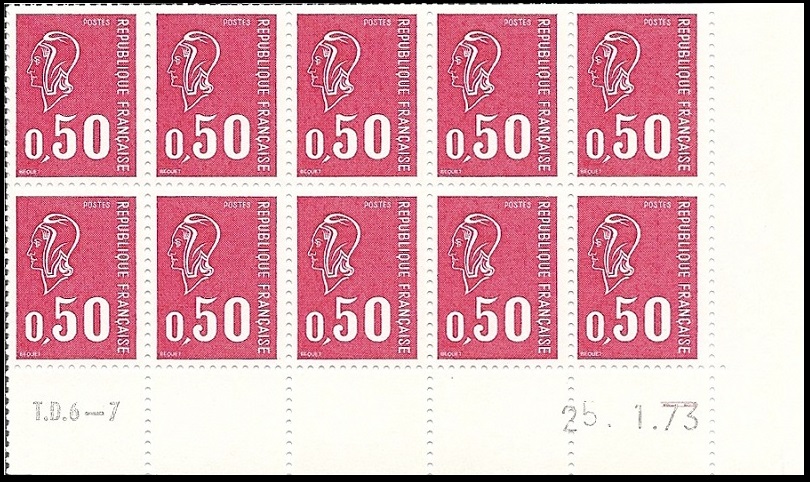
- dated plate block of 10 stamps from the 22nd printing with the cylinder X
- cylindre W, le 6.2.73, timbres sans barre phosphorescente
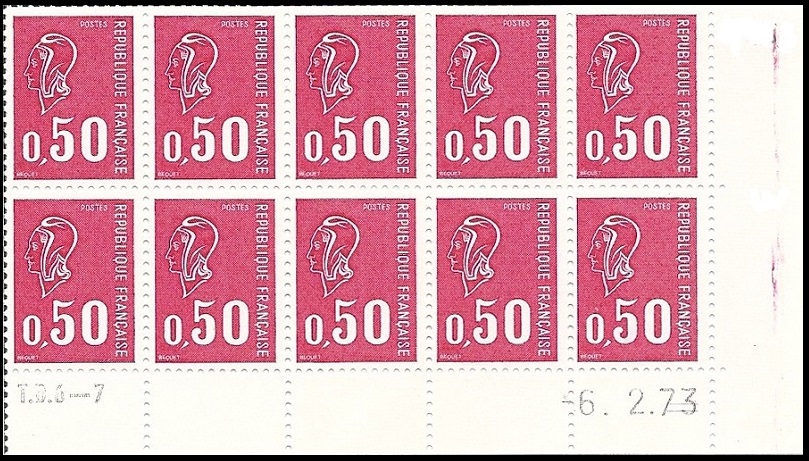
- dated plate block of 12 stamps from the 22nd printing with the cylinder W
- cylindre X, du 8.2.73 au 14.2.73, timbres sans barre phosphorescente
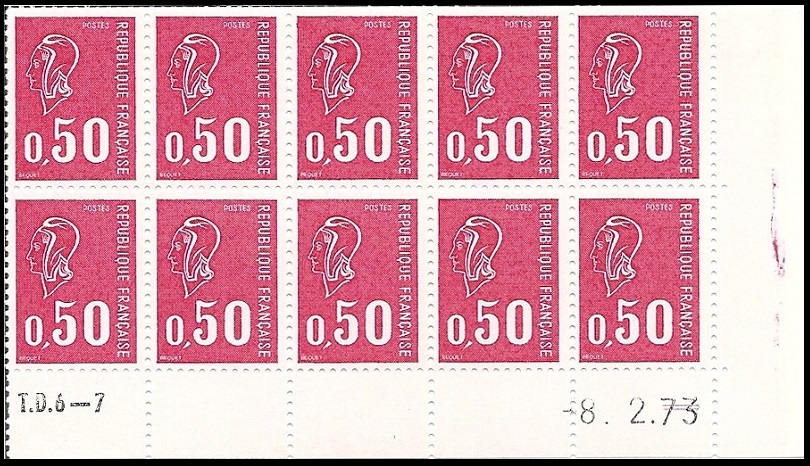
- dated plate block of 10 stamps from the 22nd printing with the cylinder X
- cylindre Y du 15.2.73 au 16.2.73, timbres sans barre phosphorescente
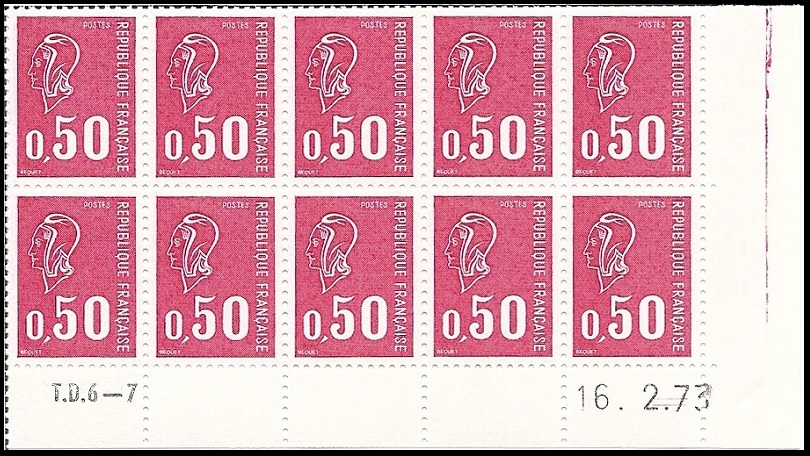
- dated plate block of 10 stamps from the 22nd printing with the cylinder Y
- cylindre X du 22.2.73 au 26.2.73, timbres sans barre phosphorescente
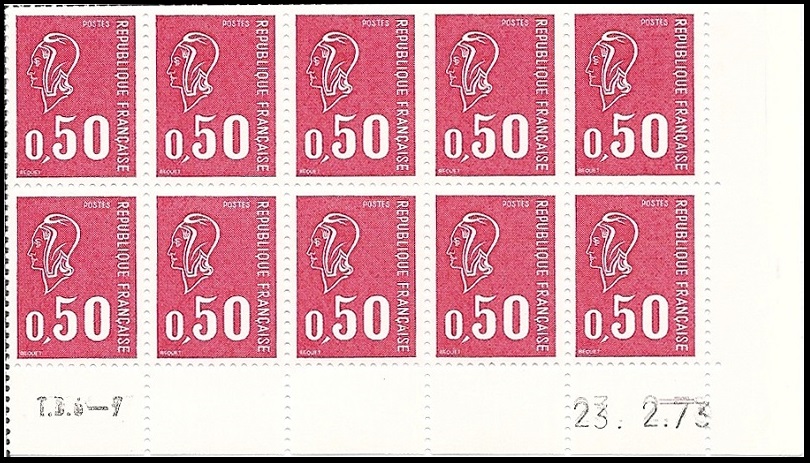
- dated plate block of 10 stamps from the 22nd printing with the cylinder X
- cylindre Z du 10.3.73 au 14.3.73, timbres sans barre phosphorescente
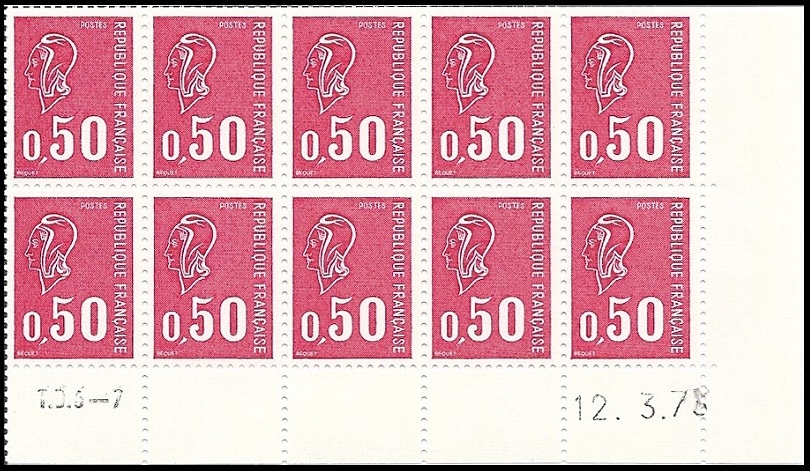
- dated plate block of 10 stamps from the 22nd printing with the cylinder Z
- cylindre AO, du 17.3.73 au 20.3.73, timbres sans barre phosphorescente
- cylindre AA, du 22.3.73 au 27.4.73, timbres sans barre phosphorescente
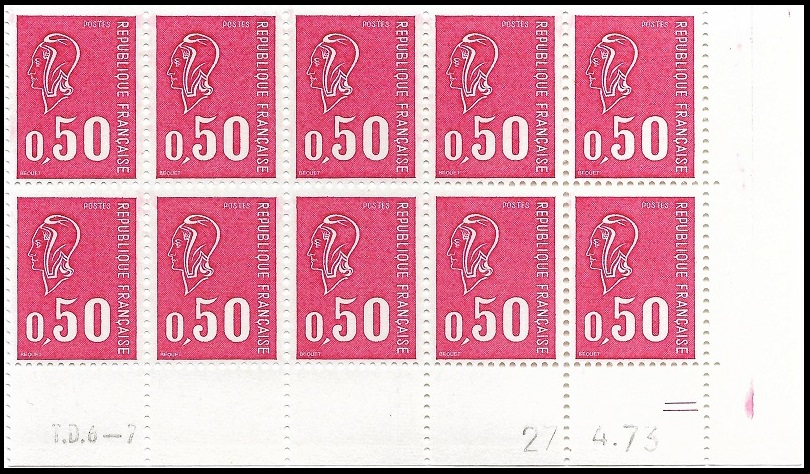
- dated plate block of 10 stamps from the 22nd printing with the cylinder AA
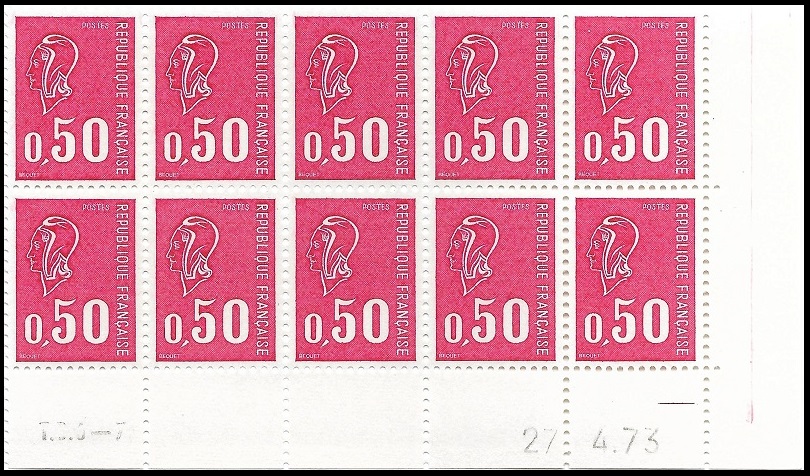
- dated plate block of 10 stamps from the 22nd printing with the cylinder AA
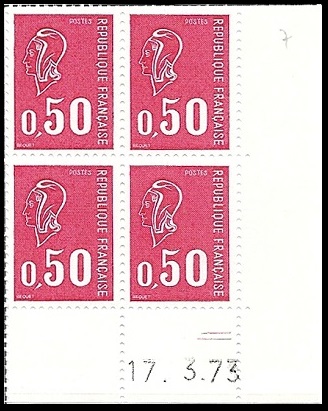
- cylindre AD, du 3.5.73 au 12.5.73, timbres sans barre phosphorescente
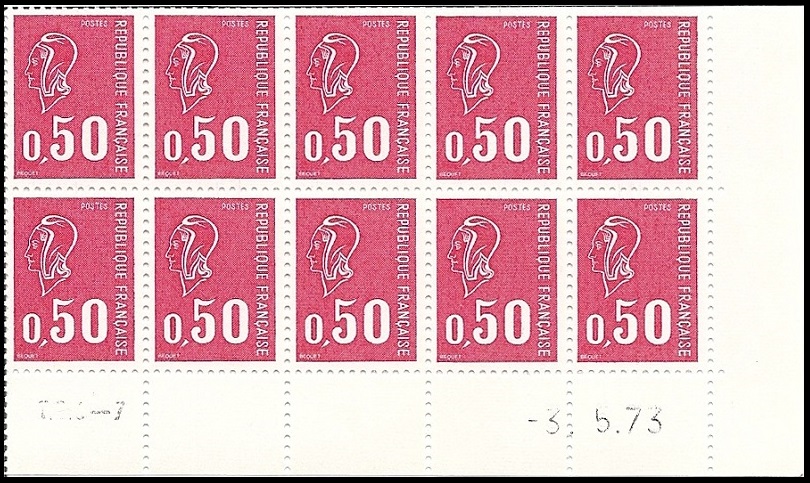
- dated plate block of 10 stamps from the 22nd printing with the cylinder AD
- cylindre P, du 16.5.73 au 18.5.73, timbres sans barre phosphorescente
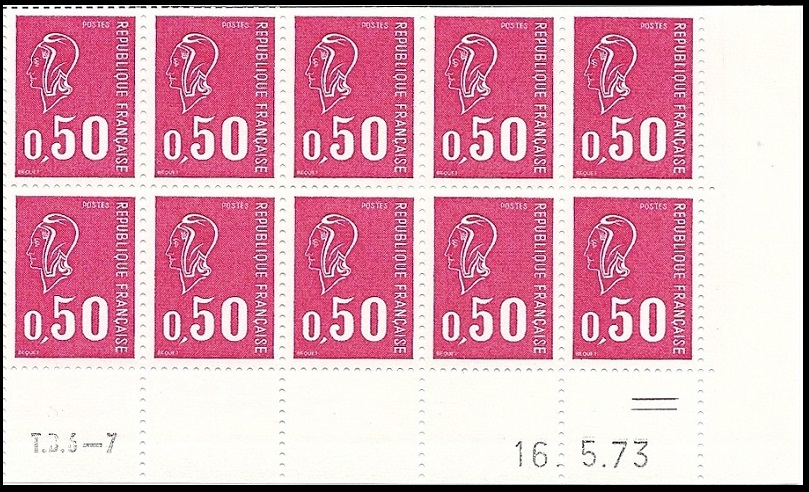
- dated plate block of 10 stamps from the 22nd printing with the cylinder P
23ème tirage, sur la presse TD6-6
- cylindre P, du 12.3.73 au 13.3.73, timbres avec 3 barres phosphorescentes au type D
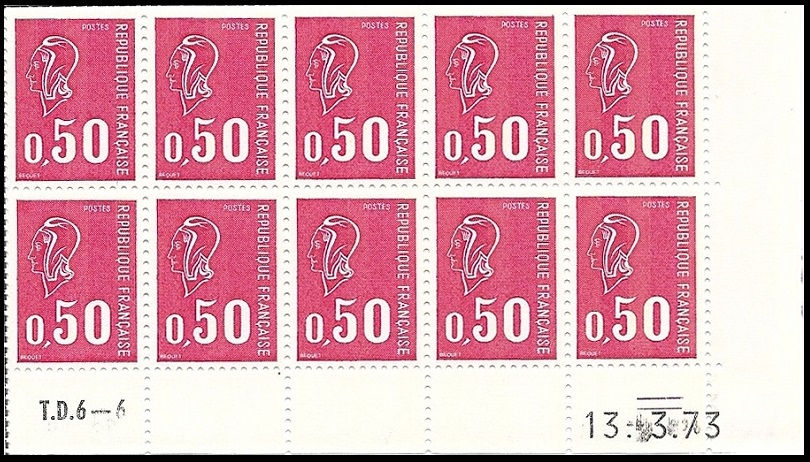
- dated plate block of 10 stamps from the 23rd printing with the cylinder P
24ème tirage, sur la presse TD6-4
- cylindre P, du 16.3.73 au 16.5.73, timbres avec 3 barres phosphorescentes au type D
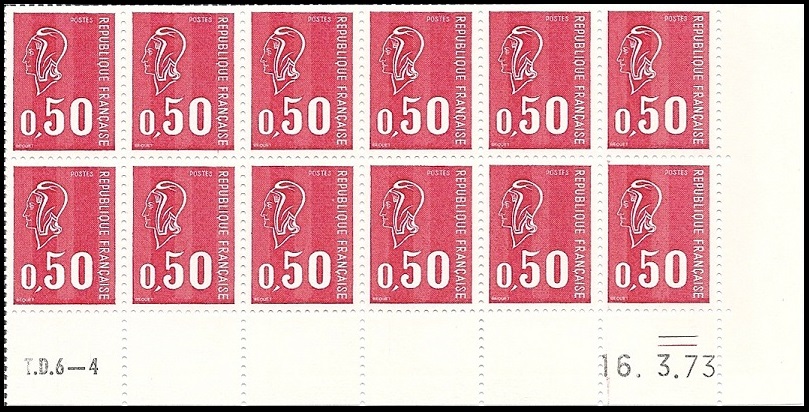
- dated plate block of 12 stamps from the 24th printing with the cylinder P
25ème tirage, sur la presse TD6-1
- cylindre AB, du 5.4.73 au 14.4.73, timbres sans barre phosphorescente
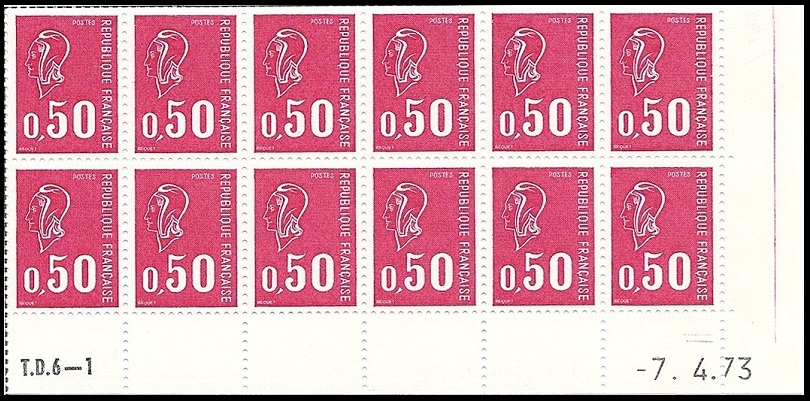
- dated plate block of 12 stamps from the 25th printing with the cylinder AB
- cylindre AC, du 16.4.73 au 3.5.73, timbres sans barre phosphorescente
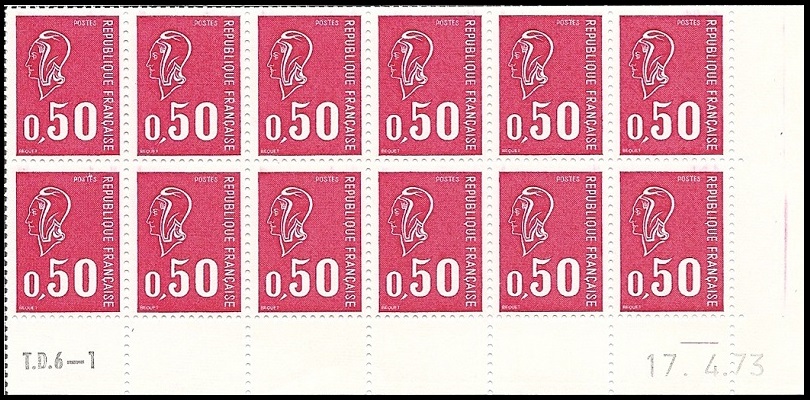
- dated plate block of 12 stamps from the 25th printing with the cylinder AC
- cylindre AB, du 4.5.73 au 15.5.73, timbres sans barre phosphorescente
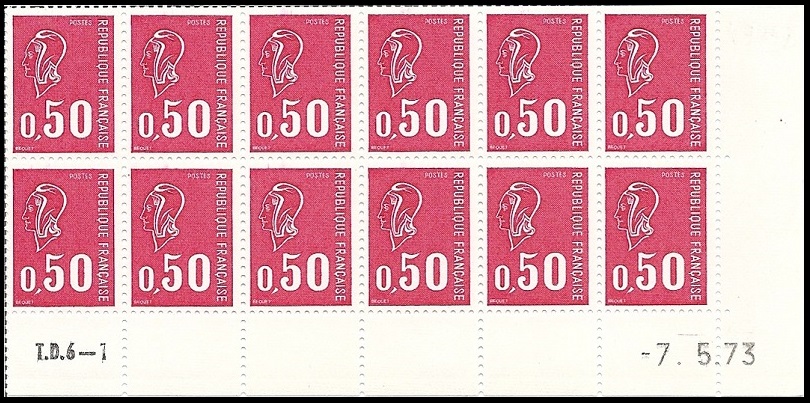
- dated plate block of 12 stamps from the 25th printing with the cylinder AB
Les 14 et 15.5.73, les timbres sont avec gomme tropicale et surchargés 25F C.F.A.. Cependant, il existe des timbres imprimés le 15.5.73 avec gomme tropicale et non surchargés 25F C.F.A.
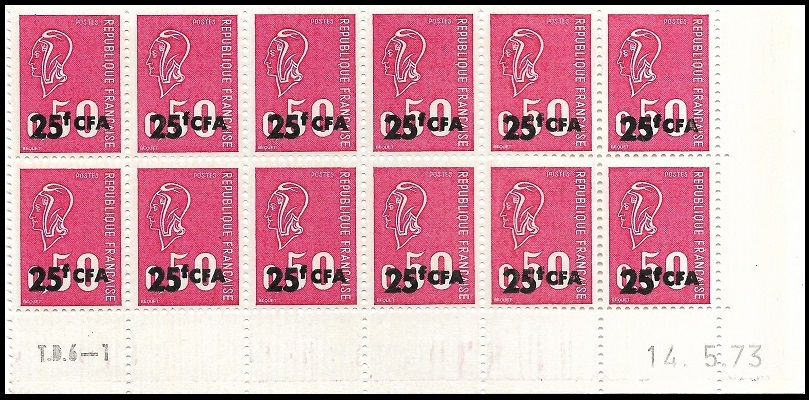
- dated plate block of 12 stamps from the 25th printing with the cylinder AB overprinted 25F CFA
26ème tirage, sur la presse TD6-4
- 1ère partie
- cylindre AB, du 18.6.73 au 3.7.73, timbres avec 3 barres phosphorescentes au type D
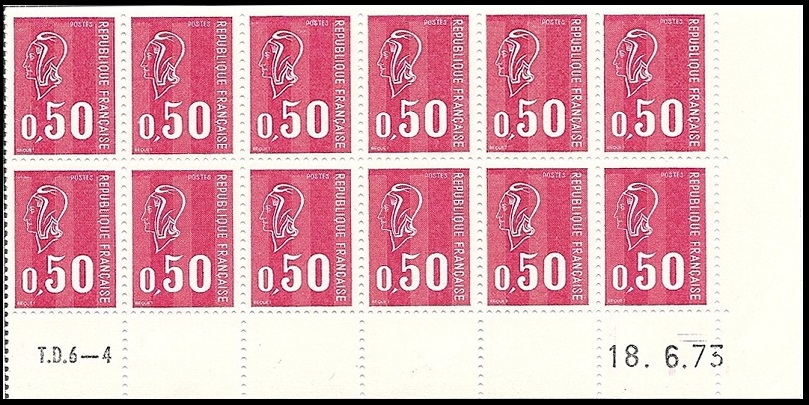
- dated plate block of 12 stamps from the 1st part of the 26th printing with the cylinder AB
- cylindre P, du 4.7.73 au 31.7.73, timbres avec 3 barres phosphorescentes au type D
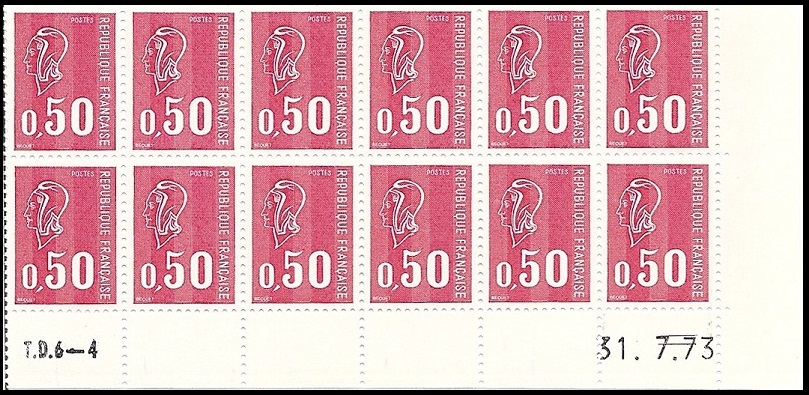
- dated plate block of 12 stamps from the 26th printing with the cylinder P
- cylindre AB, du 1.8.73 au 12.9.73, timbres avec 3 barres phosphorescentes au type D
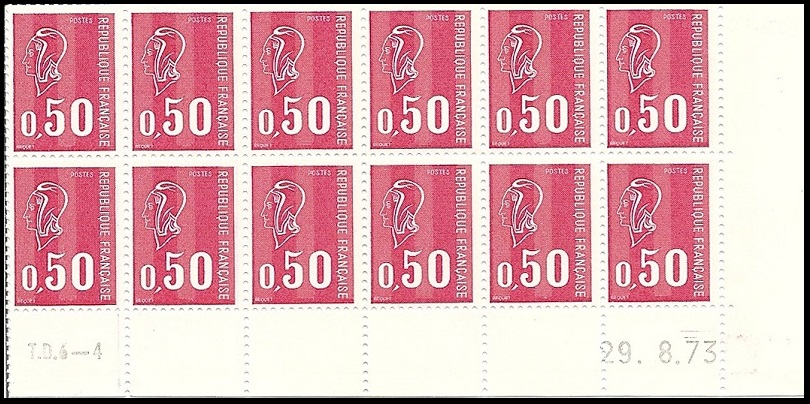
- dated plate block of 12 stamps from the 1st part of the 26th printing with the cylinder AB
- cylindre AE, du 13.9.73 au 3.10.73, timbres avec 3 barres phosphorescentes au type D
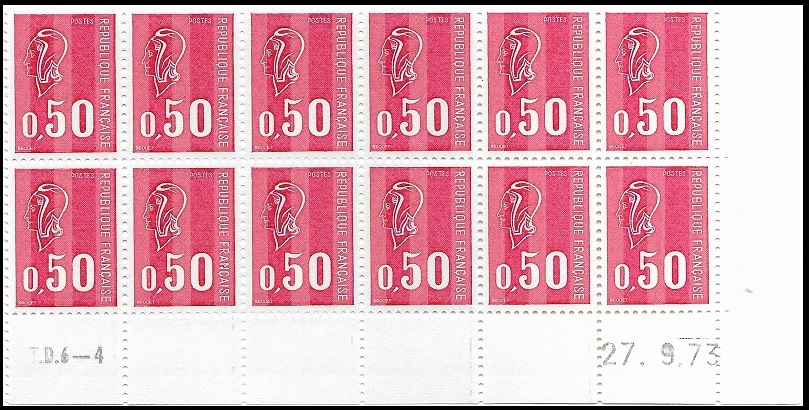
- dated plate block of 12 stamps from the 26th printing with the cylinder AE
- cylindre AB, du 5.10.73 au 8.10.73, timbres avec 3 barres phosphorescentes au type D
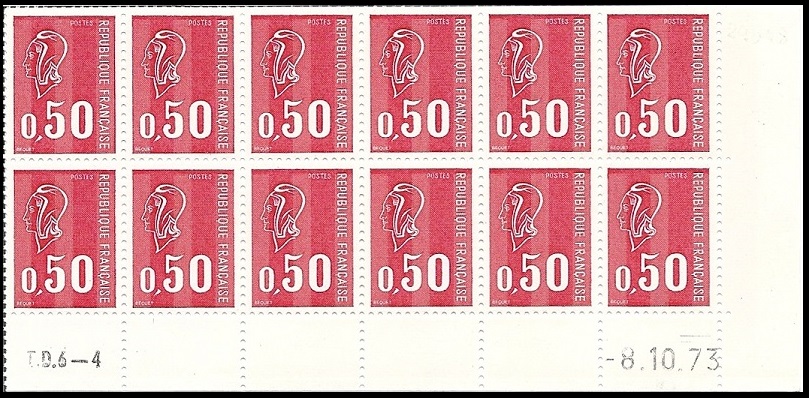
- dated plate block of 12 stamps from the 1st part of the 26th printing with the cylinder AB
- cylindre AG, du 9.10.73 au 17.11.73, timbres avec 3 barres phosphorescentes au type D
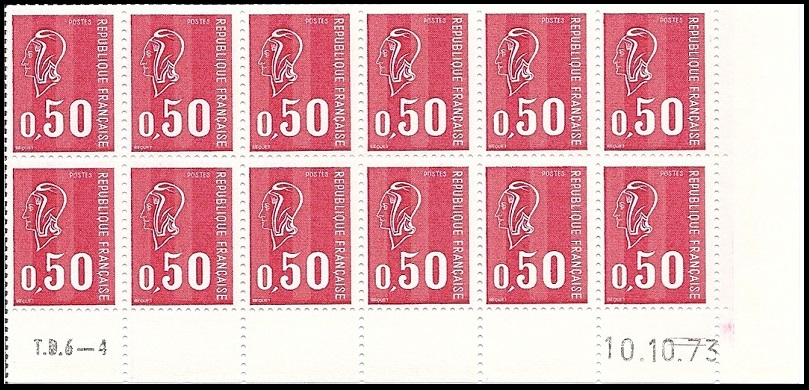
- dated plate block of 12 stamps from the 1st part of the 26th printing with the cylinder AG
- cylindre AH, du 19.11.73 au 30.11.73, timbres avec 3 barres phosphorescentes au type D
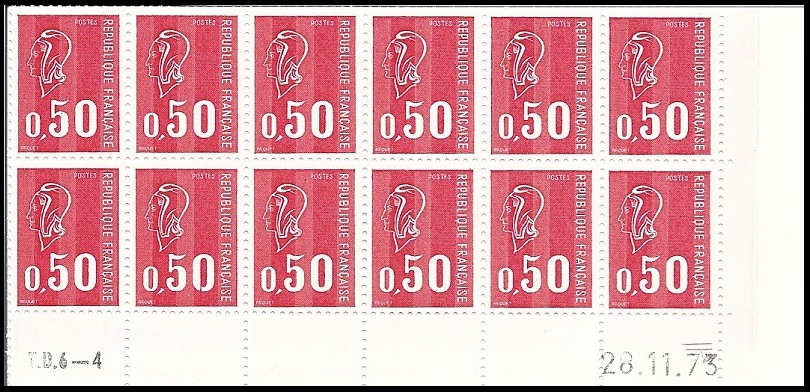
- dated plate block of 12 stamps from the 26th printing with the cylinder AH
- cylindre AG, du 5.12.73 au 14.12.73, timbres avec 3 barres phosphorescentes au type D
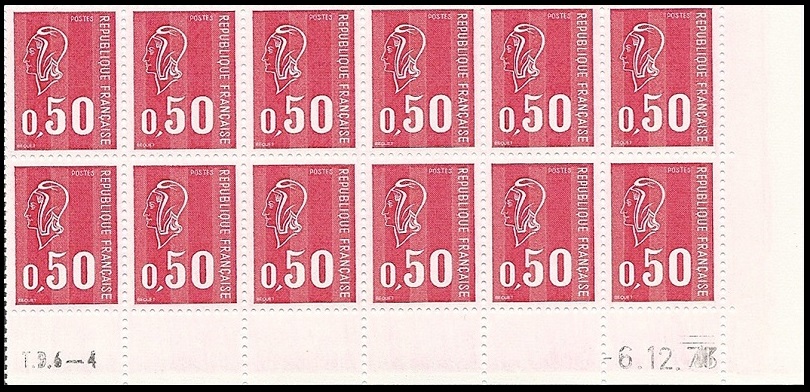
- dated plate block of 12 stamps from the 1st part of the 26th printing with the cylinder AG
- cylindre AK, du 17.12.73 au 1.2.74, timbres avec 3 barres phosphorescentes au type D
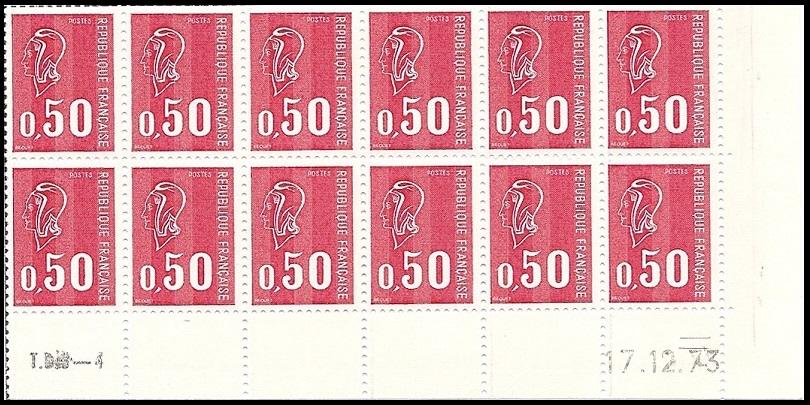
- dated plate block of 12 stamps from the 26th printing with the cylinder AK
- cylindre AL, du 1.2.74 au 5.3.74, timbres avec 3 barres phosphorescentes au type D
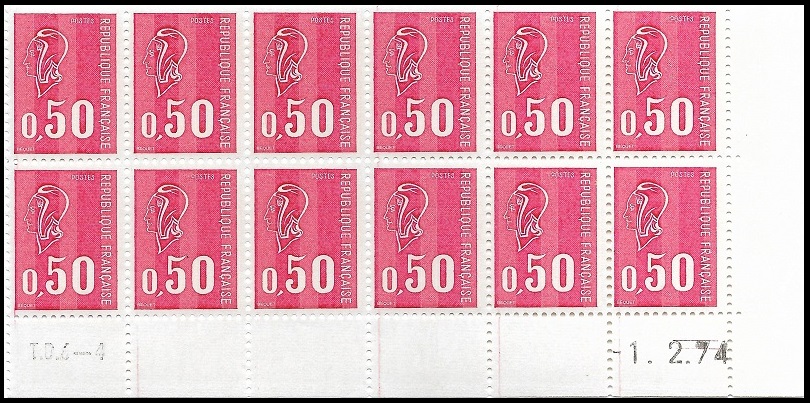
- dated plate block of 12 stamps from the 1st part of the 26th printing with the cylinder AL
Les traits sont à sec sauf les 1 et 2.2.74.
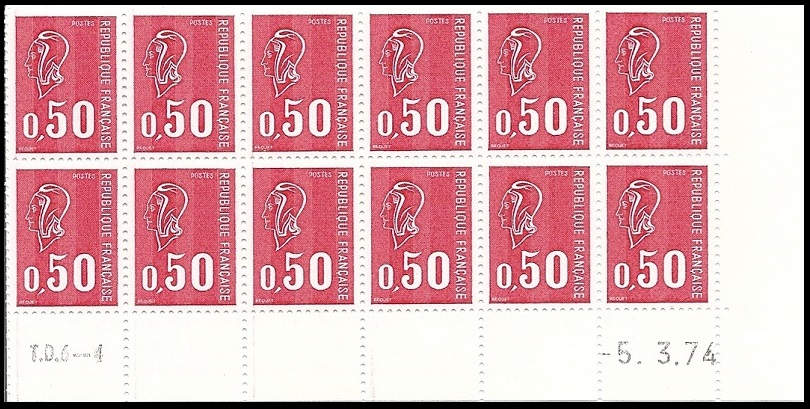
- dated plate block of 12 stamps from the 26th printing with the cylinder AL with the two lines dry printed
- cylindre AB, du 18.6.73 au 3.7.73, timbres avec 3 barres phosphorescentes au type D
- 2ème partie
- cylindre AL, du 14.3.74 au 29.3.74, timbres avec 3 barres phosphorescentes au type D
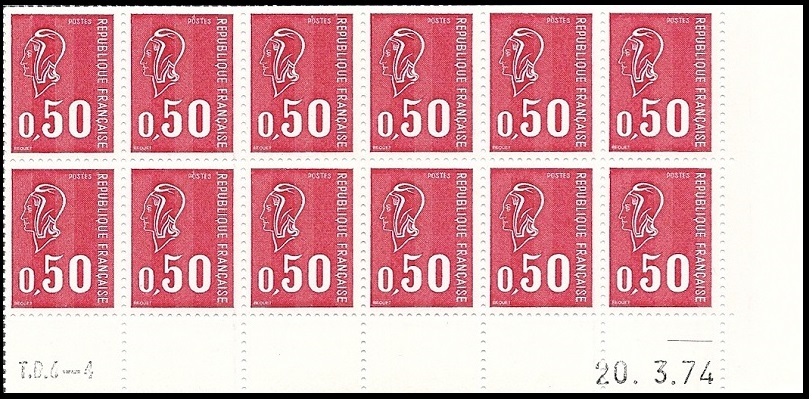
- dated plate block of 12 stamps from the 2nd part of the 26th printing with the cylinder AL
Les traits sont à sec.
- cylindre AL, du 14.3.74 au 29.3.74, timbres avec 3 barres phosphorescentes au type D
- 3ème partie
- cylindre AL, du 10.4.74 au 22.4.74, timbres avec 3 barres phosphorescentes au type D
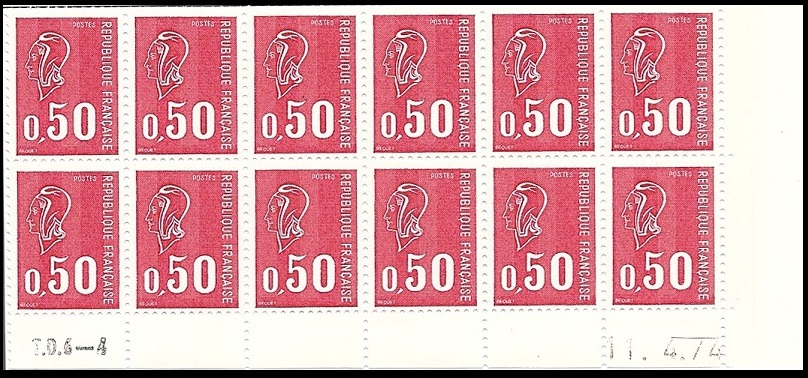
- dated plate block of 12 stamps from the 3rd part of the 26th printing with the cylinder AL
Les traits sont à sec.
- cylindre AL, du 10.4.74 au 22.4.74, timbres avec 3 barres phosphorescentes au type D
- 4ème partie
- cylindre AL, du 3.5.74 au 10.5.74, timbres avec 3 barres phosphorescentes au type D
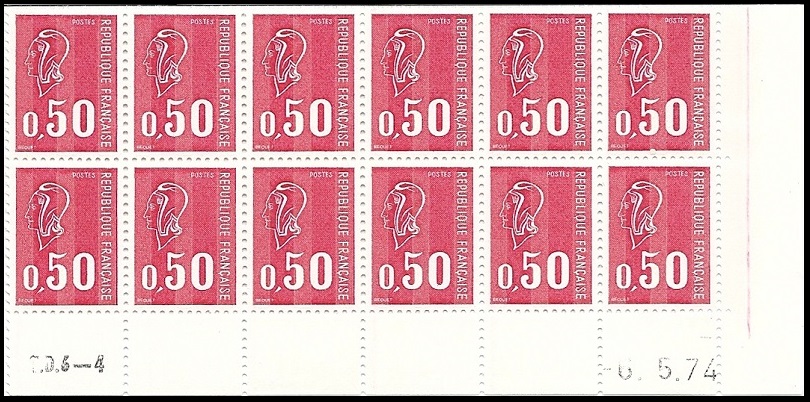
- dated plate block of 12 stamps from the 4th part of the 26th printing with the cylinder AL
Les traits sont à sec.
- cylindre AL, du 3.5.74 au 10.5.74, timbres avec 3 barres phosphorescentes au type D
27ème tirage, sur la presse TD6-6
- cylindre AH, du 23.10.73 au 7.11.73, timbres avec 3 barres phosphorescentes au type B
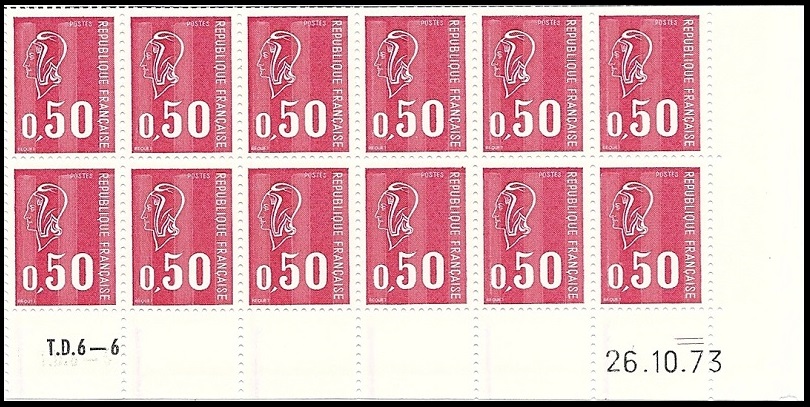
- dated plate block of 12 stamps from the 27th printing with the cylinder AH
Le trait inférieur est à sec les 23, 24 et 27.10.73.
28ème tirage, sur la presse TD6-7
- cylindre AI, du 15.12.73 au 7.1.74, timbres sans barre phosphorescente
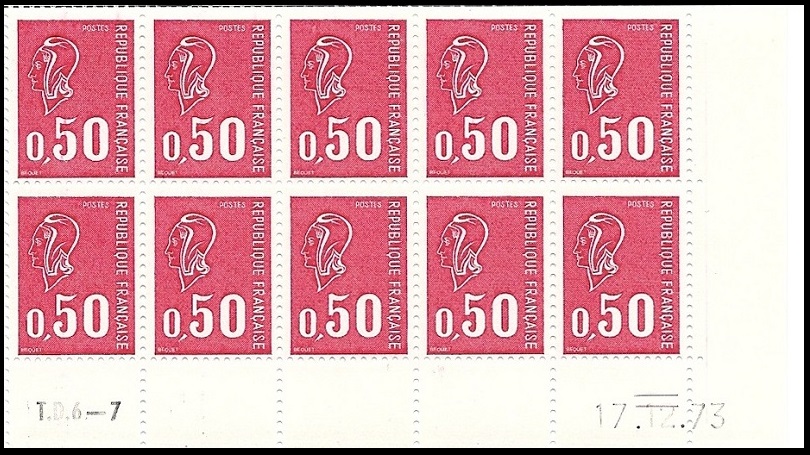
- dated plate block of 10 stamps from the 28th printing with the cylinder AI
29ème tirage, sur la presse TD6-2
- 1ère partie
- cylindre AJ du 19.12.73 au 22.12.73, timbres sans barre phosphorescente
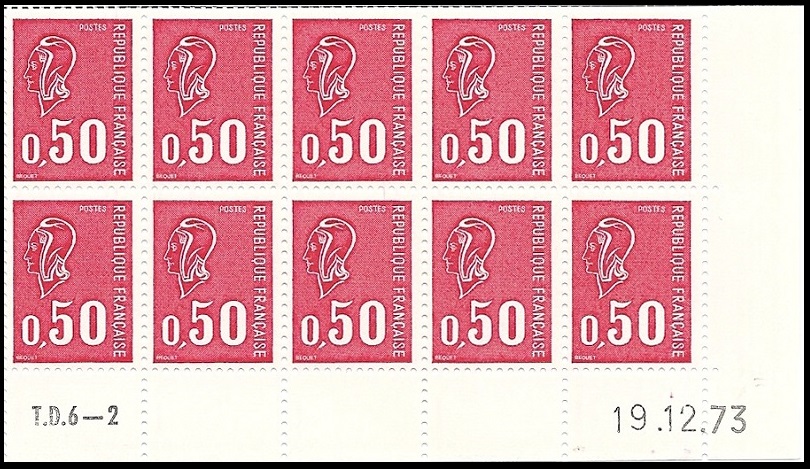
- dated plate block of 10 stamps from the 1st part of the 29th printing with the cylinder AJ
Les traits sont à sec.
- cylindre AJ du 19.12.73 au 22.12.73, timbres sans barre phosphorescente
- 2ème partie
- cylindre AJ, du 2.1.74 au 11.1.74, timbres sans barre phosphorescente
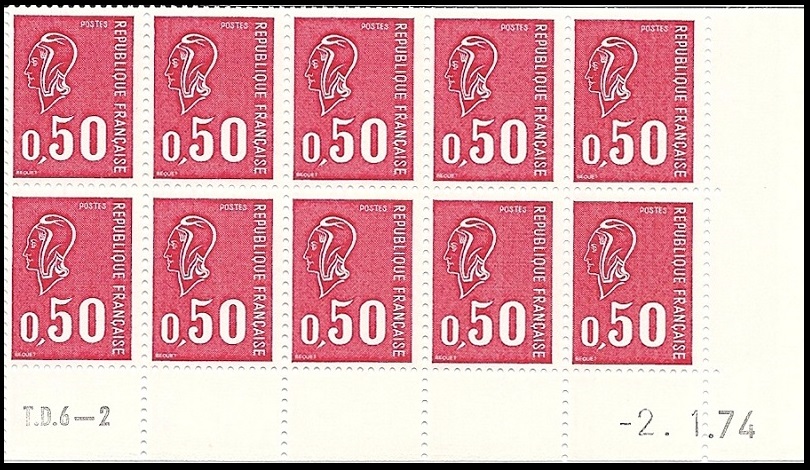
- dated plate block of 10 stamps from the 2nd part of the 29th printing with the cylinder AJ
Les traits sont à sec. - cylindre AI, du 14.1.74 au 26.1.74, timbres sans barre phosphorescente
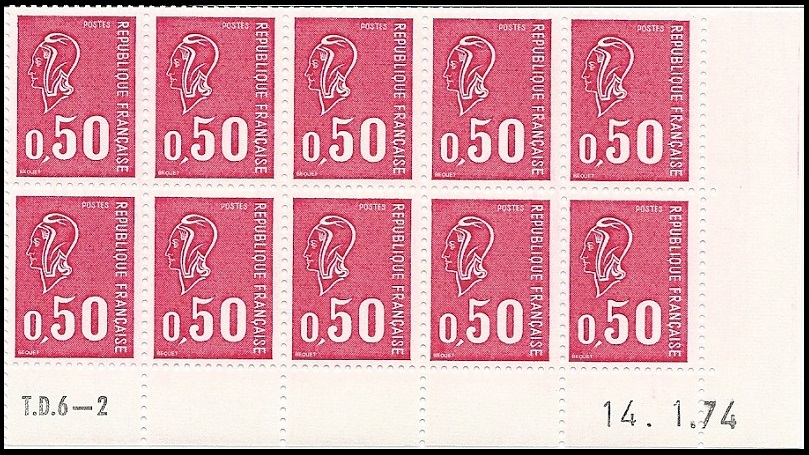
- dated plate block of 10 stamps from the 2nd part of the 29th printing with the cylinder AI
Les traits sont à sec.
- cylindre AJ, du 2.1.74 au 11.1.74, timbres sans barre phosphorescente
- 3ème partie
- cylindre AI, du 7.2.74 au 9.3.74, timbres sans barre phosphorescente
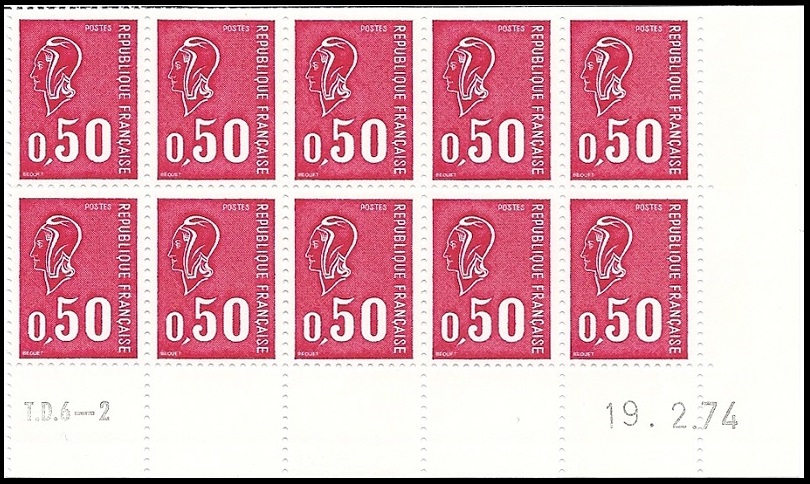
- dated plate block of 10 stamps from the 3rd part of the 29th printing with the cylinder AI
Les traits sont à sec.
- cylindre AI, du 7.2.74 au 9.3.74, timbres sans barre phosphorescente
Les 22 et 23.2.74, le tirage est sur gomme tropicale ; il a été vendu à la Réunion.
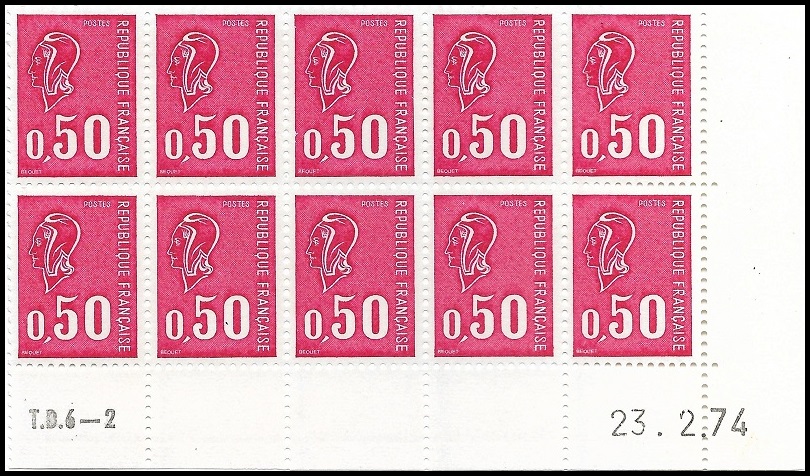
- dated plate block of 10 stamps from the 29th printing with the cylinder AI, tropical gum
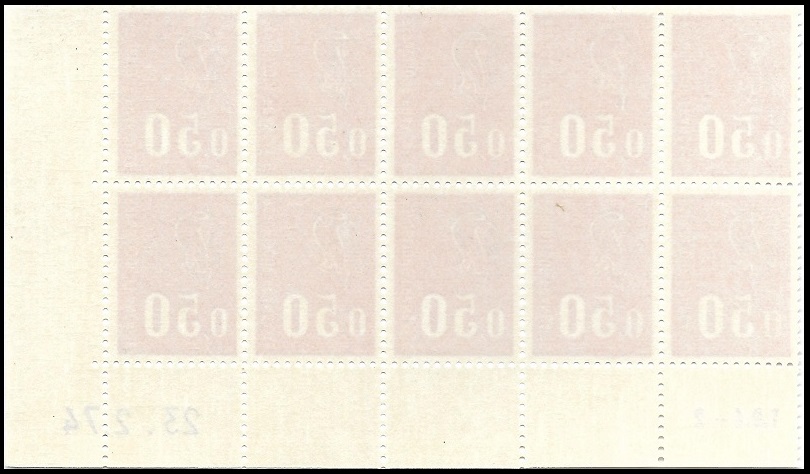
- back of the above block showing the tropical gum
30ème tirage, sur la presse TD6-5
- 1ère partie
- cylindre AJ, du 30.1.74 au 18.2.74, timbres avec 3 barres phosphorescentes au type D
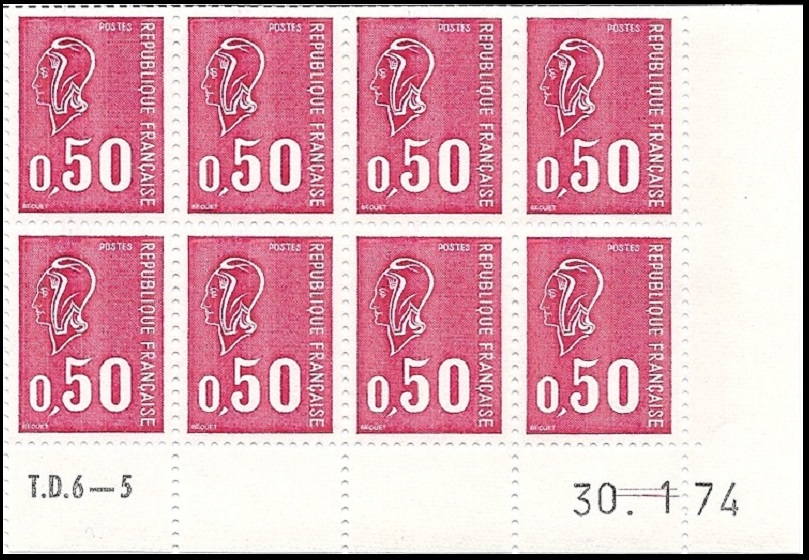
- dated plate block of 8 stamps from the 1st part of the 30th printing with the cylinder AJ
L’indicatif de presse est sous le 97ème timbre.
- cylindre AJ, du 30.1.74 au 18.2.74, timbres avec 3 barres phosphorescentes au type D
- 2ème partie
- cylindre AJ, du 7.3.74 au 22.3.74, timbres avec 3 barres phosphorescentes au type D
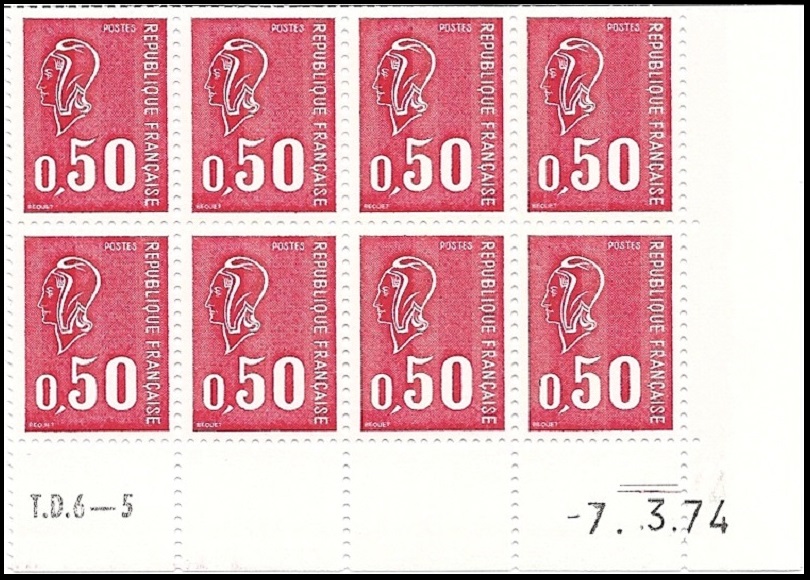
- dated plate block of 8 stamps from the 2nd part of the 30th printing with the cylinder AJ
L’indicatif de presse est sous le 97ème timbre. - cylindre AH , 26.3.74 au 18.4.74, timbres avec 3 barres phosphorescentes au type D
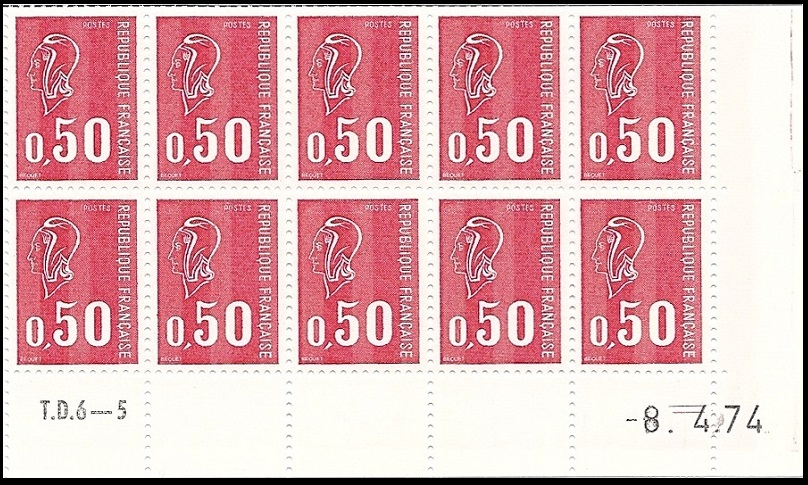
- dated plate block of 10 stamps from the 2nd part of the 30th printing with the cylinder AH
L’indicatif de presse est sous le 96ème timbre.
- cylindre AJ, du 7.3.74 au 22.3.74, timbres avec 3 barres phosphorescentes au type D
- 3ème partie
- cylindre AH, du 2.5.74 au 16.5.74, timbres avec 3 barres phosphorescentes au type D
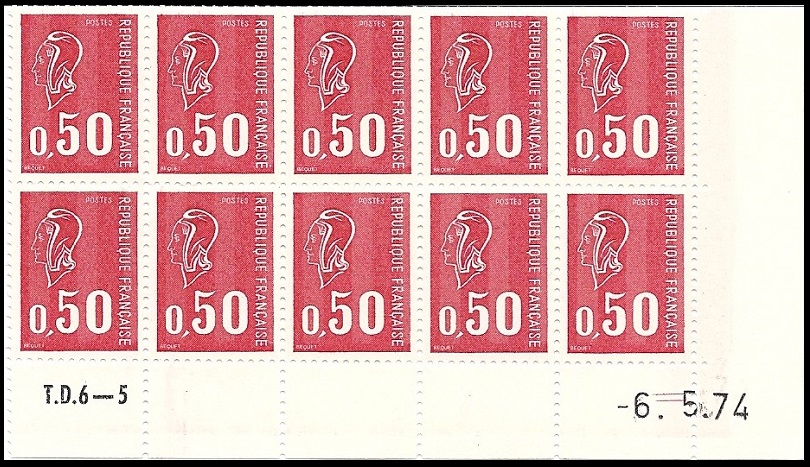
- dated plate block of 10 stamps from the 3rd part of the 30th printing with the cylinder AH
- cylindre AH, du 2.5.74 au 16.5.74, timbres avec 3 barres phosphorescentes au type D
- 4ème partie
- cylindre AH, du 30.5.74 au 12.6.74, timbres avec 3 barres phosphorescentes au type D
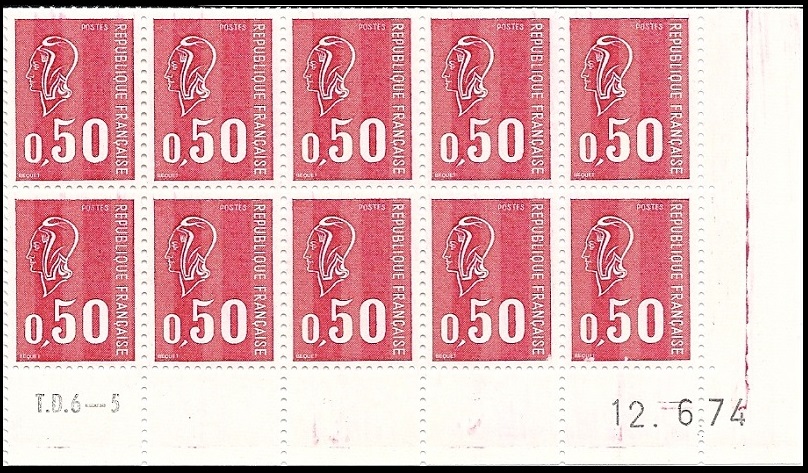
- dated plate block of 10 stamps from the 4th part of the 30th printing with the cylinder AH
- cylindre AH, du 30.5.74 au 12.6.74, timbres avec 3 barres phosphorescentes au type D
31ème tirage, sur la presse TD6-4
- cylindre AL, du 8.4.74 au 9.4.74, surchargé CFA, gomme tropicale, timbres sans barre phosphorescente
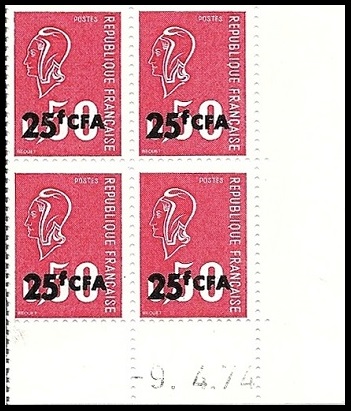
- dated plate block of 4 stamps from the 31st printing with the cylinder AL overprinted 25F CFA
32ème tirage, sur la presse TD6-4
- cylindre AL, du 13.6.74 au 9.7.74, timbres avec 3 barres phosphorescentes au type D
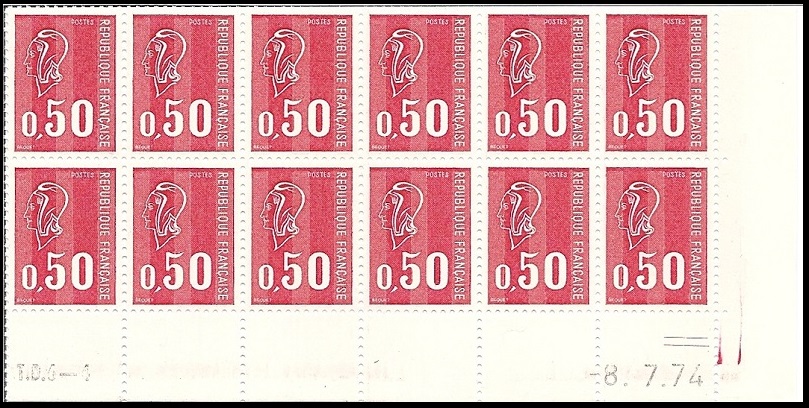
- dated plate block of 12 stamps from the 32nd printing with the cylinder AL
Traits encrés à partir du 20.6.74.
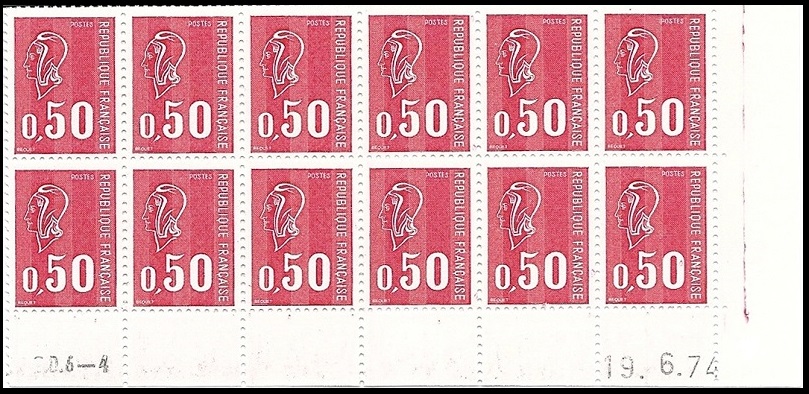
- dated plate block of 12 stamps from the 32nd printing with the cylinder AL with the two lines dry printed
- cylindre AI, du 10.7.74 au 9.8.74, timbres avec 3 barres phosphorescentes au type D
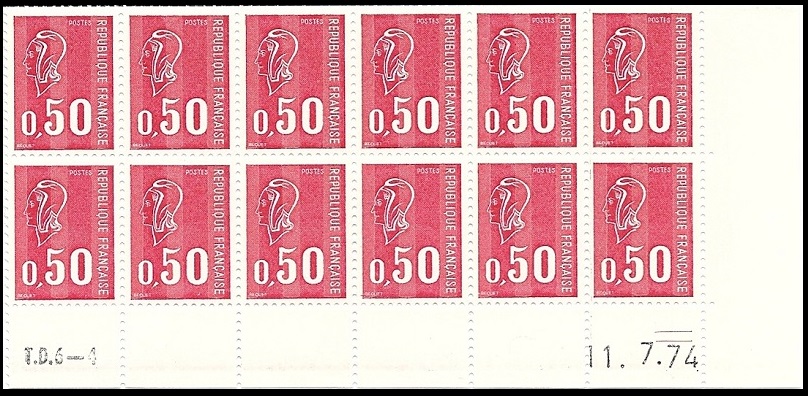
- dated plate block of 12 stamps from the 32nd printing with the cylinder AI
Traits à sec à partir du 24.7.74.
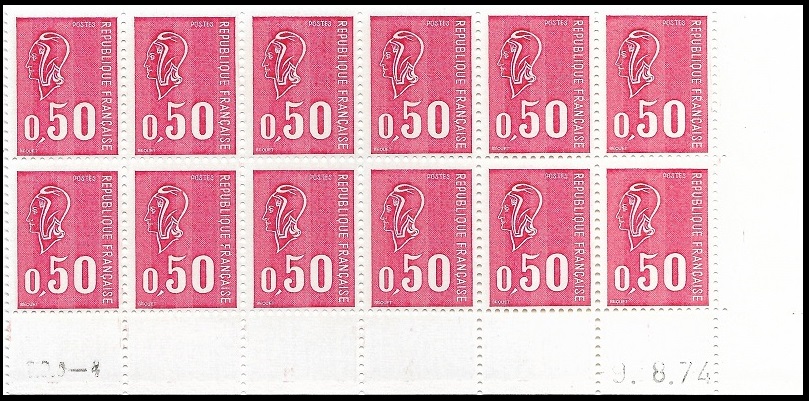
- dated plate block of 12 stamps from the 32th printing with the cylinder AI with the two lines dry printed
33ème tirage, sur la presse TD6-6
- cylindre AL, du 13.7.74 au 26.7.74, timbres avec 3 barres phosphorescentes au type B
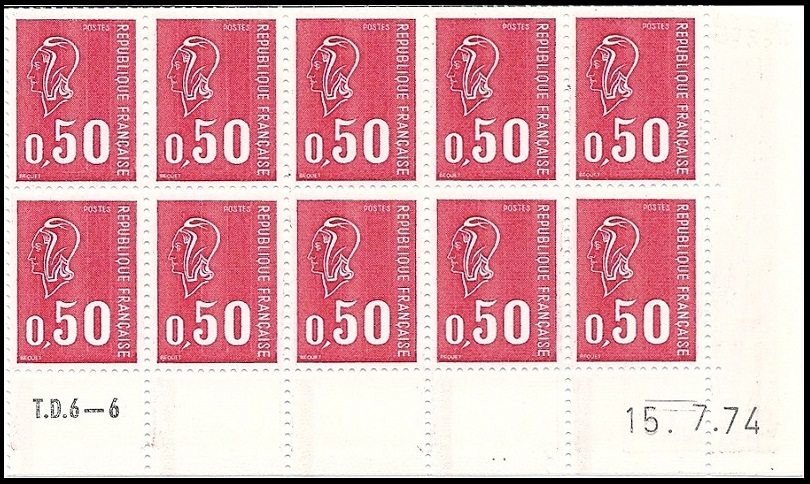
- dated plate block of 12 stamps from the 33rd printing with the cylinder AL
34ème tirage, sur la presse TD6-2
- cylindre AJ, du 18.7.74 au 25.7.74, timbres sans barre phosphorescente
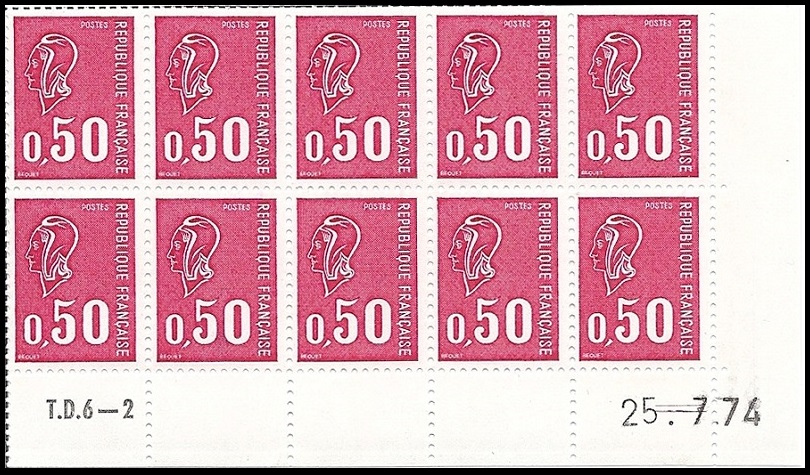
- dated plate block of 10 stamps from the 34th printing with the cylinder AJ, last printing day of the stamps without phosphor bands
35ème tirage, sur la presse TD6-1
- cylindre AJ, du 30.7.74 au 10.8.74, timbres avec 3 barres phosphorescentes au type D
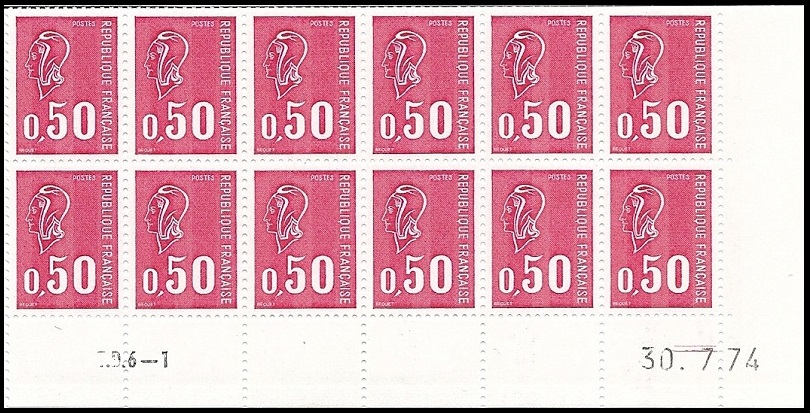
- dated plate block of 12 stamps from the 35th printing with the cylinder AJ
36ème tirage, sur la presse TD6-2
- cylindre AL, du 30.7.74 au 1.8.74, timbres avec 3 barres phosphorescentes au type D
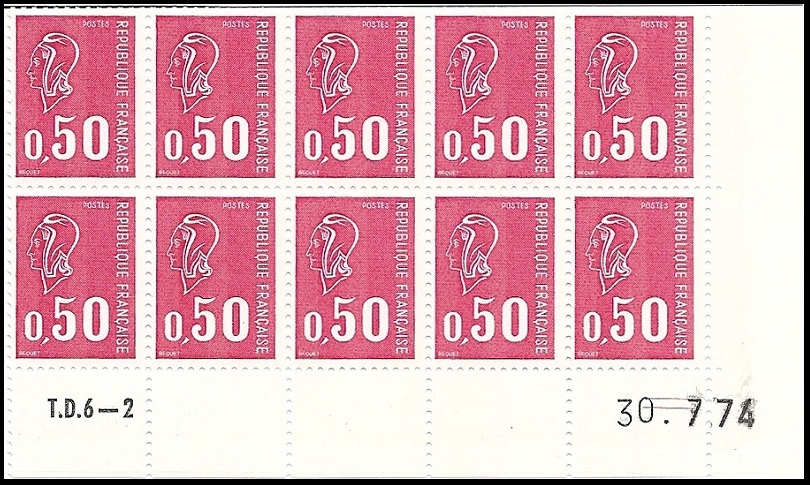
- dated plate block of 10 stamps from the 36th printing with the cylinder AL
37ème tirage, sur la presse TD6-7
- cylindre AM, du 15.10.75 au 17.10.75, timbres avec 3 barres phosphorescentes au type B
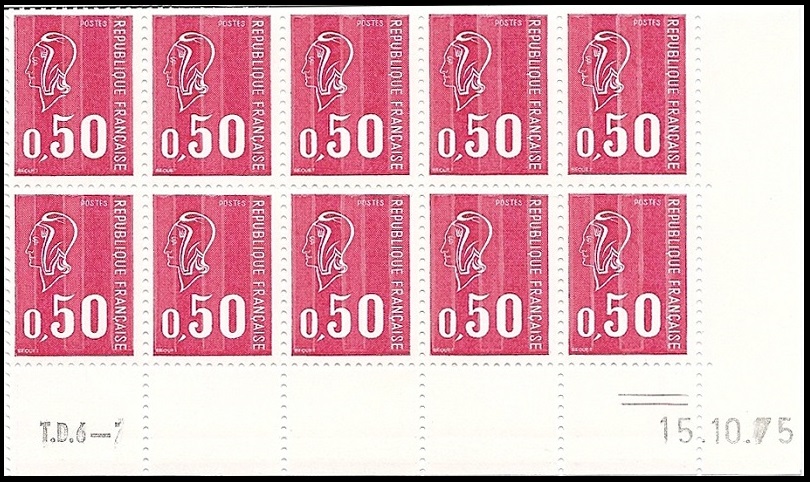
- dated plate block of 10 stamps from the 37th printing with the cylinder AM
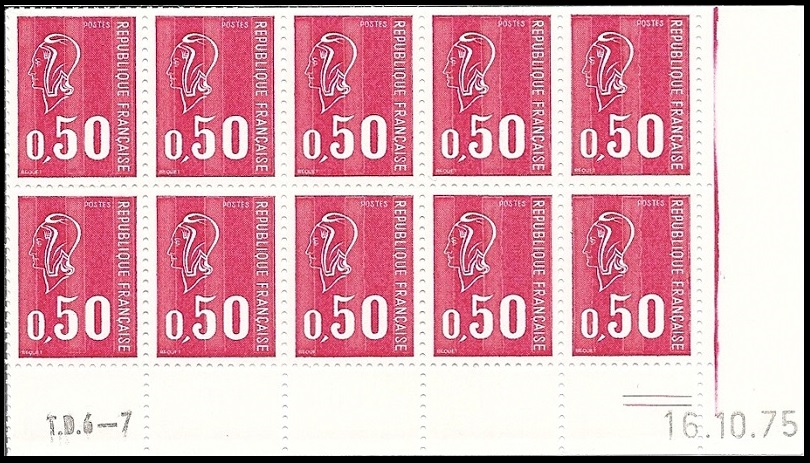
- dated plate block of 10 stamps from the 37th printing with the cylinder AM
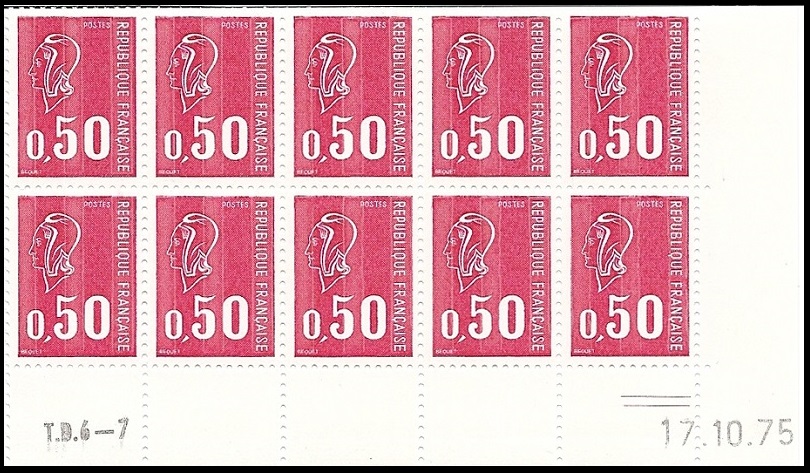
- dated plate block of 10 stamps from the 37th printing with the cylinder AM
38ème tirage, sur la presse TD6-1
- cylindre AM, du 15.10.75 au 18.10.75, timbres avec 3 barres phosphorescentes au type D
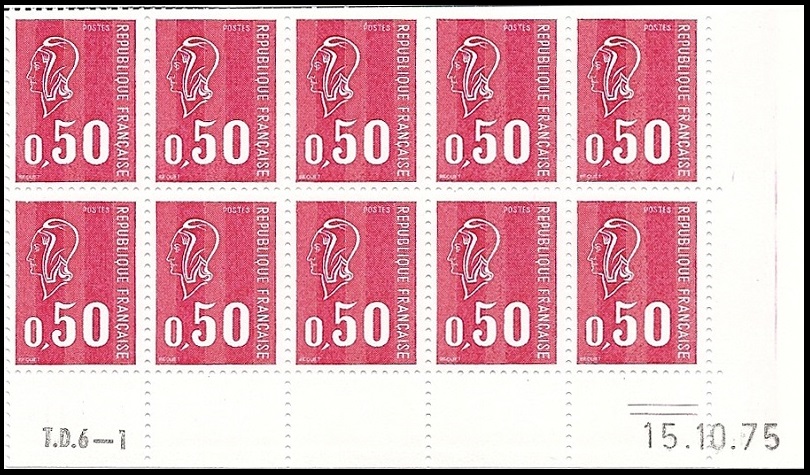
- dated plate block of 10 stamps from the 38th printing with the cylinder AM
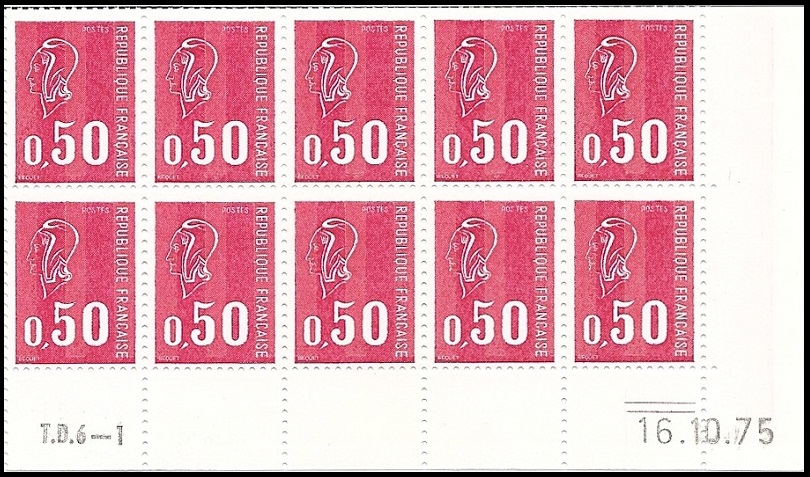
- dated plate block of 10 stamps from the 38th printing with the cylinder AM
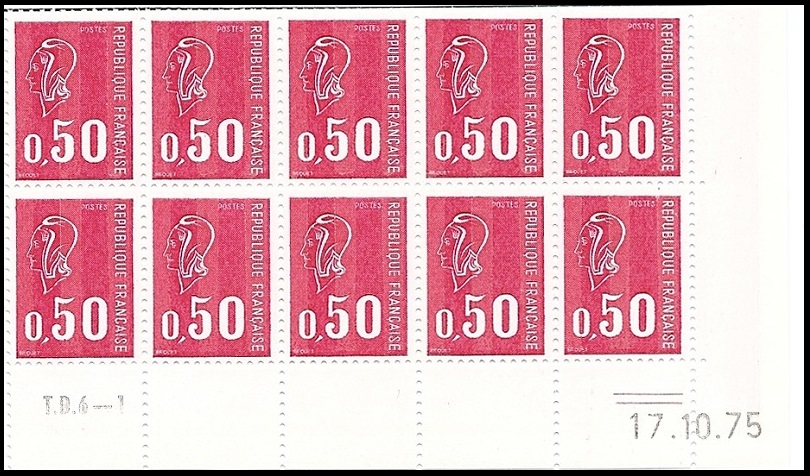
- dated plate block of 10 stamps from the 38th printing with the cylinder AM
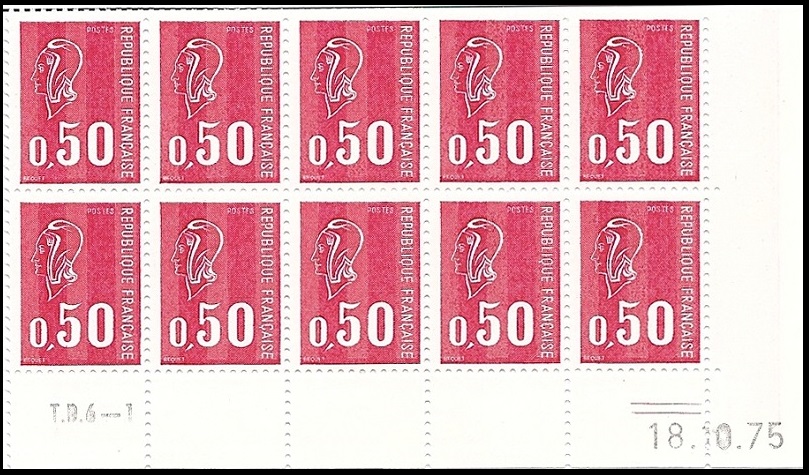
- dated plate block of 10 stamps from the 38th printing with the cylinder AM
Les tirages 37 et 38, pour lesquels j’ai montré un coin daté pour chaque journée de tirage, posent un problème. Ils utilisent le même cylindre AM sur deux presses différentes pendant les journées des 15, 16 et 17.10.75, ce qui est physiquement impossible. Il y a donc une erreur de date quelque part. On peut également noter que la presse TD6-1 a imprimé des timbres 0,80F rouge Marianne de Béquet du 23.9.75 au 5.11.75 avec le cylindre M, 3ème tirage, ce qui constitue une autre contradiction pour la presse TD6-1 aux dates indiquées ci-dessus.
39ème tirage, sur la presse TD6-6
- cylindre AN, du 24.5.76 au 8.6.76, timbres avec 3 barres phosphorescentes au type B
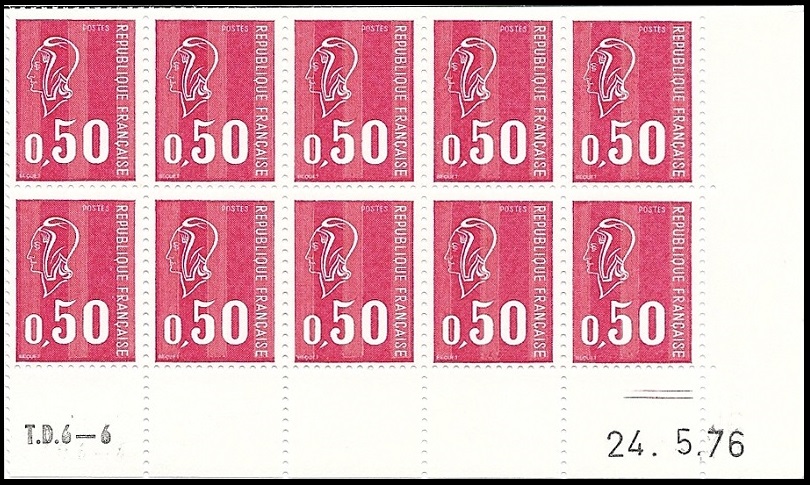
- dated plate block of 10 stamps from the 39th printing with the cylinder AN
40ème tirage, sur la presse TD6-7
- cylindre AN, du 12.7.77 au 28.7.77, timbres avec 3 barres phosphorescentes au type B
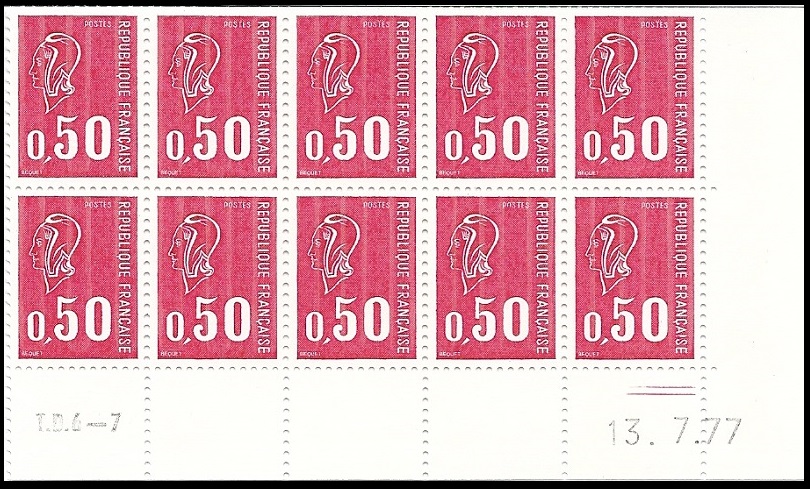
- dated plate block of 10 stamps from the 40th printing with the cylinder AN, metropolitan gum
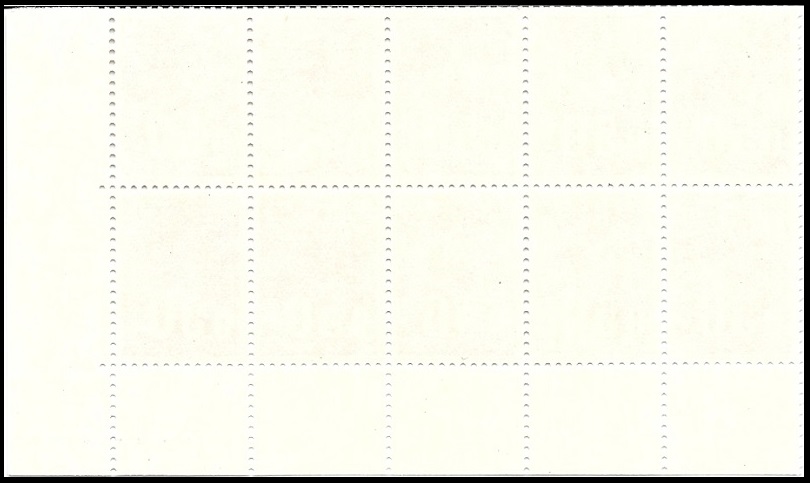
- back of the above block showing the metropolitan gum
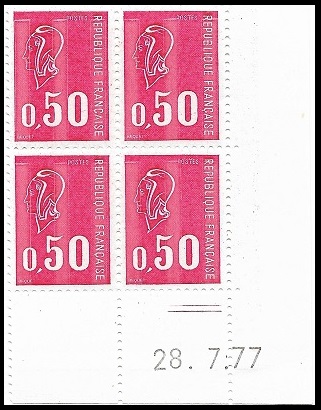
- dated plate block of 4 stamps from the 40th printing with the cylinder AN, las printing day of the stamp 0,50F Marianne de Béquet
Le 12.7.77 est imprimé sur du papier à gomme tropicale :
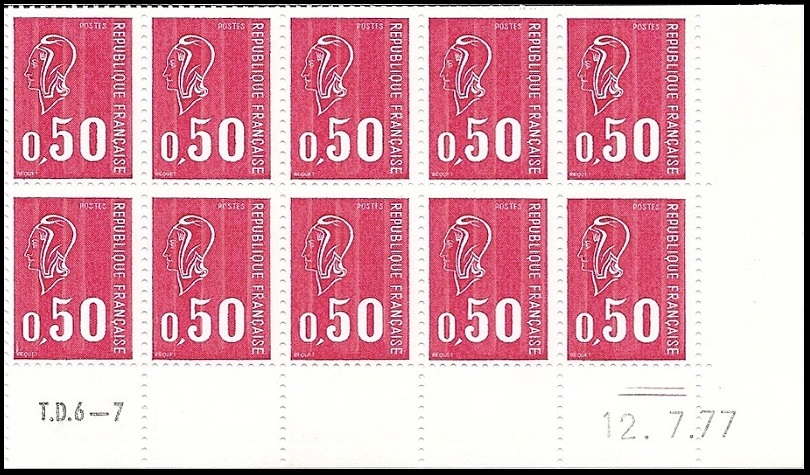
- dated plate block of 10 stamps from the 40th printing with the cylinder AN, tropical gum
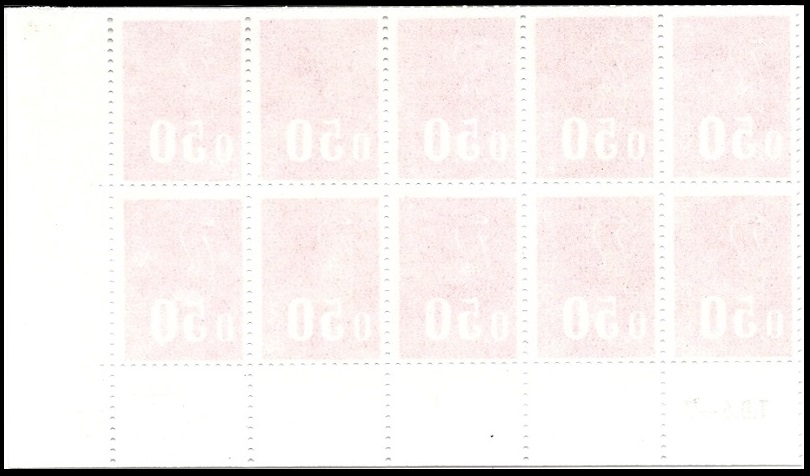
- back of the previous block showing the tropical gum
Il faut noter que le 11.7.77, la presse TD6-7 imprimait des timbres 1,00F Marianne de Béquet sur du papier avec gomme tropicale comme le montrent les deux illustrations suivantes :
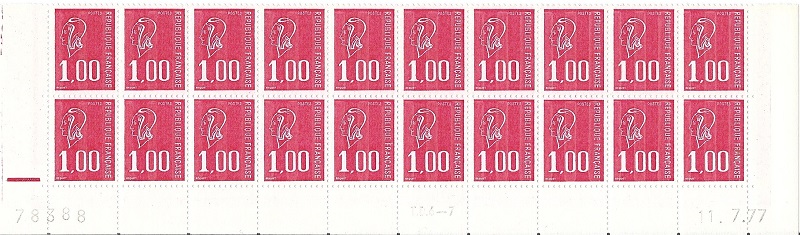
- dated plate block of 20 stamps from the 7th printing of the red stamp 1,00F Marianne de Béquet with tropical gum
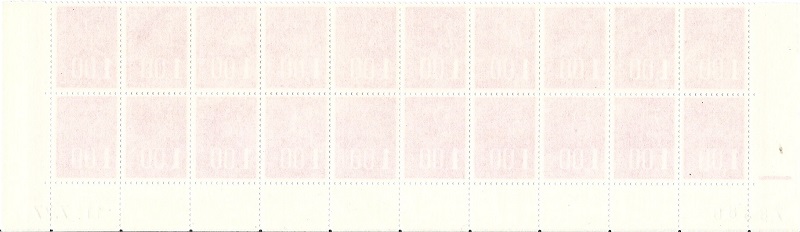
- back of the above plate block showing tropical gum
Quelques statistiques en guise de conclusion
A partir du nombre de journées d’impression des timbres de feuilles de la Marianne de Béquet à 0,50F (et en comptant les samedis travaillés connus comme des jours normaux, ce qui n’est pas tout à fait exact), il est possible d’établir des statistiques sur les tirages réalisés pour ce timbre. Ainsi
- 2% des timbres de feuilles proviennent des presses TD3 et donc 98% des presses TD6 ;
- parmi les timbres produits sur presse TD6, 2/3 sont sans barre phosphorescente et 1/3 avec 3 barres phosphorescentes ;
- parmi les timbres avec 3 barres phosphorescentes
- 70% ont des barres phosphorescentes au type D ;
- 20% ont des barres phosphorescentes au type A ;
- 10% ont des barres phosphorescentes au type B .
- 70% ont des barres phosphorescentes au type D ;
De façon plus anecdotique
- parmi les timbres sans barre phosphorescente
- 30% ont été produits sur la presse TD6-7 ;
- 27% sur la presse TD6-4 ;
- 25% sur la presse TD6-2 ;
- 8% sur la presse TD6-1 ;
- 5% sur la presse TD6-3 ;
- 4% sur la presse TD6-5 ;
- 30% ont été produits sur la presse TD6-7 ;
- parmi les timbres avec 3 barres phosphorescentes
- 65% ont été produits sur la presse TD6-4 ;
- 14% sur la presse TD6-1 ;
- 12% sur la presse TD6-5 ;
- 7% sur la presse TD6-6 ;
- 3% sur la presse TD6-7 ;
- 1% sur la presse TD6-2.
- 65% ont été produits sur la presse TD6-4 ;
Enfin, la presse TD6-1 a d’abord imprimé des timbres avec des barres phosphorescentes au type A, puis des timbres avec des barres phosphorescentes au type D (à partir du 30.7.74). La presse TD6-2 n’a imprimé que des timbres avec des barres phosphorescentes au type D. La presse TD6-4 a d’abord imprimé des barres phosphorescentes au type A, puis des barres phosphorescentes au type D (à partir du 16.1.73). La presse TD6-5 n’a imprimé que des timbres avec des barres phosphorescentes au type D, la presse TD6-6 que des timbres avec des barres phosphorescentes au type B et la presse TD6-7 que des timbres avec des barres phosphorescentes au type B.


 Plan du site
Contact
Mentions légales
Espace rédacteurs
Plan du site
Contact
Mentions légales
Espace rédacteurs


2015-2017 © Etude monographique du 0,50F Marianne de Béquet - Tous droits réservés